Recommended resources
The freely available resources this lesson will direct you to.
Welcome back. In our previous lessons, we built a comprehensive understanding of the components of gross salary (Salaire Brut Global) and calculated the social contributions for both the employee and the employer. We are now systematically moving down the payslip, from the gross salary at the top to the net pay at the bottom.
Today, our goal is to determine the Net Taxable Salary (Salaire Net Imposable - SNI). This is a critical intermediate figure in payroll calculation. It is not the final amount the employee receives, but it is the precise amount upon which the Personal Income Tax (Impôt sur le Revenu - IR) is calculated. To get to this number, we must subtract specific eligible expenses and contributions from the gross salary, as allowed by Moroccan tax law.
The Logic: From Gross to Taxable
The journey from the total gross salary to the net taxable salary follows a clear, two-step logic. It's essential to understand this sequence:
- Salaire Brut Global (SBG) → Salaire Brut Imposable (SBI): First, we remove any exempt income elements from the total gross salary. These are items that are not subject to income tax at all.
- Salaire Brut Imposable (SBI) → Salaire Net Imposable (SNI): Second, we subtract deductible items from the taxable gross salary. These are specific contributions and expenses that the tax authority allows you to deduct before calculating the tax.
Let's break down each step.
Step 1: Calculating the Taxable Gross Salary (SBI)
The Salaire Brut Imposable (SBI) is our starting point for tax calculations. We arrive at it using this formula:
So, what are these "exempt items"? In the Moroccan context, the most common ones are:
- Justified Business-Related Indemnities (
Indemnités justifiées): These are reimbursements for actual expenses incurred by the employee for work, such as transport or travel costs, provided they are properly documented. - Family Allowances (
Allocations Familiales): The amounts paid by the company on behalf of the CNSS for an employee's children are not considered taxable income.
In many standard cases, an employee might not have any exempt items, in which case their SBI is simply equal to their SBG.
Step 2: Calculating the Net Taxable Salary (SNI)
Once we have the SBI, we can calculate the SNI by subtracting a list of specific, legally defined deductible items.
To understand these deductions in detail, let's turn to our reference materials.
Barème d'imposition sur salaire au Maroc
The following document provides a concise breakdown of the calculation from Gross Salary to Net Taxable Salary. It lists the key deductions we will be discussing.
Read the sections explaining the 'Salaire Brut Imposable (SBI)' and 'Salaire Net Imposable (SNI)'. Focus on the list of 'différentes déductions' and note the items included, especially professional expenses, social contributions, and the housing loan interest.
Based on this and other official rules, the main deductible items are:
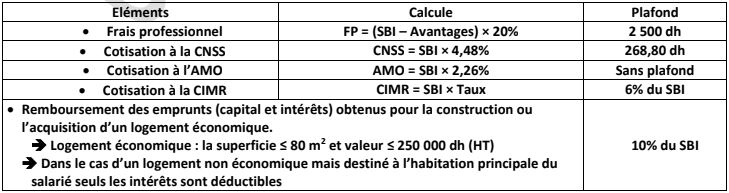
a) Professional Expenses (Frais Professionnels)
This is a flat-rate deduction intended to cover miscellaneous expenses an employee might have in the course of their job (e.g., minor travel, work clothes, etc.).
- Calculation: The standard rate is 20% of the
SBIafter subtracting benefits in kind or in cash (like a housing allowance). The formula is:
Frais Professionnels = (SBI - Avantages en nature ou en argent) × 20% - Ceiling (
Plafond): This deduction is capped. You cannot deduct more than 2,500 DH per month (which corresponds to 30,000 DH per year). If your calculation results in a number higher than 2,500 DH, you must use 2,500 DH as the deduction.
Note: While 20% is the general rate, certain professions have different rates (e.g., journalists, pilots). For our purposes, we will use the standard 20%.
b) Employee's Social Contributions
The social contributions you calculated in a previous lesson are deductible for tax purposes. This includes:
- CNSS Contribution: The employee's share, calculated as
SBI(capped at 6,000 DH) × 4.29%. - AMO Contribution: The employee's share, calculated as the full uncapped
SBI× 2.26%.
c) Other Deductions
While less common for all employees, you should be aware of other potential deductions:
- Complementary Pension Contributions (e.g., CIMR): The employee's contribution is deductible, often up to a certain percentage of their salary.
- Housing Loan Interest: Interest paid on a loan to acquire or build a primary residence is deductible, subject to specific conditions and limits.
The table below provides an excellent visual summary of these key deductions.
Full Example: Calculating Karim's SNI
Let's bring it all together by continuing with our employee, Karim. His Salaire Brut Global (SBG) is 11,420.00 DH.
For this example, we will assume Karim has:
- No exempt items (
indemnités justifiéesorallocations familialesincluded in this SBG). - No benefits in kind (
avantages en nature). - No other deductions like CIMR or housing loans.
1. Determine SBI
SBI = SBG - Exempt ItemsSBI = 11,420.00 - 0 =11,420.00 DH
2. Calculate Deductible Items
-
Professional Expenses (
Frais Professionnels):- Base =
SBI= 11,420.00 DH - Calculation = 11,420.00 × 20% = 2,284.00 DH
- This is less than the 2,500 DH cap.
- Deduction = 2,284.00 DH
- Base =
-
CNSS Contribution (Employee Share):
- Base =
SBI(11,420.00 DH) capped at 6,000.00 DH. - Calculation = 6,000.00 × 4.29%
- Deduction = 257.40 DH
- Base =
-
AMO Contribution (Employee Share):
- Base =
SBI(uncapped) = 11,420.00 DH - Calculation = 11,420.00 × 2.26%
- Deduction = 258.10 DH (rounded)
- Base =
3. Calculate SNI
SNI = SBI - (Frais Pro + CNSS + AMO)SNI = 11,420.00 - (2,284.00 + 257.40 + 258.10)SNI = 11,420.00 - 2,799.50SNI =8,620.50 DH
So, Karim's Net Taxable Salary (Salaire Net Imposable) for the month is 8,620.50 DH. This is the number we will use to calculate his income tax in the next lesson.
The following resource provides another excellent, step-by-step example.
PAIE-ET-DECLARATIONS-FISCALES-ET-SOCIALES.pdf
To reinforce your understanding, let's look at another complete example. This document walks through the calculation for an employee named M. FAHLAOUI.
Go to the sub-section '8. L’impôt général sur le revenu (IGR Salariale)'. First, review the part 'a) La détermination de la Base Imposable', which presents the formulas. Then, carefully follow the 'Application' for M. FAHLAOUI to see how the SBG is adjusted to find the SBI, and then how the different deductions are calculated to arrive at the SNI. Important: This document is older, so the rates (e.g., 17% for frais pro) are outdated, but the method and logic are perfectly illustrated and still valid.
The image below shows how this sequence typically appears in a payroll software or an Excel sheet, flowing logically from gross to taxable income.

Test your understanding!
An employee, Fatima, has a Salaire Brut Global of 16,000.00 DH. Assume she has no exempt items or benefits in kind.
Calculate her Salaire Net Imposable (SNI). Pay close attention to the ceiling for professional expenses.
Show answer
-
Determine SBI:
- Since there are no exempt items,
SBI = SBG =16,000.00 DH.
- Since there are no exempt items,
-
Calculate Deductions:
- Professional Expenses:
- Base = 16,000.00 DH
- Calculation = 16,000.00 × 20% = 3,200.00 DH.
- This is greater than the 2,500 DH cap.
- Therefore, the deduction is 2,500.00 DH.
- CNSS Contribution:
- Base is capped at 6,000.00 DH.
- Deduction = 6,000.00 × 4.29% = 257.40 DH.
- AMO Contribution:
- Base is the full SBI of 16,000.00 DH.
- Deduction = 16,000.00 × 2.26% = 361.60 DH.
- Professional Expenses:
-
Calculate SNI:
SNI = 16,000.00 - (2,500.00 + 257.40 + 361.60)SNI = 16,000.00 - 3,119.00SNI =12,881.00 DH
Conclusion
In this lesson, you have learned the crucial process of determining the Net Taxable Salary, a cornerstone of Moroccan payroll accounting.
Key Takeaways:
- The calculation is a two-step process:
SBG → SBI → SNI. - The
Salaire Brut Imposable(SBI) is the gross salary minus any tax-exempt items like justified indemnities. - The
Salaire Net Imposable(SNI) is theSBIminus deductible items. - The three main deductions are Professional Expenses, employee CNSS contributions, and employee AMO contributions.
- Professional expenses are calculated at 20% of the SBI (less benefits) but are capped at 2,500 DH per month.
Preview of the Next Lesson:
You are now fully prepared for the final calculation step. With the Salaire Net Imposable (SNI) correctly determined, our next lesson will focus on how to apply the progressive Personal Income Tax (IR) scale to this amount to calculate the monthly tax withholding. This will bring us one step closer to finding the final net pay.