Recommended resources
The freely available resources this lesson will direct you to.
- Energy stored in capacitor derivation (why it's not QV) | Electrostatic potential | Khan Academywww.youtube.com
- Energy stored in inductor (1/2 Li^2) | Electromagnetic induction | Physics | Khan Academywww.youtube.com
- Intuitive way of "visualizing" how the energy is stored in an inductor?electronics.stackexchange.com
- Energy Stored in a Capacitor | SciencePediawaf-www-bohrium-com-hngfcxduded0fmhr.a03.azurefd.net
Hello!
In our previous lessons, we established the fundamental behaviors of capacitors and inductors. We saw that a capacitor stores energy in an electric field to oppose changes in voltage (), while an inductor stores energy in a magnetic field to oppose changes in current ().
Today, we will quantify exactly how much energy these components store. This lesson directly addresses the learning outcome: Calculate the energy stored in a capacitor and an inductor. In line with your preference for building deep physical intuition, we won't just learn the formulas. We'll derive them from first principles, focusing on the concepts of work and power to understand why the formulas take the shape they do.
1. Energy Stored in a Capacitor: The Work of Building a Field
To store energy in a capacitor, a power source must do work to move charge from one plate to the other against the repulsive force of the growing electric field. Think of it as compressing an "electric spring." The total energy stored is equal to the total work done in this process.
A common first guess for the stored energy is simply the final charge multiplied by the final voltage . However, this is incorrect. Let's watch a video that builds the intuition for why this is wrong and then derives the correct formula.
Energy stored in capacitor derivation (why it's not QV) | Electrostatic potential | Khan Academy
The Khan Academy video 'Energy stored in capacitor derivation' provides an excellent step-by-step explanation. It starts by framing the problem as calculating the work done to charge the capacitor and then uses calculus to perform the calculation correctly.
Watch the entire video (approximately 13 minutes). Pay close attention to these key stages: (00:00 - 01:49) The initial framing of stored energy as the work done by an external agent. (01:49 - 08:03) The crucial argument for why the work is not simply Q*V. The voltage changes as the capacitor charges, so the work required to move each bit of charge is different. (08:03 - 13:21) The formal derivation using an integral, which correctly sums the work done on each infinitesimal charge.
As the video masterfully explains, because the voltage across the capacitor increases from 0 to its final value during the charging process, the average voltage is only . This leads to the correct formulas for the energy stored in a capacitor:
You can use whichever form is most convenient depending on whether you know the voltage, charge, or capacitance.

A Deeper Look: The Case of the "Missing" Energy
Your interest in energy flow brings up a fascinating puzzle. If a battery with a constant voltage charges an empty capacitor, the total work done by the battery is . But we just found that the capacitor only stores . Where did the other half of the energy go?
The article 'Energy Stored in a Capacitor' from SciencePedia explains this beautifully. It reveals a fundamental principle about charging capacitors from constant voltage sources.
Read the section titled 'The Work of Charging and the Curious Case of the Missing Energy'. Focus on the explanation for why exactly half the energy supplied by the source is dissipated as heat, regardless of the circuit's resistance.
This is a profound insight: charging a capacitor from a constant voltage source is an inherently lossy process. Exactly 50% of the energy drawn from the source is converted to heat in the circuit's resistance. Even in an "ideal" circuit with zero resistance, that energy would be lost, radiated away as an electromagnetic wave.
2. Energy Stored in an Inductor: The Energy of a Moving Current
In the last lesson, we developed an analogy of an inductor having "electrical inertia." Now, we'll see how this connects to energy. Just as a moving mass has kinetic energy (), a flowing current in an inductor has magnetic energy. To get the current flowing, the source must do work to build the magnetic field. That work is then stored as energy in the field.
Energy stored in inductor (1/2 Li^2) | Electromagnetic induction | Physics | Khan Academy
This Khan Academy video on inductor energy provides a great intuitive demonstration and a powerful analogy before deriving the formula.
Please watch the video from the beginning to 10:19. (00:17 - 03:32) Observe the demonstration of the bulb staying lit after the battery is removed. This is direct evidence that the inductor had energy stored in it. (03:32 - 05:22) Pay attention to the analogy drawn between an inductor and a mass. This connects the energy formula we are about to see with the familiar formula for kinetic energy. (05:22 - 10:19) Follow the derivation of the energy formula, which starts from the power equation P = VI and uses integration.
The analogy to kinetic energy is striking and provides a strong conceptual hook:
- Inductance () is analogous to mass (), representing inertia.
- Current () is analogous to velocity (), representing motion.
- Magnetic Energy () is analogous to Kinetic Energy ().
The derivation confirms this intuition. By integrating the power () delivered to the inductor over time, we find that the total energy stored in the magnetic field is:
Unlike the capacitor, there is only one common form for this formula.
3. Practice: Tying It All Together
Let's solve a problem that requires you to apply these new formulas. This circuit problem also serves as a review, as you'll first need to determine the steady-state conditions of the circuit—a concept from our previous lessons.
Consider the following circuit, which has been connected for a long time. Your task is to calculate the energy stored in the capacitor and the inductor.
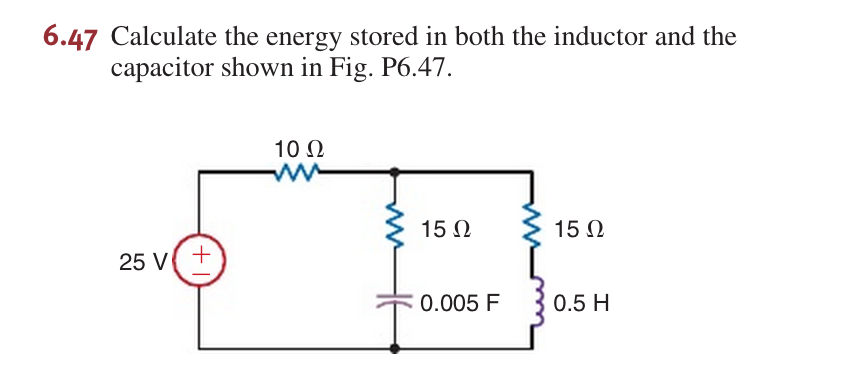
Your approach should be:
- Analyze the circuit in DC steady-state. How does an inductor behave after a long time in a DC circuit? How does a capacitor behave? Redraw the circuit based on this.
- Solve for the key quantities. Using your simplified circuit, find the voltage across the capacitor () and the current through the inductor ().
- Calculate the stored energy. Apply the formulas and .
Give it a try! Once you have your answers, you can check your work against the solution below.
Click here for the step-by-step solution.
Step 1: Analyze DC Steady-State
After a long time, the currents and voltages in a DC circuit become constant.
- The voltage across the inductor is . Since the current is constant, , so . An inductor acts as a short circuit (a wire).
- The current through the capacitor is . Since the voltage is constant, , so . A capacitor acts as an open circuit.
Our simplified steady-state circuit looks like this:
- The 25V source is connected to the 10Ω resistor.
- The top branch becomes an open circuit due to the capacitor. The 15Ω resistor in that branch has no current flowing through it.
- The bottom branch has the 15Ω resistor in series with a short circuit (the inductor).
Step 2: Solve for and
- To find : The current from the source flows only through the 10Ω resistor and the bottom branch. The total resistance in this path is . The current flowing through this path is the inductor current, .
- To find : The capacitor acts as an open circuit. The voltage across it, , is the same as the voltage across the lower branch (the 15Ω resistor and the inductor). Since the inductor is a short, this is just the voltage across the 15Ω resistor in the lower branch.
Step 3: Calculate Stored Energy
Now we plug our calculated values into the energy formulas.
- Capacitor Energy:
- Inductor Energy:
Final Answer: The energy stored in the capacitor is 0.5625 Joules, and the energy stored in the inductor is 0.25 Joules.
Conclusion
In this lesson, we quantified the energy storage capabilities of capacitors and inductors, deriving their respective formulas from the physical concepts of work and power.
Key Takeaways:
- Energy is stored in a capacitor's electric field. The amount is given by .
- Energy is stored in an inductor's magnetic field. The amount is given by .
- The factor of in the capacitor formula arises because the voltage increases as it is charged.
- The inductor energy formula is conceptually analogous to the formula for kinetic energy, with inductance acting as inertia and current as motion.
- In DC steady-state, you can calculate stored energy by first simplifying the circuit (capacitors become opens, inductors become shorts) to find the relevant voltages and currents.
Preview of the Next Lesson:
Now that we understand these components individually, our next step is to analyze how they behave when combined. We will derive the formulas for equivalent capacitance and inductance for series and parallel combinations. You might be surprised to find that the rules are "swapped" compared to resistors—parallel capacitors add, while series inductors add. We will explore the physical reasoning for this difference.