Recommended resources
The freely available resources this lesson will direct you to.
Welcome to the next lesson in our module on Release Engineering for LLMs. In our last session, you learned how to use feature flags to gain precise control over model deployments, targeting specific user segments for rollouts. While powerful, this still requires a human to decide if a new model version is performing well enough for promotion. This manual step can become a bottleneck and is prone to error.
Today, we will take a significant step towards a fully automated, safe-release process. This lesson will teach you how to set up automated evaluation gates in a CI/CD pipeline that block promotion based on quality regressions. This is the mechanism that automatically answers the question, "Is this new model version good enough to deploy?" for every change you make. We will cover the core concepts of LLM evaluation, what metrics to track, and how to implement these gates within a CI/CD workflow like GitHub Actions.
1. The Need for Evaluation-Driven Workflows
In traditional software engineering, unit and integration tests provide a deterministic safety net. If all tests pass, you have a high degree of confidence that your changes haven't broken existing functionality. With LLMs, this is more complex due to their non-deterministic nature. A small change in a prompt or a new model version can introduce subtle regressions that are hard to catch.
An evaluation gate addresses this by creating an automated quality control checkpoint in your pipeline. Before any code or model change is merged or deployed, it is run against a standardized set of tests to ensure it meets your quality bar.

The following video provides an excellent introduction to why systematic evaluation is non-negotiable for LLM applications and introduces the core cycle of Analyze, Measure, and Improve that underpins this process.
Why Most AI Projects Fail and How to Fix It
This video from Dave Ebbelaar provides a strong conceptual foundation for LLM evaluations, explaining the core challenges and the different levels of testing.
Please watch these two segments: Introduction to LLM Evaluations: This covers the "why"—the unique challenges of LLMs that necessitate a systematic evaluation process. Pay close attention to the Analyze, Measure, Improve cycle. Levels of Evaluation: This breaks down evaluation into three levels. Our focus for CI/CD gates will be on automating Level 1 (Unit Tests) and Level 2 (Model Evaluations).
2. Defining the Gate: Metrics and Datasets
An evaluation gate is only as good as the metrics it measures and the data it tests against.
The "Golden Dataset"
The foundation of any evaluation gate is a golden dataset: a curated collection of inputs (prompts) and their expected outputs or behaviors. This dataset should be:
- Representative: It should cover common use cases, important edge cases, and known failure modes.
- Small and Fast: It must run quickly enough to not slow down your CI/CD pipeline excessively. A typical CI evaluation might run on 50-200 examples, not thousands.
- Versioned: Your golden dataset should be stored in your Git repository so that it evolves alongside your code and prompts.
Evaluation Metrics: From Simple to Sophisticated
The metrics you choose define your quality bar. They can range from simple assertions to complex, model-graded assessments.
Level 1: Unit Tests & Static Checks
These are fast, cheap checks that act as a first line of defense. Given your background, you can think of these as analogous to traditional unit tests.
This section from the "Practical LLM CI/CD Guide" by LaikaTest demonstrates how to write simple, fast-running tests for LLM components.
Read Step 1: Unit Tests and Static Checks for LLM Pipelines. The Python code examples for test_prompt_format() and test_prompt_schema_valid() show how to use pytest to validate prompt templates and schemas before any model is even called.
Level 2: Model-Based Evaluations & "LLM-as-a-Judge"
This is where we assess the quality of the model's output. While simple metrics like "exact match" are useful, they often fail to capture semantic correctness. A more powerful and flexible approach is LLM-as-a-judge, where you use a powerful model (e.g., GPT-4o) to score the output of your candidate model based on a custom rubric.
The process of creating a reliable LLM-as-a-judge involves aligning its evaluations with human judgment. The following video segment explains this critical alignment process.
Why Most AI Projects Fail and How to Fix It
This part of the "How to Systematically Setup LLM Evals" video details the iterative process of creating an automated evaluator that mimics human expertise.
Watch the section on Aligning with Human Judgment. The Excel-based example clearly illustrates how to compare human vs. model critiques, calculate an agreement score, and iterate on the judge's prompt until it reliably reflects your quality standards.
Frameworks like DeepEval provide tools to formalize this process. They offer predefined metrics and make it easy to create your own custom, model-graded evaluations.
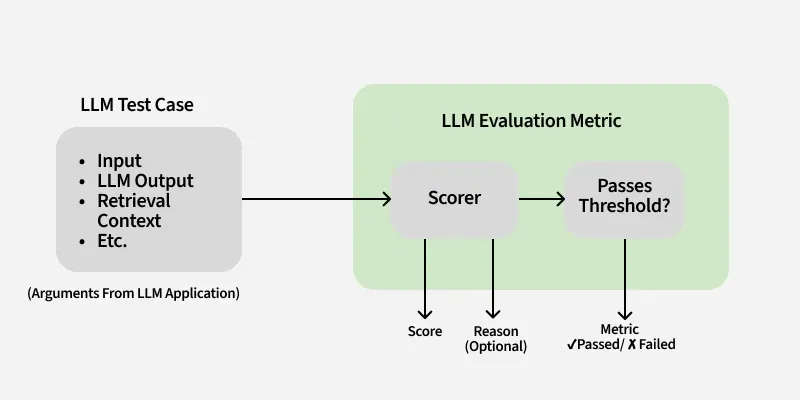
This next video gives a practical walkthrough of using DeepEval to implement various evaluation metrics, from custom correctness checks to predefined metrics for RAG systems.
Evaluate LLMs in Python with DeepEval
This tutorial by NeuralNine demonstrates how to use the DeepEval library to create powerful evaluation test cases in Python.
Watch the entire video. It's a hands-on guide that covers: The LLM-as-a-judge concept Setting up a custom correctness metric with a natural language criteria and threshold. Running an assertion test and interpreting the results. Evaluating conversational qualities like professionalism. Using predefined RAG metrics like AnswerRelevancy and Faithfulness. Evaluating against a ground-truth dataset and comparing different models.
3. Implementing the Gate in a CI/CD Pipeline
Now, let's bring it all together. We will construct a CI/CD pipeline in GitHub Actions that runs an evaluation script and blocks deployment if the model's performance regresses.
The core components are:
- An evaluation script (e.g.,
evaluate.py) that runs the golden dataset, computes metrics, and exits with a non-zero status code on failure. - A CI/CD workflow (e.g.,
.github/workflows/ci.yml) that executes the script and has a conditional deployment step.
The following guide provides a complete, practical blueprint for this setup.
This guide from LaikaTest is a concise and actionable walkthrough for building a full CI/CD pipeline with an evaluation gate.
Please read the following sections carefully: Overview and Prerequisites: This sets the stage and lists the necessary components, including the golden set and artifact store. Step 2: Add Prompt and Model Evaluations to CI: This is the heart of the lesson. Study the eval/evaluate_prompts.py script. Note how it loads a dataset, calls a model API, computes a simple exact_match metric, and then exits with a non-zero code if the metric is below the THRESHOLDS. This exit code is what fails the CI job. Step 3: GitHub Actions CI Pipeline Example: Analyze the ci.yml file. Pay close attention to these details: The eval job runs the Python evaluation script. The deploy job needs: [unit-tests, eval], making it dependent on the eval job. The crucial gate condition: if: github.ref == 'refs/heads/main' && needs.eval.result == 'success'. This line ensures the deploy job only runs if the eval job succeeds.
Alternative: Using a Specialized Tool like promptfoo
While writing a custom Python script gives you full control, dedicated tools like promptfoo can streamline the process. They abstract away much of the boilerplate code for defining test cases, calling providers, and asserting outputs.
The promptfoo documentation shows how to achieve the same outcome using a configuration-driven approach.
CI/CD Integration for LLM Eval and Security - Promptfoo
The promptfoo documentation provides excellent examples of integrating evaluation gates into various CI/CD platforms.
Focus on these two sections: 3. Quality Gates: This shows two ways to fail a build. The --fail-on-error flag is the simplest. The shell script example using jq and bc is highly relevant to your DevOps skill set, demonstrating how to implement custom threshold logic on the evaluation results. GitHub Actions: Review the eval.yml example. It's conceptually identical to the one from the LaikaTest guide but uses the promptfoo CLI instead of a custom Python script. Note the "Check quality gate" step, which implements the pass/fail logic.
Conclusion
You have now learned how to automate one of the most critical aspects of LLMOps: quality assurance. By embedding evaluation gates into your CI/CD pipeline, you transform release engineering from a reactive, manual process into a proactive, automated discipline. This ensures that every change is systematically vetted for regressions before it impacts users.
Key Takeaways:
- Evaluation gates are automated jobs in a CI/CD pipeline that run tests against a new model or prompt and fail the build if quality metrics drop below a threshold.
- They rely on a version-controlled golden dataset of representative test cases.
- Metrics can range from simple unit tests (schema validation) to sophisticated LLM-as-a-judge evaluations that assess semantic quality.
- The implementation involves an evaluation script that exits with a non-zero status code on failure, and a conditional deployment job in the CI/CD workflow that only runs if the evaluation job succeeds.
- Tools like DeepEval and promptfoo can significantly simplify the process of defining and running evaluations.
Your mastery of release strategies—canary, A/B testing, feature flags—is now augmented with a powerful automation layer. However, even the best evaluation gates can't catch every possible issue. What happens when a regression slips through and impacts production? Our next lesson will address this by focusing on automated rollbacks triggered by live monitoring data, completing our journey through the release engineering lifecycle.