Recommended resources
The freely available resources this lesson will direct you to.
Welcome to the final lesson in our module on Release Engineering and MLOps for LLMs. In our last session, we established how to build automated evaluation gates into a CI/CD pipeline, creating a crucial quality checkpoint that blocks new model versions from being deployed if they don't meet your quality standards. This is a powerful preventative measure.
But what happens if a problem isn't caught by your pre-deployment evaluation dataset? Subtle issues might only appear under the unique conditions of live production traffic. Today, we address this final frontier of release safety by learning how to configure automated rollbacks triggered by either evaluation gate failure or live monitoring SLO violations. This lesson will equip you with the tools and techniques to create a system that not only prevents bad deployments but also automatically corrects them the moment they show signs of trouble in a live environment.
1. The Principle of Automated Rollback
An automated rollback is the ultimate safety net in a CI/CD process. It transforms a deployment from a high-stakes event into a controlled experiment. If the experiment fails, the system automatically reverts to a known good state without human intervention. This dramatically improves Mean Time to Recovery (MTTR) and builds confidence in your ability to deploy frequently.
The core idea is to use a progressive delivery strategy, like a canary release, where the new version is exposed to a small fraction of users first. During this period, its performance is continuously monitored against predefined Service Level Objectives (SLOs).

There are two primary triggers for such a rollback in an LLM context:
- Pre-release Evaluation Failure: As discussed in the last lesson, if a model fails its offline evaluation against a "golden dataset," the CI pipeline can be configured not just to block the deployment, but to formally abort the rollout process before it even begins.
- Live Monitoring SLO Violation: If the model passes offline evaluation but then shows degraded performance (e.g., high latency, increased error rate, or poor quality scores) with live traffic, the system triggers an immediate rollback.
2. The Architecture of Automated Progressive Delivery
To implement this, you need a set of tools that work together within your Kubernetes environment. Given your extensive experience with Kubernetes and infrastructure automation, you'll recognize how these components form a powerful, integrated system.
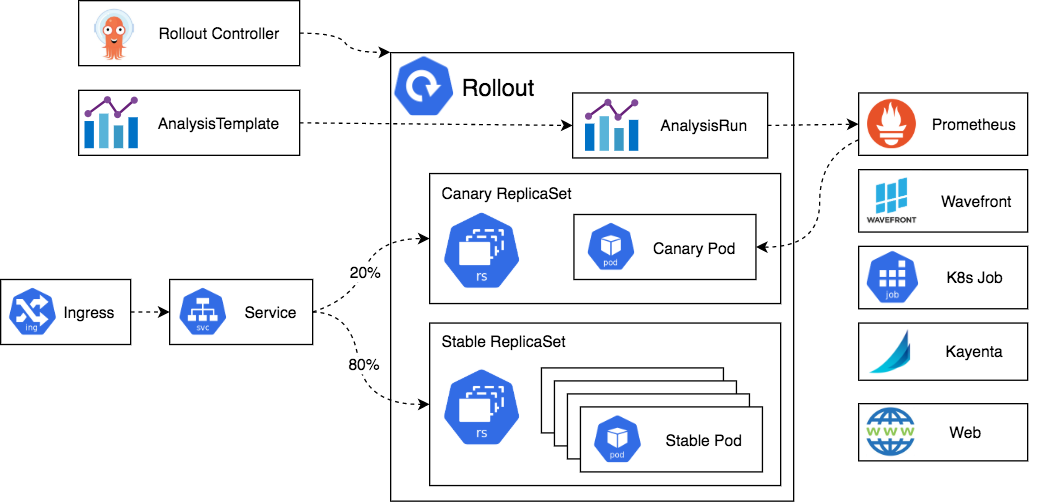
The following article provides an excellent, in-depth look at a production-grade architecture for this.
Implementing Production-Grade Progressive Delivery with ... - Medium
This article from Simardeep Singh Oberoi on Medium details the "why" and "how" of building a progressive delivery system with automated rollbacks.
Please read the first two sections: The Problem With Traditional Deployments: This section sets the context, highlighting the risks of "all-or-nothing" deployments and the need for a data-driven, automated approach. Architecture and Component Selection: This is the key part. Pay close attention to the role of each component: Argo Rollouts: The progressive delivery controller that extends Kubernetes deployments. Istio: The service mesh that handles the fine-grained, percentage-based traffic splitting. Prometheus: The monitoring system that collects the metrics used for analysis. Argo CD: The GitOps tool that ensures the cluster state matches your configuration in Git.
3. Configuring Rollbacks Based on Live SLO Monitoring
The magic of automated rollback lies in two key Kubernetes custom resources provided by Argo Rollouts: the Rollout and the AnalysisTemplate.
- A
Rolloutresource defines the deployment strategy, including the steps for gradually shifting traffic (e.g., 10%, 30%, 60%) and when to pause for analysis. - An
AnalysisTemplatedefines the SLOs. It contains a query to a metrics provider (like Prometheus) and a success condition. If the condition is not met, the analysis fails, and Argo Rollouts aborts the deployment.
The video below provides a fantastic practical demonstration of how these pieces fit together and result in an automated rollback.
Argo Rollouts - Canary Deployments Made Easy In Kubernetes
The "DevOps & AI Toolkit" channel provides a clear, hands-on demonstration of configuring Argo Rollouts with Prometheus for a canary deployment and triggering an automatic rollback.
Please watch these segments carefully: Analysis Template: See how an AnalysisTemplate is defined in YAML to query Prometheus for success rate and request duration. Note the failureLimit, which dictates how many failed checks trigger a rollback. Rollout Strategy: Observe the strategy.canary.steps section in the Rollout definition. This is where the traffic shifting percentages and pauses for analysis are configured. Live Rollback Demo: This is the payoff. The demonstrator deploys a faulty new version. You will see Argo Rollouts pause, run the analysis, detect the high error rate, and automatically "degrade" the rollout, scaling down the new pods and restoring the stable version.
To solidify your understanding, let's look at the YAML configuration that drives this behavior. The following reading provides concrete examples of the Rollout and AnalysisTemplate resources.
Implementing Production-Grade Progressive Delivery with ... - Medium
This part of the Medium article provides the YAML configurations that define the progressive delivery strategy and the SLO-based analysis.
Please read these two sections: Progressive Delivery Strategy: Examine the Rollout resource definition. Focus on the strategy.canary block, where the steps for traffic shifting and analysis templates are specified. SLO Based Automated Analysis: This is the most critical part. Study the two AnalysisTemplate examples. Note how they use Prometheus queries (query: | ...) to calculate success-rate and latency-p95. The successCondition (e.g., result >= 0.99 or result <= 300) is what defines the SLO that the new version must meet.
The metrics used in these examples (HTTP success rate, latency) are directly applicable to an LLM serving endpoint. Your inference server exposes these metrics, and Prometheus can scrape them just as it would for any other microservice. You could easily adapt the latency query to measure P95 Time-To-First-Token (TTFT), a key performance indicator for LLMs.
4. Rollbacks Triggered by LLM Quality Regressions
Beyond operational metrics like latency and error rate, the most advanced systems can trigger rollbacks based on a drop in the quality of the LLM's responses. This connects directly to our previous lesson on evaluation gates. Instead of only running evaluations pre-deployment, you can run them continuously on a sample of live traffic.
If the live quality score for the canary version drops below a defined threshold, it can trigger a rollback, just like a latency spike would.
This concept is a cornerstone of Eval-Driven Development (EDD). The following resource explains how evaluation scores are used not just as pre-deployment gates but as live rollback triggers.
What is eval-driven development: How to ship high-quality agents ...
This article from Braintrust explains how evaluation becomes the central mechanism for controlling the entire release lifecycle, including automated rollbacks.
Read the following sections to understand how this applies to rollbacks: Release management and eval gates: This section describes how CI/CD pipelines can block changes if metrics fall below a threshold. Rollback triggers: This is the key insight. It explicitly states that "Production evaluation scores can trigger alerts or automatic rollbacks when quality drops below thresholds." This means your AnalysisTemplate in Argo Rollouts could query a metric representing the live quality score. FAQ: What are eval gates, and how do they prevent regressions?: This provides a concise summary of how these automated checks function in a pipeline.
Imagine an AnalysisTemplate that queries Prometheus for a metric like llm_canary_avg_correctness_score_5m. If that score, generated by a live evaluation sidecar, drops below 0.85, Argo Rollouts would initiate a rollback. This provides the ultimate safety net, catching not just performance regressions but also subtle drops in output quality that only manifest with real-world user prompts.
Conclusion
You have now reached the pinnacle of release engineering for LLMs. By combining progressive delivery with automated, data-driven analysis, you can create a resilient system that deploys new models frequently and safely. The decision to promote or roll back is no longer a stressful human judgment call but an automated process based on empirical evidence from live monitoring data.
Key Takeaways:
- Automated rollbacks are achieved using a progressive delivery controller like Argo Rollouts, which orchestrates canary releases in Kubernetes.
- Rollbacks are triggered when an
AnalysisTemplatefails. This template defines your SLOs by querying a monitoring system like Prometheus. - Triggers for LLM services can be standard operational metrics (latency, error rate) or, more advanced, live quality scores generated by continuous evaluation on production traffic.
- This approach turns deployments into low-risk, controlled experiments, dramatically improving system reliability and developer velocity.
This lesson concludes our deep dive into the release engineering and MLOps lifecycle. You now have a comprehensive understanding of how to take a model from development through a series of automated quality and performance checks, and deploy it to production with robust safety nets.
In our next module, LLM Security and Governance, we will shift our focus from the deployment pipeline to securing the models and infrastructure themselves. We'll explore critical topics like PII redaction, implementing content guardrails, and establishing robust access control for your LLM services.