Recommended resources
The freely available resources this lesson will direct you to.
Hello. In the previous lesson, you diagnosed the health of an engineering delivery system through service objectives, release risk, incidents, and technical debt. Those signals tell you what is happening: releases are slow, recoveries rely on heroics, or customers are finding issues before monitoring does. This lesson examines the organizational system beneath those signals: the structure, decision rights, leadership habits, and talent practices that make those patterns persist.
For a Director, an organizational diagnosis is not a verdict on whether people are working hard. It is a disciplined explanation of whether the organization has the clarity, authority, capability, and relationships needed to deliver its mandate. By the end of this lesson, you will be able to use evidence about team structure, accountability, delegation, talent, succession, and conflict to identify the real organizational constraint and recommend focused action.
Diagnose systems, not personalities
When a release train misses commitments or customer escalations consume leadership attention, the visible explanation is often personal:
- “That manager is not proactive.”
- “The teams do not collaborate.”
- “People need to take more ownership.”
- “Engineering and QA are in conflict.”
These statements may contain a fragment of truth, but they are not yet diagnoses. They describe symptoms or impressions. A Director needs to identify the mechanism producing the symptom.
For example, suppose a Quality Manager is repeatedly late in reporting release risk. Several explanations are possible:
| Observation | Possible interpretation | Evidence needed before acting |
|---|---|---|
| Risk arrives late | The manager lacks judgment or follow-through. | Review prior risk reviews, commitments, and follow-up actions. |
| Risk arrives late | The team cannot access development or dependency information early enough. | Map when design, code, environment, and dependency information become available. |
| Risk arrives late | No one has explicitly defined what “release risk” means or when it must be escalated. | Examine release criteria, meeting decisions, and escalation thresholds. |
| Risk arrives late | The manager expects the Director to make every difficult trade-off. | Observe decision behavior and clarify actual decision rights. |
| Risk arrives late | The manager’s span is too broad for meaningful review. | Assess direct-report load, work complexity, and manager capacity. |
The same surface problem can therefore imply a capability issue, an operating-model issue, a structure issue, or a decision-rights issue. Treating all of them as a performance problem is unfair and usually ineffective.
A useful discipline is to separate three layers:
- Facts: observable events, patterns, documents, metrics, meeting behavior, staffing data, customer feedback.
- Interpretations: the most plausible explanation of those facts.
- Hypotheses to test: alternative explanations that would lead to different actions.
For example:
Fact: Four high-severity issues in two quarters were escalated directly to the Director after the assigned managers had already been involved.
Interpretation: Escalation paths may be unclear, or customer-facing teams may not trust that managers can resolve difficult trade-offs.
Hypothesis to test: Review who had authority to approve mitigations, how long decisions waited, and whether customer communication ownership was explicit.
This distinction matters in external Director-level interviews. It demonstrates executive judgment: you do not rush from a difficult outcome to a story about weak people.
The six lenses of an organizational leadership diagnosis
A practical diagnosis should examine six connected areas. They should not be treated as isolated checkboxes: weak delegation may conceal a succession problem; recurring conflict may actually be caused by unclear decision rights.
| Lens | Core question | Evidence to inspect | Common failure pattern |
|---|---|---|---|
| Team structure | Is work organized around the outcomes and interfaces that matter? | Reporting lines, workflow handoffs, span of control, shared dependencies, duplicated roles | Functional silos own local activity but no one owns the end-to-end customer outcome |
| Accountability | Does every important outcome have one accountable driver and a known decision path? | Project plans, meeting decisions, escalation records, approval bottlenecks | Multiple contributors believe someone else will decide or coordinate |
| Delegation | Have leaders transferred responsibility and authority, with the right support and controls? | Decision logs, check-in cadence, manager behavior, work retained by senior leaders | Director becomes the permanent approval gate and problem solver |
| Talent | Do current managers have the skills, support, and expectations required by the role? | Outcomes, observed management behavior, feedback quality, hiring and performance evidence | Strong individual contributors are promoted without developing management capability |
| Succession | Can the organization sustain leadership capacity if a key person changes role or leaves? | Named successors, readiness plans, critical-role coverage, exposure opportunities | One respected manager or principal becomes a single point of failure |
| Conflict | Are disagreements resolved through shared goals, evidence, and timely decisions? | Repeated disputes, meeting dynamics, customer impact, rework, escalation patterns | Teams relitigate the same trade-offs because no decision rule exists |
The objective is not to make all parts of an organization equally formal. A small team may work effectively with lightweight agreements. A large infrastructure organization with release trains, shared environments, customer escalations, and multiple dependencies requires more explicit coordination.
For an organization responsible for enterprise infrastructure releases, useful units of analysis are often customer workflows, not merely departmental boundaries. Examples include:
- delivering a safe upgrade;
- assessing and communicating release risk;
- reproducing and resolving a strategic customer defect;
- coordinating a critical incident;
- moving a customer fix from diagnosis to validated release.
If each function performs its own portion well but no one owns the complete workflow, customers still experience the failure as one organization.
Start with structure: where does work break across boundaries?
Organization charts show reporting relationships. They do not show how work actually moves.
A release-readiness group may formally include development, validation, release engineering, customer support, and product management. Yet the real work may be governed by informal influence: a senior architect whose opinion becomes decisive, a Director who resolves every disagreement, or a long-tenured release lead who personally remembers every hidden dependency.
A Director should map the path of one important outcome from beginning to end:
- Define the outcome: for example, “a critical upgrade is ready for customer exposure.”
- Identify every team that must contribute.
- Identify the handoffs and dependencies between them.
- Find where work waits, gets reworked, or escalates.
- Identify who can make a trade-off when goals conflict.
- Ask whether a single person has end-to-end accountability for driving the outcome.
This is not automatically an argument for reorganizing. A functional structure can work well when cross-functional outcomes have clear ownership, decision rules, and operating cadence. Reorganization is justified only when the current structure repeatedly prevents the organization from making necessary trade-offs or delivering a key outcome.
Structural warning signs
Look for patterns rather than one-off frustrations:
- Teams optimize different measures that conflict: development is rewarded for feature completion, QA for defect discovery, and release teams for predictability.
- A workflow crosses many teams, but no person owns its final outcome.
- The same senior people attend every decision meeting because coordination depends on their memory.
- Managers have nominal ownership but lack authority over capacity, priorities, or dependencies.
- One team is routinely brought in late, particularly security, operations, validation, or support.
- A customer escalation crosses several groups before anyone can make a meaningful commitment.
- A manager has so many direct reports, projects, or dependencies that coaching and risk detection become superficial.
A structural diagnosis should name the interface that is failing, not simply say “the silos are bad.” For instance:
The release organization is divided functionally, but safe customer upgrade is an end-to-end workflow with no accountable driver. Development, validation, and support each provide status, yet no one has authority to resolve a capacity trade-off between regression depth, a delivery date, and customer exposure.
That statement points toward a specific remedy: establish outcome ownership and decision rights around the workflow. It does not require an immediate large-scale reorganization.
Make accountability visible: contribution is not ownership
In multi-team work, many people can contribute, advise, approve, or implement. But an outcome needs one person accountable for driving it to completion.
The MOCHA framework is a useful way to examine whether responsibility is explicit:
- Manager: supports the Owner, reviews progress, asks probing questions, and intervenes when work is off track.
- Owner: drives the work to completion and coordinates the required contributions. There should be one Owner for a defined outcome.
- Consulted: provides relevant input or expertise.
- Helper: actively implements part of the work.
- Approver: signs off on a final output or a defined decision.
MOCHA is not the only responsibility model. Its practical value is that it separates the person who drives the work from the person who supports, contributes to, or approves it. That distinction prevents the common situation in which everyone attends meetings but nobody owns the outcome.
MOCHA Framework: How to Assign Responsibilities - The Management Center
Read The Management Center’s explanation of MOCHA to see how a responsibility model can expose dropped work, duplicated effort, and hidden decision bottlenecks.
Under “What Does MOCHA Stand For?”, read the role definitions carefully, especially the distinction between Manager and Owner. Then read the table under “When Should I Use MOCHA?” beginning with the diagnostic examples. Finish with “3 Tips for Using MOCHA Effectively,” including the alignment guidance. Focus on the requirement to agree roles, capacity, and authority rather than merely assigning names in a spreadsheet.
Test accountability with decisions, not titles
A role title does not establish accountability. To diagnose decision rights, choose several recent decisions and ask:
- Who was expected to decide?
- Who actually decided?
- Who could block the decision?
- What evidence or threshold was required?
- How long did the decision wait?
- Who communicated the outcome to affected teams and customers?
- Did the same issue reappear later?
Consider a material release decision:
| Decision element | Healthy pattern | Warning sign |
|---|---|---|
| Outcome owner | One release or program owner drives readiness across teams | Several managers issue separate status reports, but none integrates the conclusion |
| Technical input | Engineering, quality, support, security, and operations provide evidence | Stakeholders are invited only after the decision is effectively made |
| Decision threshold | Risk criteria and exception path are known in advance | Every unusual issue must be settled through executive escalation |
| Approval | Approval is limited to material risk acceptance or exceptions | Senior leaders approve routine details because no one trusts delegated authority |
| Communication | One coherent decision, rationale, and customer-impact plan | Different teams communicate incompatible messages |
A frequent Director-level trap is becoming the “responsible” leader by absorbing every unresolved decision. It can feel effective in the short term: work moves because the Director makes the call. But it trains managers to escalate instead of exercising judgment, makes the Director a bottleneck, and leaves the organization fragile when that leader is unavailable.
The corrective action is not simply “delegate more.” It is to define which decisions managers own, the boundaries of that authority, the information they need, and the escalation conditions that genuinely require senior intervention.
Delegation is a leadership system, not task distribution
Delegation is complete only when responsibility and appropriate authority move with the work. Assigning a manager a task while retaining every meaningful decision is not delegation; it is remote execution through someone else.
The delegation cycle below captures the three recurring leadership responsibilities: establish the assignment clearly, remain appropriately engaged, and use results to create accountability and learning.
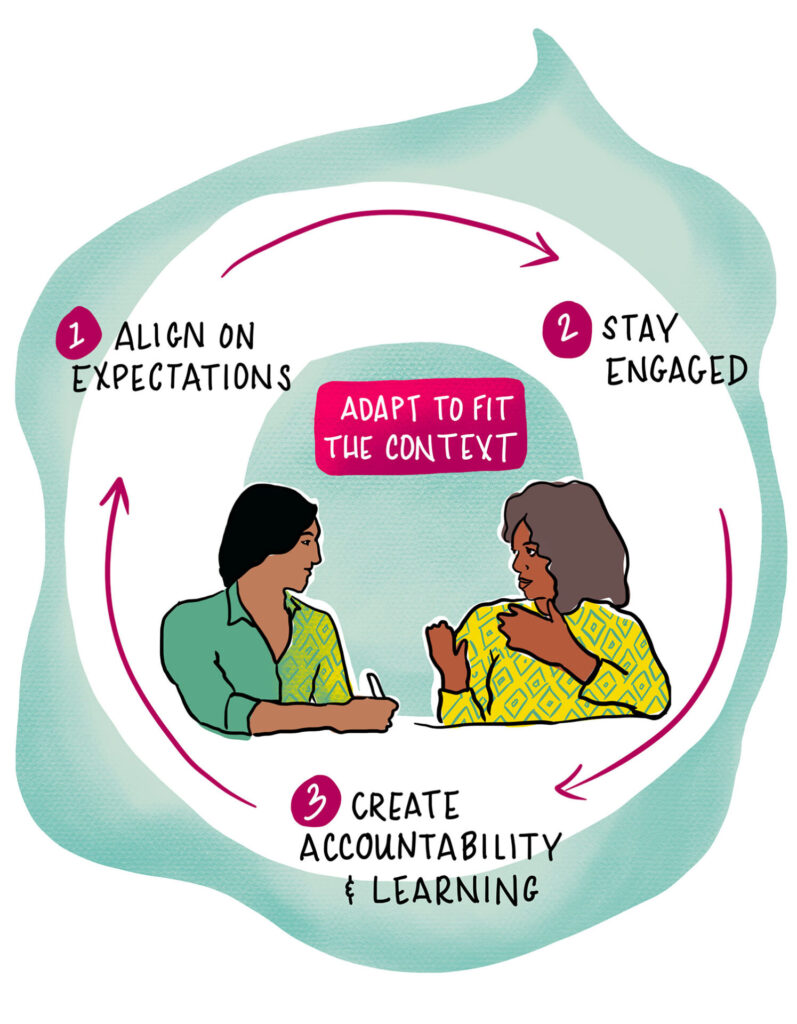
The level of oversight should vary with the risk of the decision and the capability of the person taking it. A new manager handling an unfamiliar, high-impact customer escalation may need close coaching and explicit checkpoints. An experienced manager running a familiar release process may need a clear outcome, guardrails, and periodic review rather than approval at every step.
Leadership: Delegating Effectively
Watch “Leadership: Delegating Effectively” by Bran van der Meer for a concise explanation of responsibility transfer, outcome-focused delegation, and accountability without micromanagement.
Watch true delegation to distinguish handing off a chore from transferring responsibility and authority. Continue with why and what, which explains why leaders should give context and outcomes before prescribing methods. Finish with cadence and review for deadlines, check-ins, feedback, and accountability. Apply the ideas to management work such as release-risk ownership, escalation leadership, or a cross-team improvement initiative.
A strong delegation conversation makes six elements explicit:
| Element | What the manager needs to know |
|---|---|
| Why | The business, customer, or organizational reason the work matters |
| Outcome | The result, quality bar, and success measures |
| Authority | Decisions they can make independently and decisions requiring escalation |
| Constraints | Budget, timeline, reliability, policy, customer, or technical boundaries |
| Support | Available expertise, resources, sponsorship, and access to stakeholders |
| Cadence | When to review progress, surface risks, and learn from the result |
For example, “Own release readiness for the next upgrade” is too vague. A more useful delegation statement is:
You own the integrated readiness decision for the next upgrade train. Your outcome is a recommendation on customer exposure that brings together validation evidence, known-risk assessment, rollback readiness, and support preparedness. You may resolve routine priority conflicts across the release teams. Escalate if a proposed exception could materially affect a strategic customer, a reliability commitment, or the release date. We will review risks weekly and conduct a retrospective after customer exposure.
This gives the manager genuine responsibility without removing the Director’s obligation to provide support, set boundaries, and accept material enterprise risk.
Diagnose talent and succession through observed leadership behavior
At Director level, talent diagnosis cannot rely only on delivery outcomes. A manager may hit near-term milestones through unsustainable heroics, by retaining all decisions personally, or by allowing a high-performing senior individual contributor to carry invisible leadership work.
Look at both results and management behaviors.
Six Tips for Managing Managers - The Management Center
Read The Management Center’s guidance on managing managers for practical ways to gather evidence about management capability rather than relying only on second-hand impressions.
In “Cultivate and affirm ownership,” read the discussion of managerial responsibility. In “Understand their management and leadership style,” focus on the strengths-and-growing-edges example. Then read “Always be modeling,” especially the observation methods, and “See the work in action, too,” from the section on staying connected to real work. Notice that observing a manager’s actual meetings, feedback, and decisions produces better evidence than relying on reputation.
Useful evidence includes:
- quality and timeliness of decisions, not only whether work eventually shipped;
- clarity of goals, priorities, and delegation in staff meetings;
- whether direct reports understand expectations and raise risks early;
- calibration and quality of performance feedback;
- whether the manager develops others or hoards high-visibility work;
- ability to resolve conflict without simply escalating it upward;
- retention, engagement, and workload patterns, interpreted carefully rather than mechanically;
- direct observation of planning, coaching, hiring, customer, and incident-management situations.
Skip-level conversations can also reveal organizational patterns, but they must not become a covert parallel management chain. Use them to test themes and understand the work, not to invite employees to bypass their manager for routine decisions. If several people independently describe unclear priorities, delayed decisions, or inconsistent feedback, that is a useful signal to investigate. It is not automatically proof that a particular manager is at fault.
Separate performance, potential, and readiness
These three ideas are related but distinct:
| Dimension | Question | Example |
|---|---|---|
| Performance | Is the person delivering the current role’s required outcomes and behaviors? | A manager runs a stable release process and gives clear feedback. |
| Potential | Could the person grow into broader or more complex leadership scope? | The manager can handle ambiguity, influence peers, and develop other leaders. |
| Readiness | Could the person take on a specific next role soon, with reasonable support? | The manager could lead a larger cross-functional release organization within six months. |
A succession plan should identify critical roles, plausible successors, readiness gaps, and development experiences. It is not a confidential list of “favorites.”
For a release-quality organization, critical roles may include:
- overall release-readiness leadership;
- strategic customer escalation leadership;
- cross-team quality and reliability leadership;
- a manager responsible for a scarce technical domain;
- a principal program or operations leader who coordinates a complex workflow.
A credible succession plan contains more than names. It specifies how candidates will acquire evidence of readiness: leading a high-stakes release, owning a customer escalation, managing a manager, presenting a resource trade-off, or building a cross-functional operating mechanism.
Conflict is evidence about the system
Conflict is not necessarily unhealthy. In an infrastructure organization, disagreements about release timing, residual risk, customer commitments, operational burden, and technical investment are unavoidable. In fact, an absence of disagreement can indicate that people do not feel safe raising risks.
The diagnostic question is whether conflict improves the decision or degrades the organization.
| Type of conflict | Constructive form | Destructive form |
|---|---|---|
| Task conflict | Teams disagree about evidence, risk, or technical options, then reach a decision | Teams defend preferred solutions regardless of new evidence |
| Priority conflict | Teams make explicit trade-offs between roadmap, quality, and customer commitments | Each function optimizes its own target without an enterprise decision |
| Process conflict | Teams improve unclear handoffs or decision paths | Teams repeatedly argue about who should have done what |
| Relationship conflict | Tension is acknowledged, addressed respectfully, and does not obstruct work | Distrust, status competition, avoidance, or public blame dominate interactions |
The most common organizational mistake is to treat recurring conflict as a communication problem when it is actually a goal or authority problem.
For instance, Development may argue that a defect can be fixed after release; Quality may argue that the release must be delayed; Support may fear a strategic-customer escalation. If no one has set the decision criteria, risk threshold, or authority to accept an exception, each group will keep defending its local concern. Better communication alone cannot resolve that.
A Director should make four things explicit:
- Shared outcome: What is the organization collectively trying to protect or achieve?
- Decision criteria: What evidence determines the trade-off?
- Decision owner and deadline: Who decides, and by when?
- Post-decision commitment: Once a decision is made, how will teams execute, communicate, and learn?
Stanley McChrystal’s discussion of “shared consciousness and purpose” is useful here: cross-functional networks need common context and a meaningful shared outcome, not merely more reporting lines or collaboration tools.
Stanley McChrystal: Leadership is a Choice
Watch Stanford Graduate School of Business’s “Stanley McChrystal: Leadership is a Choice” for a broader view of leading across boundaries when formal authority alone cannot coordinate complex work.
Watch shared purpose, focusing on why influence, shared information, and ownership matter when central command cannot keep up with complexity. Then watch defining the team for the idea that the real team includes everyone required to deliver the outcome, including contributors outside one reporting line. Translate this to a release workflow that spans engineering, validation, support, and product stakeholders.
Worked organizational diagnosis: a release organization under strain
Consider a fictional enterprise infrastructure group, Atlas Release and Customer Quality, with 54 people. It supports quarterly appliance-software releases, urgent customer fixes, and release-risk decisions across several development teams.
The Director has three managers:
- Release Engineering Manager: owns packaging, deployment infrastructure, and release coordination.
- Quality and Upgrade Validation Manager: owns regression and upgrade validation.
- Customer Readiness Manager: owns customer issue reproduction, support coordination, and field readiness.
Over the past two quarters, two of three major release trains slipped. Four strategic-customer incidents required Director involvement. Employee feedback says priorities change late and decisions take too long.
Evidence collected
| Area | Evidence |
|---|---|
| Structure | Each manager reports progress for their function, but no role owns safe customer exposure end to end. Development teams provide inputs but are not part of an integrated readiness mechanism. |
| Accountability | The Director approves most high-risk defects, schedule changes, customer communications, and exception requests. Managers provide recommendations but rarely make the final call. |
| Delegation | The Quality Manager assigns test execution but personally decides test scope, triage priority, and risk framing. Senior engineers wait for direction when results are ambiguous. |
| Talent | The Customer Readiness Manager has strong customer credibility but avoids difficult performance conversations. A senior technical lead informally coordinates many cross-team issues but has no formal development plan. |
| Succession | No one has led an entire release-readiness cycle in the Director’s absence. The Director is considered the only person able to negotiate difficult risk trade-offs with development leadership. |
| Conflict | Development and Quality repeatedly argue over whether defects are release blockers. Meetings revisit the same disputes because severity definitions and exception criteria are vague. |
Diagnosis
A weak conclusion would be:
The managers need to be more accountable and collaborative.
A stronger diagnosis is:
Atlas has an end-to-end accountability gap around customer exposure. Functional managers own important components, but no one owns the integrated release-readiness outcome with authority to coordinate evidence and resolve routine cross-functional trade-offs. The Director compensates by approving too many operational decisions, which slows execution and prevents managers from developing judgment. Ambiguous release-blocker and exception criteria turn legitimate risk disagreements into recurring conflict. The organization also has a succession risk because key coordination and escalation capabilities remain concentrated in the Director and an informal senior technical lead.
Notice that this diagnosis does not assume any manager is incapable. It identifies the organizational design and leadership system that make underperformance likely.
Focused recommendation
The first moves should address the constraint directly.
| Action | Why it addresses the diagnosis | Evidence of progress |
|---|---|---|
| Name one Release Readiness Owner for each release train | Creates end-to-end ownership across functional contributions | Integrated recommendation exists before key milestones; fewer late escalations |
| Define decision criteria for defects, exceptions, and customer exposure | Converts recurring conflict into evidence-based trade-offs | Faster decisions; fewer repeated disputes on the same issue |
| Establish a MOCHA for the release-readiness workflow | Makes Manager, Owner, Helper, Consulted, and Approver roles explicit | Teams can explain their role and escalation path consistently |
| Delegate routine release-risk decisions within clear guardrails | Removes the Director as a daily approval bottleneck and develops management judgment | Percentage of routine decisions made at manager level; quality of decision reviews |
| Observe and coach the Quality and Customer Readiness Managers in live situations | Distinguishes capability gaps from unclear operating conditions | Improvement in delegation, feedback, risk communication, and conflict handling |
| Build a succession plan around release leadership and customer escalation | Reduces concentration of critical knowledge and authority | At least one successor has led a full release cycle and a significant escalation |
| Create a short post-release learning review | Ensures the new system improves rather than becoming another meeting layer | Actions have owners, due dates, and verified outcomes |
The sequence matters. Do not begin with a reorganization or broad culture initiative. First make the outcome, authority, and operating rhythm visible. Then assess whether structural changes, role changes, or additional talent interventions are necessary.
A one-page organizational diagnosis format
For an executive review or interview case, organize your answer in six parts:
-
Mandate and symptom
State the organization’s purpose and the business impact of the observed problem. -
Evidence
Separate facts by structure, accountability, delegation, talent, succession, and conflict. -
Core diagnosis
Identify the few mechanisms most likely producing the problem. Avoid a list of generic weaknesses. -
Options and trade-offs
For example: clarify decision rights within the current structure, add a cross-functional owner, or redesign reporting lines. Explain why the chosen option is proportionate. -
Actions, owners, and cadence
Name who will do what, by when, and how progress will be reviewed. -
Risks and validation plan
State what could fail, what you still need to learn, and what evidence would cause you to adjust course.
This format turns organizational leadership into an operating discipline. It is especially useful when moving from a Senior Development Manager role toward Engineering Director, Product Operations, or Principal TPM leadership: it shows that you can improve the system through which many teams make decisions, rather than merely manage one team’s delivery.
Key takeaways
A strong organizational diagnosis explains how the system produces its outcomes; it does not reduce complex problems to effort, attitude, or personality.
- Examine six connected lenses: team structure, accountability, delegation, talent, succession, and conflict.
- Begin with observable evidence, distinguish it from interpretation, and test alternative explanations before acting.
- Map work through customer-relevant outcomes, such as safe release readiness or strategic-customer resolution, rather than relying on the organization chart alone.
- Clarify one accountable Owner for an outcome while distinguishing contributors, supporters, and approvers.
- Delegate responsibility with authority, context, guardrails, support, and review cadence; do not retain every meaningful decision at Director level.
- Assess managers through observed leadership behavior as well as results, and develop succession through deliberate exposure to larger scope.
- Treat recurring conflict as evidence: it often reveals missing decision criteria, misaligned goals, or unclear authority.
- Start with focused operating-model fixes before assuming a large reorganization is required.
Next, you will shift from organizational diagnosis to a financial and strategic leadership decision: producing a one-page resource-allocation recommendation using capacity, staffing options, cost, expected value, risk, and opportunity cost.