Recommended resources
The freely available resources this lesson will direct you to.
Hello! Welcome to your third lesson in the course.
In our last session, we explored the primary real estate investment strategies—Buy-and-Hold, Fix-and-Flip, and BRRRR—and analyzed their viability in the Spanish market. We learned how investors approach real estate. Now, we begin our journey into how to evaluate if an investment is worthwhile.
This lesson marks our first step into quantitative analysis. We will focus on the starting point of all property profitability calculations: Gross Rental Income. You will learn how to calculate the total potential income a property can generate from its rent specifications and how to adjust that figure to a more realistic estimate by accounting for vacancy and other income sources. This is the top line of any investment property's financial statement and the foundation for all the metrics we will build upon.
1. From Gross Potential Rent to Effective Gross Income
When we talk about "gross income," we need to be precise. There are two key concepts to understand:
- Gross Potential Rent (GPR): This is the maximum possible rental income a property could generate in a year if it were 100% occupied with all tenants paying their rent on time. It's a theoretical ceiling.
- Effective Gross Income (EGI): This is the realistic income you can expect to collect. It starts with the GPR, subtracts losses from vacancy and non-paying tenants, and adds any other income the property generates.
Let's start by seeing how to calculate the GPR.
Rentabilidad inmobiliaria explicada: bruta, neta y ...
The article 'Rentabilidad inmobiliaria explicada' provides a straightforward definition and a simple, Spain-based example of calculating gross rental income to determine a property's initial profitability.
Please read the section 'Rentabilidad bruta: el primer vistazo a tus ganancias.' Focus on the formula and the first example of the apartment in Malasaña, which shows the basic calculation: multiplying the monthly rent by 12.
As the article shows, the formula for Gross Potential Rent is simple:
For a multi-unit property, you would sum the annual rent for all units.
2. Factoring in Real-World Conditions: Vacancy and Other Income
A 100% occupancy rate is rarely achievable. Properties have periods of vacancy between tenants, and unfortunately, sometimes tenants fail to pay rent (credit loss). To get a more accurate income figure, we must account for these realities. We also need to add any other income the property might generate.
The following video breaks down this process step-by-step. While the video uses US dollars, the concepts of GPR, vacancy, and other income are universal.
How to Calculate the Net Operating Income (NOI) & Cap Rate for Real Estate Investments
The video 'How to Calculate the Net Operating Income (NOI) & Cap Rate' provides a clear, structured explanation of how to move from potential rent to a more realistic income figure.
Please watch from 01:05 to 03:56. The first part (up to 01:56) mirrors the GPR calculation we just discussed. The second part (from 01:56 onwards) is crucial. Pay close attention to how vacancy loss is calculated as a percentage of potential income and how 'other income' is added to arrive at the Effective Gross Income.
Let's summarize the components of the calculation:
- Gross Potential Rent (GPR): As established, this is
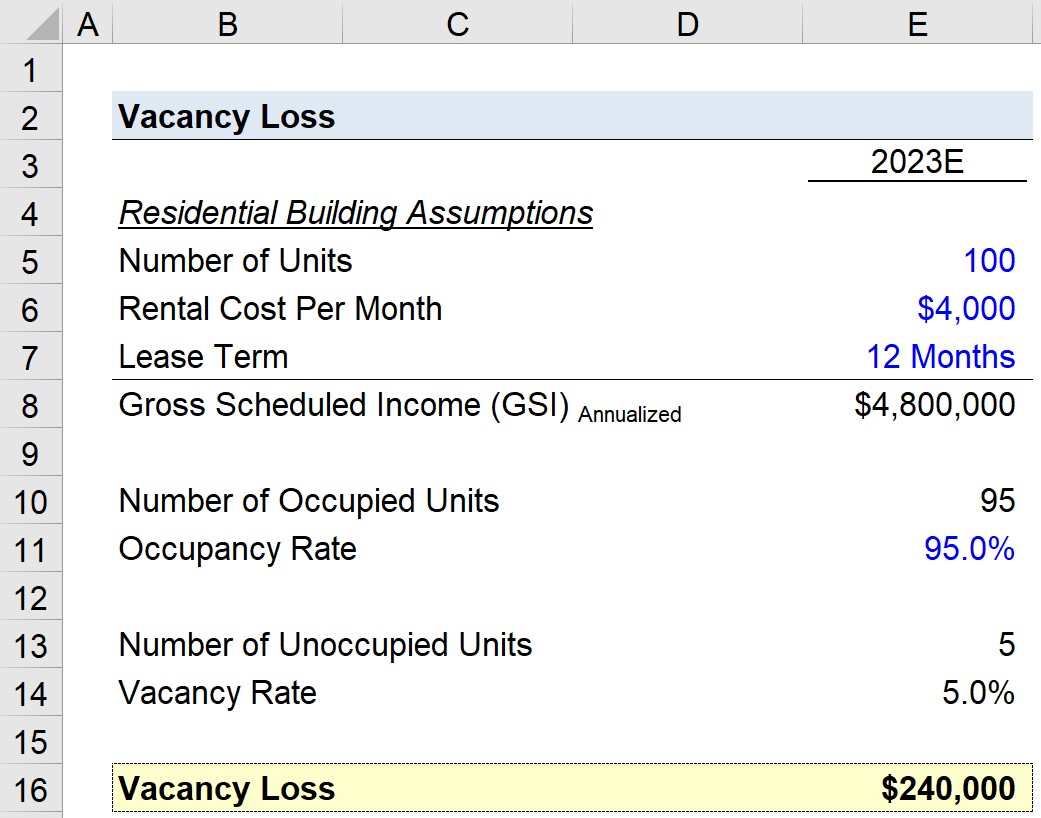
Monthly Rent * 12. - Vacancy Loss: This is an allowance for the income you'll lose due to empty units. It's typically estimated as a percentage of GPR (e.g., 5% is a common starting point, but it depends heavily on the market).
- Other Income: This includes all revenue generated by the property that isn't rent. Examples include fees for parking spaces, laundry machines, storage units, or even non-returned security deposits.
- Effective Gross Income (EGI): This is the final, more realistic income figure.
The image below shows a clear example of how vacancy loss is calculated for a residential building.
3. The Spanish Context: What Counts as Income?
For tax and legal purposes, it's essential to understand what the Spanish tax authority (Agencia Tributaria) considers income from a rental property, known as rendimiento del capital inmobiliario.
Impuestos del Alquiler de Viviendas en España 2025
The article 'Impuestos del Alquiler de Viviendas en España 2025' from Alexlegal.ai provides specific details on what to include in your gross income calculation according to Spanish law.
Read the sections '¿Qué son los Ingresos por Alquilar tu Piso?' and the subsection 'Lo que Cobras' under 'Cómo Calcular lo que Pagas a Hacienda.' Focus on what is explicitly included (rent, non-returned deposits) and excluded (IVA, expenses paid directly by the tenant).
Key takeaways for the Spanish market:
- You must include: The monthly rent (
alquiler mensual) and any extras like security deposits that you do not return (fianzas no devueltas). - You do not include: IVA (which doesn't apply to long-term residential rentals anyway) or expenses like community fees (
gastos de comunidad) if the contract specifies that the tenant pays them directly to the provider.
4. Practical Application: Reading a Rent Roll
For a single-family home, calculating GPR is simple. But for a multi-unit building, you'll need a document called a Rent Roll. This is a ledger that itemizes the income from each unit. Given your background in software engineering, you can think of it as a structured dataset or a table detailing the revenue streams of the asset.

A rent roll allows an investor to see, at a glance:
- Which units are occupied or vacant.
- What each tenant is actually paying.
- If the current rents are above or below the market rate.
- What additional fees are being collected.
- When leases are due to expire, which helps in projecting future vacancy.
Test your understanding!
You are analyzing a small apartment building in Valencia with 3 units.
- Unit A is rented for €900/month.
- Unit B is rented for €950/month.
- Unit C is currently vacant, but the market rent is €900/month.
You estimate a 5% vacancy and credit loss for the year. The building also generates €600 per year from renting out two parking spaces.
Calculate the property's:
- Gross Potential Rent (GPR)
- Vacancy Loss
- Effective Gross Income (EGI)
Show answer
-
Gross Potential Rent (GPR):
- First, calculate the total monthly potential rent: €900 (Unit A) + €950 (Unit B) + €900 (Unit C) = €2,750 per month.
- Then, annualize it: €2,750 * 12 = €33,000.
-
Vacancy Loss:
- Calculate 5% of the GPR: €33,000 * 0.05 = €1,650.
-
Effective Gross Income (EGI):
- Use the formula
EGI = (GPR - Vacancy Loss) + Other Income. - EGI = (€33,000 - €1,650) + €600 = €31,950.
- Use the formula
5. Modeling Gross Income with Python
As we progress, we will build a comprehensive financial model for a property. Let's start with a simple Python function to codify what we've learned today. This function will calculate GPR, vacancy loss, and EGI.
def calculate_gross_income(monthly_rent_per_unit, num_units, vacancy_rate, other_annual_income):
    """
    Calculates gross income metrics for a rental property.

    Args:
        monthly_rent_per_unit (float): The average monthly rent for one unit.
        num_units (int): The number of units in the property.
        vacancy_rate (float): The estimated vacancy and credit loss rate (e.g., 0.05 for 5%).
        other_annual_income (float): Total other income generated per year.

    Returns:
        dict: A dictionary containing GPR, Vacancy Loss, and EGI.
    """

    # 1. Calculate Gross Potential Rent (GPR)
    gross_potential_rent = monthly_rent_per_unit * num_units * 12

    # 2. Calculate Vacancy Loss
    vacancy_loss = gross_potential_rent * vacancy_rate

    # 3. Calculate Effective Gross Income (EGI)
    effective_gross_income = (gross_potential_rent - vacancy_loss) + other_annual_income

    return {
        "Gross Potential Rent (GPR)": gross_potential_rent,
        "Vacancy Loss": vacancy_loss,
        "Effective Gross Income (EGI)": effective_gross_income
    }

# --- Example usage based on the exercise ---
# For the exercise, we had different rents, so we'd calculate total monthly rent first.
total_monthly_rent = 900 + 950 + 900 # €2,750
# We can adapt the function or pre-calculate the GPR. Let's use a simplified call:
# Assume an average rent of €916.67 for 3 units.
# GPR = 916.67 * 3 * 12 = ~€33,000

# Let's use simpler inputs for a clear example:
# A 4-unit building where each unit rents for €800/month.
income_metrics = calculate_gross_income(
    monthly_rent_per_unit=800,
    num_units=4,
    vacancy_rate=0.05,
    other_annual_income=500
)

print(income_metrics)
# Expected Output:
# {'Gross Potential Rent (GPR)': 38400.0, 'Vacancy Loss': 1920.0, 'Effective Gross Income (EGI)': 36980.0}
This simple script forms the first building block of our investment analysis model.
Conclusion
Today we laid the critical groundwork for financial analysis by defining and calculating the top-line income of a rental property.
Key Takeaways:
- Gross Potential Rent (GPR) is the theoretical maximum annual rent, calculated as
Monthly Rent * 12. - Effective Gross Income (EGI) provides a more realistic income picture by subtracting vacancy/credit loss and adding other income sources. The formula is
EGI = GPR * (1 - Vacancy Rate) + Other Income. - In Spain, gross rental income (
rendimiento del capital inmobiliario) includes the rent and any non-returned funds from the tenant, but excludes expenses paid directly by the tenant if stipulated in the contract. - The Rent Roll is the primary document used to source income data for multi-unit properties.
Preview of the Next Lesson:
With a solid understanding of a property's income, we can now turn to its costs. In the next lesson, we will identify and calculate the Operating Expenses (OpEx)—the day-to-day costs of running a property, such as maintenance, insurance, and taxes. By subtracting these expenses from the EGI, we will arrive at one of the most important metrics in real estate: Net Operating Income (NOI).