Recommended resources
The freely available resources this lesson will direct you to.
Hello! Welcome to your second lesson.
In our first lesson, we mapped out the landscape of real estate by identifying the four main property types: residential, commercial, industrial, and land, with a specific focus on their classification in Spain. We learned the what of real estate investing.
Today, we transition to the how. This lesson will introduce you to the primary strategies investors use to generate returns from properties. We will distinguish between four key approaches: Buy-and-Hold, Fix-and-Flip, BRRRR, and Wholesaling. Understanding these strategic frameworks is crucial because every metric and calculation we learn in this course is designed to evaluate the viability of one of these strategies. We will pay special attention to how these popular strategies, often originating in the US market, are applied and adapted within the unique financial and regulatory environment of Spain.
1. The Two Foundational Strategies: Income vs. Capital Gain
Most real estate investment strategies can be categorized by their primary goal: generating steady income over time or achieving a large, one-time profit. This leads us to the two most fundamental approaches: Buy-and-Hold and Fix-and-Flip.
For a comprehensive overview, let's start with a detailed academic paper that analyzes these strategies in the context of the Valencia market.
Análisis comparativo de estrategias de inversión ...
The following document, 'Análisis comparativo de estrategias de inversión inmobiliaria en Valencia,' provides a thorough breakdown of several investment models. We will use it as a foundational text for this lesson.
Please read Chapter 3, 'Estrategia de inversión a corto plazo: Compra para revender,' and Chapter 4, 'Estrategia de inversión a largo plazo: compra para alquiler de larga duración.' For the Fix-and-Flip (compra para revender) section, focus on its definition, the source of its profitability (plusvalía inmediata), and the associated risks (cost overruns, market changes). For the Buy-and-Hold (compra para alquiler) section, focus on its dual-return nature (cash flow and appreciation) and the key risks (vacancy, non-payment).
Now, let's break down each strategy with more practical insights, especially for the Spanish market.
Buy-and-Hold (Comprar para Alquilar)
This is the classic strategy of acquiring a property to rent it out. The goal is to create a long-term, relatively passive income stream while the property appreciates in value and the mortgage is paid down by the tenant's rent.
- Primary Goal: Long-term wealth creation through cash flow, appreciation, and equity buildup.
- Time Horizon: Long (5+ years).
- Investor Profile: Typically more conservative, seeking stable, predictable returns.
While it sounds straightforward, executing this strategy successfully in Spain has specific challenges. The following video explains the most significant one: scalability.
💰Comprar con HIPOTECA para ALQUILAR 🤦🏻♂️🏠📉 Solo FUNCIONARÁ si aplicas ESTO 🎯
The video '💰Comprar con HIPOTECA para ALQUILAR...' by Jose Muñoz offers a crucial, real-world perspective on the limitations of the traditional buy-and-hold strategy in Spain.
Watch the segment from 00:12 to 03:48. Pay close attention to the explanation of the 'ratio de endeudamiento' (debt-to-income ratio) and how Spanish banks calculate it. This is a critical difference from the US system often described in investment books.
As the video highlights, Spanish banks focus on your personal income to determine your borrowing capacity, not just the income of the property itself. They generally cap your total debt payments (including your primary residence mortgage and other loans) at around 35-40% of your net income. This makes it difficult to acquire a large portfolio of mortgaged properties, as you quickly hit your debt ceiling.
Fix-and-Flip (Compra, Reforma y Venta)
This strategy is focused on capital gains. An investor buys an underperforming property, renovates it ("adds value"), and sells it for a profit in a short period.
- Primary Goal: Short-term profit (capital gain).
- Time Horizon: Short (typically 6-18 months).
- Investor Profile: More active and risk-tolerant, often with expertise in construction or project management.
The key to a successful flip is to "force appreciation" through renovation, rather than just waiting for the market to rise. Jose Muñoz, in the same video, presents this strategy as a powerful way to build capital that can later be deployed into a buy-and-hold portfolio.
💰Comprar con HIPOTECA para ALQUILAR 🤦🏻♂️🏠📉 Solo FUNCIONARÁ si aplicas ESTO 🎯
Let's return to Jose Muñoz's video to see how he frames the flipping strategy and what kind of properties are ideal candidates.
Please watch from 09:48 to 15:48. This section outlines the step-by-step process of a flip and, most importantly, identifies six types of 'problem' properties that offer the best potential for adding value. This is the essence of 'buying right'.
The core idea is that the profit is made on the purchase by finding a deal the average homebuyer would overlook.
Test your understanding!
An investor has two goals:
- Generate an extra €500 per month to supplement their salary.
- Quickly accumulate €100,000 in capital to start a new business venture.
Which strategy is better suited for each goal?
Show answer
- Buy-and-Hold is best for generating a steady monthly income stream.
- Fix-and-Flip is designed for generating a large lump sum of capital in the short term.
2. The Hybrid Strategy: BRRRR
What if you could combine the forced appreciation of a flip with the long-term cash flow of a rental? That’s the idea behind the BRRRR strategy. The acronym stands for:
- Buy: Purchase a distressed property below market value.
- Rehab: Renovate the property to increase its value (force appreciation).
- Rent: Find a tenant and start generating cash flow.
- Refinance: Go to a bank and get a new mortgage based on the property's new, higher value (the After-Repair Value or ARV).
- Repeat: Use the cash pulled out during the refinance to fund the down payment for the next property.
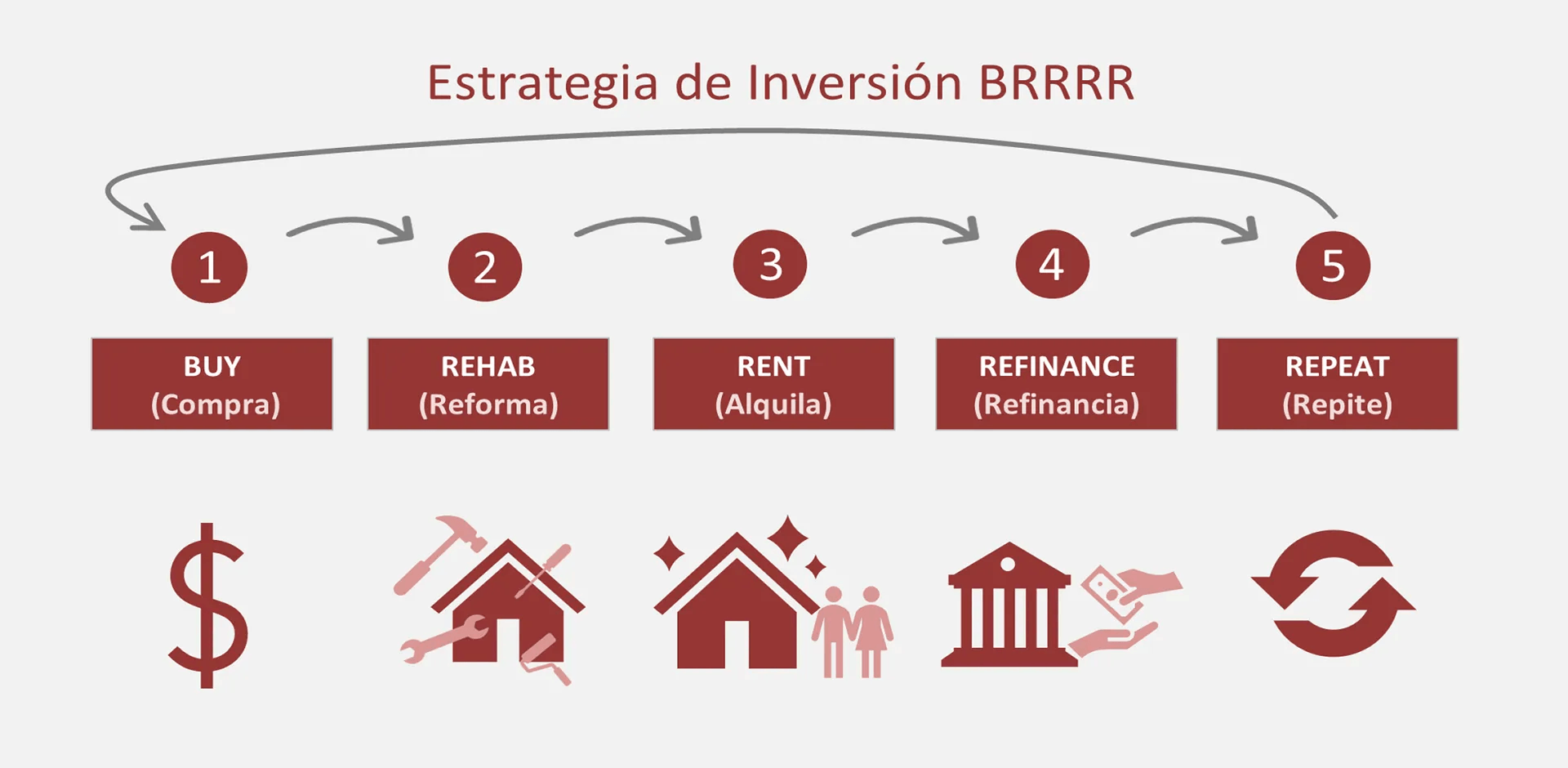
This strategy is powerful because, if executed perfectly, you can get most or all of your initial capital back, essentially acquiring a cash-flowing asset for little to no money down. It's a system designed for rapid portfolio growth.
However, does it work in Spain? The "Refinance" step is the most critical and challenging part.
¿Qué es el BRRRR? 🏠💰 ¿Sirve en España?
The video '¿Qué es el BRRRR? 🏠💰 ¿Sirve en España?' by Alex Emebe directly addresses the viability of this popular strategy in the Spanish financial system.
Please watch the entire video (it's short). Focus on why refinancing based on the new value is more difficult in Spain than in the US. The speaker, who has experience in bank risk analysis, explains that Spanish banks are more conservative with 'cash-out' refinancing, especially for non-professional investors.
The key takeaway is that while BRRRR is theoretically possible in Spain, it's not as straightforward. Spanish banks are generally reluctant to give you a mortgage that is significantly larger than your purchase price plus renovation costs. They may offer a new loan based on the higher valuation, but the Loan-to-Value (LTV) ratio might be lower, or they may simply not approve a large "cash-out" for an individual investor. It's a strategy that often requires a strong relationship with a bank and a professional track record.
3. The Transactional Strategy: Wholesaling
You may have heard of "wholesaling" in US real estate circles. In its purest form, this strategy involves getting a property under contract and then selling or "assigning" that contract to another buyer for a fee. The wholesaler never actually buys the property.
This model is not common for individual investors in Spain due to legal and transactional complexities. The formal process would involve a cesión del contrato de arras, which can be complicated.
The more practical Spanish equivalent is acting as a property finder or personal shopper inmobiliario. This is less of an investment strategy and more of a service business. The process is:
- Find: You specialize in finding off-market or undervalued properties (like the ones Jose Muñoz described for flipping).
- Analyze: You analyze the deal for a potential investor client.
- Connect: You connect your client with the property. If they buy it, you earn a finder's fee.
Essentially, you are selling your expertise in deal-finding, not a property or a contract. This requires zero capital but significant time, networking, and market knowledge.
4. Choosing the Right Strategy for You
There is no single "best" strategy. The optimal choice depends entirely on your personal resources, goals, and risk tolerance.
The academic paper you read earlier provides an excellent summary and comparison that can help you frame your decision.
Análisis comparativo de estrategias de inversión ...
Let's revisit the UPV thesis to see a structured comparison of the strategies, which can guide your own strategic thinking.
Please read Chapter 7, 'Análisis comparativo de estrategias de inversión inmobiliaria en Valencia,' and the recommendations in section 7.3. Pay attention to Table 2 in section 7.1, which compares the strategies on key financial indicators. Review the SWOT analysis (Strengths, Weaknesses, Opportunities, Threats) for each strategy in section 7.2. Finally, read the recommendations in 7.3, which match strategies to different investor profiles.
Additionally, the article "Flipping vs buy-to-let" offers another clear, concise guide for making this choice.
Flipping vs buy-to-let: rentabilidad, tiempos y riesgo operativo
This article from Parlantia provides a direct, easy-to-read comparison to help you decide which path might be right for you.
Please read the section titled '¿Cuál elegir? Factores de decisión.' It presents a clear checklist for when to choose flipping versus buy-to-let.
Conclusion
In this lesson, we've deconstructed the primary real estate investment strategies and analyzed their application within the Spanish context.
Key Takeaways:
- Buy-and-Hold is a long-term strategy focused on rental income and appreciation, but its scalability in Spain is limited by personal debt-to-income ratios.
- Fix-and-Flip is a short-term, active strategy focused on generating capital gains by forcing appreciation through renovations. It's an effective way to build capital quickly.
- BRRRR is a powerful hybrid strategy for scaling a rental portfolio, but the crucial "Refinance" step is more challenging to execute in Spain's conservative banking environment.
- Wholesaling, in the Spanish context, is best understood as a service business (property finding) rather than a pure investment strategy.
- The right strategy for you depends on your capital, time commitment, risk tolerance, and ultimate financial goals.
Preview of the Next Lesson:
Now that we've covered the foundational strategies, we're ready to start crunching numbers. Our next lesson will dive into the most fundamental metric for any rental property: Gross Rental Income. We will learn how to calculate it from a property's rent specifications, setting the stage for analyzing a property's true profitability.