Recommended resources
The freely available resources this lesson will direct you to.
Hello! Welcome to your fourth lesson.
In our last session, we focused on the "top line" of a property's finances, learning to calculate Gross Potential Rent and the more realistic Effective Gross Income (EGI). We now have a solid understanding of a property's income-generating potential.
This lesson shifts our focus from income to costs. We will dissect the expenses involved in the day-to-day running of a rental property. Your learning goal is to itemize and calculate the operating expenses (OpEx) for a rental property, specifically covering maintenance, insurance, property tax, and utilities within the Spanish context. Mastering this is crucial because subtracting these expenses from your EGI will lead us to the Net Operating Income (NOI), one of the most important metrics in real estate investment, which we will tackle in the next lesson.
1. Defining Operating Expenses (OpEx)
Operating Expenses are the costs required to keep a property operational and generating income. They are the recurring, day-to-day costs of ownership. Think of them as the "cost of doing business" for your property.
It's equally important to understand what is NOT an operating expense:
- Debt Service: Your mortgage payments (principal and interest). This is a financing cost, not an operational one.
- Capital Expenditures (CapEx): Large, infrequent expenses that improve the property or extend its life (e.g., a new roof, a full kitchen renovation). We'll cover these in a future lesson.
- Income Taxes: Taxes on the profit you make.
- Depreciation: This is a non-cash expense for tax purposes, not an actual cash outlay.
Correctly identifying and categorizing OpEx is fundamental for accurate profitability analysis and, as you'll see, for your Spanish tax declaration (IRPF).
2. Itemizing Operating Expenses in Spain
Let's break down the typical operating expenses you'll encounter as a property owner in Spain. The following infographic provides a great high-level summary of the main deductible expenses.
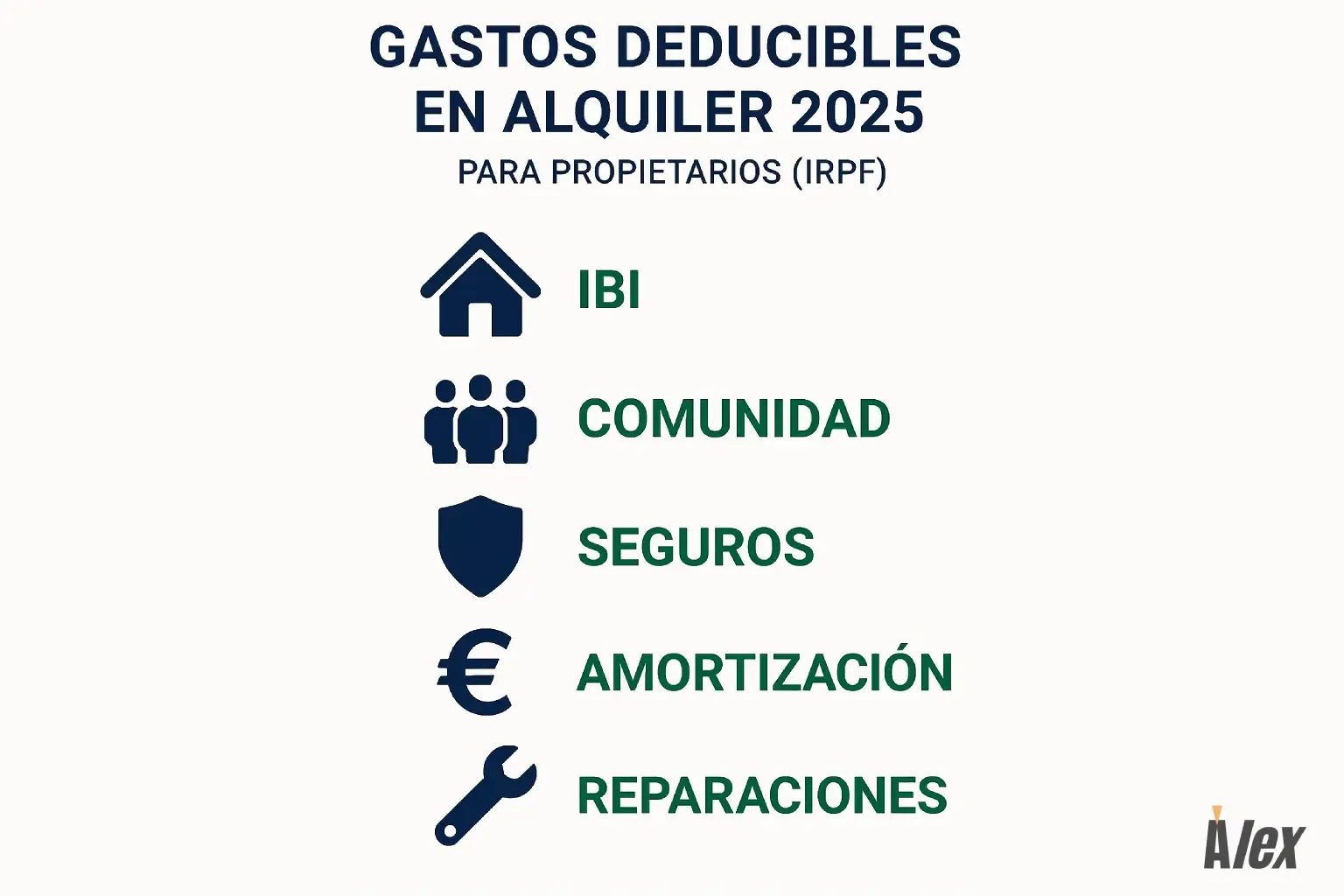
We will now explore these and others in more detail.
Cómo calcular la rentabilidad neta de un alquiler
The article 'Cómo calcular la rentabilidad neta de un alquiler' from Reental provides a clear and concise list of the typical fixed and recurring expenses for a rental property in Spain. It's a great starting point for our itemization.
Please read the section titled 'Gastos fijos (y recurrentes) a considerar'. Focus on the list of expenses: 'Impuestos y tributos', 'Comunidad, seguros y servicios', 'Mantenimiento y reparaciones', and 'Gestión e intermediación'. This will give you a solid framework of the categories.
Based on this, here is a comprehensive list of operating expenses in the Spanish market:
-
Taxes and Levies (
Impuestos y Tributos):- Property Tax (
Impuesto sobre Bienes Inmuebles - IBI): An annual municipal tax based on the property's cadastral value (valor catastral). This is a non-negotiable expense for every property owner. - Waste Collection Fee (
Tasa de Recogida de Basuras): Another municipal fee for rubbish collection services.
- Property Tax (
-
Community Fees (
Gastos de Comunidad): If your property is part of a building or development with shared areas (hallways, elevators, pools), you will pay a monthly or quarterly fee to the community of owners. This covers the maintenance of those common elements. Be aware of special assessments (derramas) for large, unexpected repairs (e.g., façade renovation), which also fall under this category. -
Insurance (
Seguros):- Home Insurance (
Seguro de Hogar): Covers the building (continente) and potentially its contents (contenido) against risks like fire, theft, and water damage. This is essential. - Rent Default Insurance (
Seguro de Impago de Alquiler): A popular option in Spain that protects you against non-paying tenants and can cover legal costs for eviction.
- Home Insurance (
-
Utilities (
Suministros): This includes electricity, water, and gas. In most long-term Spanish rental contracts, these are transferred to the tenant's name and paid by them directly. However, if you as the landlord pay them, they become an operating expense. You might do this in short-term rentals or if it's included in the rent. -
Maintenance and Repairs (
Mantenimiento y Reparaciones): These are costs to keep the property in its current condition, not to upgrade it. Examples include fixing a leaky tap, repairing a broken appliance, or repainting a room due to wear and tear. It's wise to budget a certain amount for this annually, often as a percentage of your rental income. A common rule of thumb is to set aside 5-10% of your gross rent. -
Property Management Fees (
Gestión Inmobiliaria): If you hire an agency to find tenants, collect rent, and manage the property, their fees are a direct operating expense. This is typically a percentage of the monthly rent (e.g., 5-10%).
The following video gives a fantastic, detailed walkthrough of these expenses from the perspective of what is deductible on your Spanish income tax return (IRPF).
IMPUESTOS en la inversión inmobiliaria💰FISCALIDAD💰Parte 1
The video 'IMPUESTOS en la inversión inmobiliaria' from 'El Excel de Alex' is an excellent, practical guide to deductible expenses in Spain. The presenter uses a real-life example to explain each category.
Please watch the following segments: 04:12 - 05:34: Focus on the distinction between 'reparación y conservación' (deductible OpEx) and 'mejoras' (improvements/CapEx). 05:34 - 06:43: This part clearly covers community fees, home insurance, IBI, and trash fees. 11:34 - 12:44: Pay attention to how utility costs ('suministros') are handled depending on who pays them (landlord or tenant).
3. A Closer Look at Key Expenses
Property Tax (IBI)
The IBI is one of your largest and most predictable operating expenses. Its amount varies significantly depending on the municipality (ayuntamiento).
Take a look at the infographic below. It shows how much the IBI for a property with the same cadastral value (€80,000) can differ across various provincial capitals in Spain. This highlights the importance of researching local tax rates when analyzing a potential investment.

Prorating Expenses
A critical concept in accounting for expenses is prorating. You can only deduct expenses for the period the property was actually rented out. For example, if you pay an annual IBI of €600, but the property was only rented for 9 months of the year, you can only count a proportional amount as an operating expense against that rental income.
This principle applies to all annual or recurring expenses.
4. Calculating Total Operating Expenses: An Example
Let's bring this all together. Imagine you are analyzing a flat in Valencia that you plan to rent out. You have already calculated an Effective Gross Income (EGI) of €11,400 for the year.
Now, you research and estimate the annual operating expenses:
- IBI: €420
- Tasa de Basuras: €50
- Gastos de Comunidad: €60/month => €720/year
- Seguro de Hogar: €250
- Seguro de Impago de Alquiler: €450
- Maintenance Provision (5% of EGI): €11,400 * 0.05 = €570
Now, we simply sum these up to find the Total Operating Expenses:
Your total estimated operating cost for the year is €2,460.
Test your understanding!
You are evaluating a property in Seville. It was rented for the entire year. Your research provides the following cost estimates:
IBI: €380 for the year.Gastos de Comunidad: €45 per month.Seguro de Hogar: €220 for the year.Tasa de basuras: Included in the community fees.- You decide to hire a property manager for 8% of the €850 monthly rent.
- You want to set aside a maintenance fund equal to one month's rent.
What is the total estimated annual operating expense for this property?
Show answer
Let's itemize and annualize each expense:
- IBI: €380 (annual)
- Community Fees: €45/month * 12 months = €540 (annual)
- Home Insurance: €220 (annual)
- Property Management:
- Monthly rent = €850
- Annual rent = €850 * 12 = €10,200
- Management fee = €10,200 * 0.08 = €816 (annual)
- Maintenance Provision: One month's rent = €850 (annual)
Total Annual Operating Expenses:
Conclusion
In this lesson, we have moved down the financial statement from income to expenses. You are now equipped to identify, categorize, and calculate the costs of running a rental property in Spain.
Key Takeaways:
- Operating Expenses (OpEx) are the recurring costs needed to maintain a property and its income stream.
- Key OpEx categories in Spain include
IBI,Gastos de Comunidad,Seguros,Mantenimiento,Suministros(if paid by landlord), andGestión. - It is crucial to distinguish OpEx from financing costs (debt service) and capital expenditures (property improvements).
- Accurate tracking of OpEx is essential not only for evaluating profitability but also for correctly calculating your taxable income under Spanish
IRPFrules. - Expenses should be prorated for the time the property is generating rental income.
Preview of the Next Lesson:
We have now calculated the two main components of a property's operating performance: Effective Gross Income (EGI) and Operating Expenses (OpEx). In our next lesson, we will combine them using the formula NOI = EGI - OpEx to calculate the Net Operating Income (NOI). The NOI is a cornerstone metric that forms the basis for valuation and for comparing the profitability of different properties, regardless of how they are financed.