Recommended resources
The freely available resources this lesson will direct you to.
Hello! Welcome to your fifth lesson in the Foundations of Real Estate Investment module.
In our last two sessions, we've built the top and middle sections of a property's financial statement. First, we determined the income side by calculating Effective Gross Income (EGI). Then, we detailed the cost side by itemizing and calculating the annual Operating Expenses (OpEx).
Today, we will connect these two pieces to arrive at what is arguably the most important single metric for evaluating a property's performance. Your learning outcome is to calculate Net Operating Income (NOI) from gross rental income and operating expenses. NOI is the bedrock upon which many other valuation and return metrics are built, making it an essential concept to master.
1. Defining Net Operating Income (NOI)
Net Operating Income, or NOI (in Spanish, Ingreso Operativo Neto), represents a property's profitability from its core operations. It is the total income the property generates after paying for all necessary operating expenses but before accounting for financing costs and taxes.
The formula is simple and intuitive:
Think of NOI as the "pure" profit generated by the asset itself, irrespective of how the investor financed it or their personal tax situation. This is precisely why it's so powerful: it allows for an "apples-to-apples" comparison between different properties.
Given your background, you can think of NOI as being conceptually similar to EBITDA (Earnings Before Interest, Taxes, Depreciation, and Amortization) in corporate finance. Both metrics aim to measure the core operational profitability of an asset (a company or a property) by stripping out the effects of financing and accounting decisions.
Specifically, NOI excludes:
- Debt Service: Mortgage principal and interest payments.
- Income Taxes: Such as the Spanish
IRPFon rental profits. - Capital Expenditures (CapEx): Funds set aside for major property improvements.
- Depreciation (
Amortización): A non-cash expense for tax purposes.
This strict definition is crucial for valuation, which we will cover in later modules.
2. Calculating NOI: A Step-by-Step Example
Let's continue with the example from our previous lesson. We were analyzing a flat in Valencia and had already calculated:
- Effective Gross Income (EGI): €11,400
- Total Operating Expenses (OpEx): €2,460
Now, calculating the NOI is a single subtraction:
The property is expected to generate €8,940 per year before considering mortgage payments or income taxes. This is the figure you would use to compare its fundamental performance against another property.
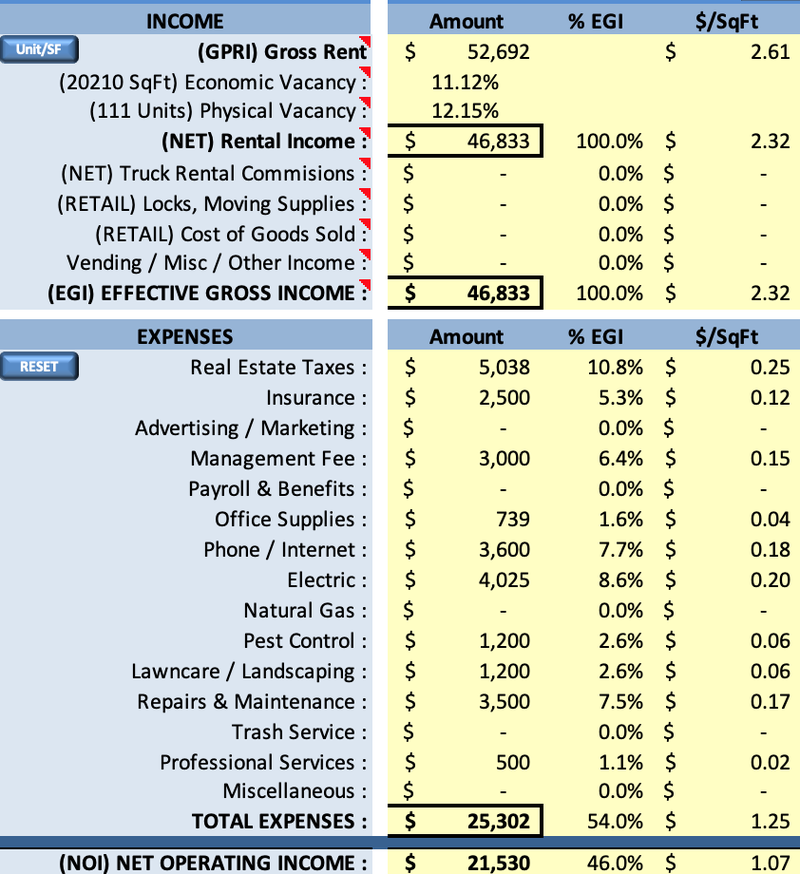
The diagram below provides an excellent visual summary of this entire process, starting from the top-line income and working its way down past expenses to arrive at NOI.
3. Understanding the Components of NOI
To solidify your understanding, let's turn to some resources that explain how professionals use this metric.
Calculadora de rentabilidad inmobiliaria: guía de uso
The article 'Calculadora de rentabilidad inmobiliaria: guía de uso' from Borneo Advisors clearly defines NOI and its components in a Spanish context. It also provides a practical example.
Please read the following parts: Under 'Métricas clave que debes conocer', read the bullet point defining NOI (ingreso operativo neto). Review the 'Ejemplo guiado paso a paso', focusing on how they calculate Ingresos efectivos and Gastos operativos totales to arrive at the NOI. In the FAQ section at the end, read the answer to '¿Cómo calculo bien el NOI?'. Notice how consistently the definition excludes debt and amortization.
This next video gives a clear, generic breakdown of a property cash flow statement. It reinforces the universal structure of the calculation.
Real Estate Cash Flow Statement Breakdown
The video 'Real Estate Cash Flow Statement Breakdown' by Break Into CRE walks through the calculation step-by-step. It will help you visualize the flow from gross income to NOI.
Watch the segment from 03:07 to 04:02. Pay close attention to how the presenter lists the operating expenses and then subtracts them from the 'effective gross revenue' to calculate 'net operating income'.
A Note on Practical Spreadsheets vs. Formal Definitions
Sometimes, in practical tutorials or spreadsheets, you might see calculations that blend operating expenses with financing costs. For example, some might include mortgage interest when calculating "net income."
Cómo Calcular la Rentabilidad de un Inmueble
Let's watch a short clip from the video 'Cómo Calcular la Rentabilidad de un Inmueble' from Libertad Inmobiliaria. The presenter's spreadsheet is practical for a personal cash flow analysis, but it's important to see how it differs from a formal NOI calculation.
Watch from 02:03 to 03:04. Notice that under the annual expenses ('gastos'), the presenter includes 'intereses de la hipoteca' (mortgage interest). A formal NOI calculation would exclude this. What the spreadsheet is calculating is closer to Pre-Tax Cash Flow, a metric we'll discuss in the next module. This distinction is key for advanced analysis.
Recognizing this difference is important. For valuation and direct property-to-property comparison, you must use the strict definition of NOI, which is always calculated before debt service.
4. Comprehensive Calculation Practice
Let's work through one more complete example to tie everything together.
Scenario: You are analyzing an apartment in the Chamberí district of Madrid.
Income Data:
- Projected Monthly Rent: €1,300
- Estimated Vacancy & Credit Loss: 5% of Gross Potential Rent
- No other income sources.
Expense Data (Annual):
IBI: €650Gastos de Comunidad: €80/monthSeguro de Hogar: €300Tasa de Basuras: €60- Maintenance & Repairs Budget: 5% of Effective Gross Income
Calculation:
Step 1: Calculate Effective Gross Income (EGI)
- Gross Potential Rent (GPR) = €1,300/month * 12 months = €15,600
- Vacancy Loss = €15,600 * 0.05 = €780
- EGI = GPR - Vacancy Loss = €15,600 - €780 = €14,820
Step 2: Calculate Total Operating Expenses (OpEx)
IBI: €650Comunidad: €80/month * 12 = €960Seguro: €300Tasa de Basuras: €60- Maintenance = €14,820 (EGI) * 0.05 = €741
- Total OpEx = €650 + €960 + €300 + €60 + €741 = €2,711
Step 3: Calculate Net Operating Income (NOI)
- NOI = EGI - Total OpEx = €14,820 - €2,711 = €12,109
The projected annual Net Operating Income for this Madrid apartment is €12,109.
Test your understanding!
You are evaluating a property in Barcelona's Gràcia district. The property was rented for the entire year.
- Monthly Rent: €950
- Annual
IBI: €400 - Annual
Seguro de Hogar: €240 - Monthly
Gastos de Comunidad: €55 - You hire a management company that charges 8% of collected rent.
- You budget €500 for annual maintenance.
- Vacancy was zero for this year.
What is the property's Net Operating Income (NOI) for the year?
Show answer
Step 1: Calculate Effective Gross Income (EGI)
- Since vacancy is zero, EGI is the same as Gross Potential Rent.
- GPR = €950/month * 12 months = €11,400
- EGI = €11,400
Step 2: Calculate Total Operating Expenses (OpEx)
IBI: €400Seguro: €240Comunidad: €55/month * 12 months = €660- Management Fee: €11,400 * 0.08 = €912
- Maintenance: €500
- Total OpEx = €400 + €240 + €660 + €912 + €500 = €2,712
Step 3: Calculate Net Operating Income (NOI)
- NOI = EGI - Total OpEx = €11,400 - €2,712 = €8,688
Conclusion
Congratulations! You can now calculate one of the most fundamental metrics in real estate investment analysis. By understanding how to derive NOI, you can assess the standalone financial performance of any income-producing property.
Key Takeaways:
- NOI is the income a property produces after all operating expenses are paid.
- The formula is NOI = Effective Gross Income - Operating Expenses.
- NOI is calculated before debt service (mortgage) and income taxes, making it the ideal metric for comparing the operational profitability of different properties.
- Mastering the components of EGI and OpEx is essential for an accurate NOI calculation.
Preview of the Next Lesson:
Now that we have clearly defined and calculated both Operating Expenses and Net Operating Income, we can use them to derive another useful metric. In the next lesson, we will calculate the Operating Expense Ratio (OER). The OER tells you what percentage of your income is consumed by operating costs, providing a quick measure of the property's efficiency.