Recommended resources
The freely available resources this lesson will direct you to.
Hello! Welcome to your sixth lesson in the "Foundations of Real Estate Investment" module.
In the last lesson, we reached a major milestone by calculating Net Operating Income (NOI), which represents a property's pure operational profitability. We established that NOI is a crucial, standardized figure for comparing properties because it's calculated before financing costs and taxes.
Today, we'll build directly on that knowledge to explore a key performance indicator for efficiency. The learning outcome for this lesson is to calculate the operating expense ratio (OER) to assess property efficiency. This metric answers a simple but vital question: "For every euro of income the property generates, how many cents are spent on running it?"
1. Defining the Operating Expense Ratio (OER)
The Operating Expense Ratio (OER) measures the relationship between a property's operating costs and the income it generates. It is expressed as a percentage and provides a quick snapshot of how efficiently a property is managed. A lower OER generally indicates better operational efficiency, as a smaller portion of the income is consumed by expenses.
The formula for OER uses the two components we've already mastered:
As a software engineer, you might think of this as analogous to measuring the overhead of a system. Just as you might analyze the percentage of CPU time spent on system processes versus application logic, the OER tells you what percentage of your income is spent on "system maintenance" (operating the property) versus what's left over for profit and financing (the NOI).
To get a formal definition, let's turn to a professional real estate analysis resource.
Everything you should know about the operating expense ratio in real estate
The article 'Everything you should know about the operating expense ratio' from BullpenRE provides a concise definition and the formula for OER.
Please read the first two sections of the article: 'How do you calculate the operating expense ratio?' to see the formula. 'What is included in operating expenses for real estate?' to reinforce why we use EGI in the denominator and which costs are excluded (like CapEx and depreciation), something we've touched on previously.
As the article confirms, OER focuses strictly on the day-to-day running costs relative to the realistic income (EGI), making it a pure measure of operational performance.
2. Calculating the OER in Practice
Let's apply this formula immediately using the examples from our previous lessons.
Example 1: Valencia Apartment
In the last lesson, we analyzed a flat in Valencia and calculated:
- Effective Gross Income (EGI): €11,400
- Total Operating Expenses (OpEx): €2,460
Now, we calculate the OER:
This means that for every euro of effective income this property generates, about 21.6 cents go toward paying its operating expenses.
Example 2: Spanish Residential Property from Borneo Advisors
Let's also use the numbers from the guided example in the Borneo Advisors article we reviewed.
Ingresos efectivos(EGI): €17,100Gastos operativos totales(OpEx): €3,705
Let's calculate the OER for this property:
The result is remarkably similar to our first example, suggesting a common efficiency level for this type of residential asset in Spain.
This visual shows how OER fits into a multi-year financial projection.
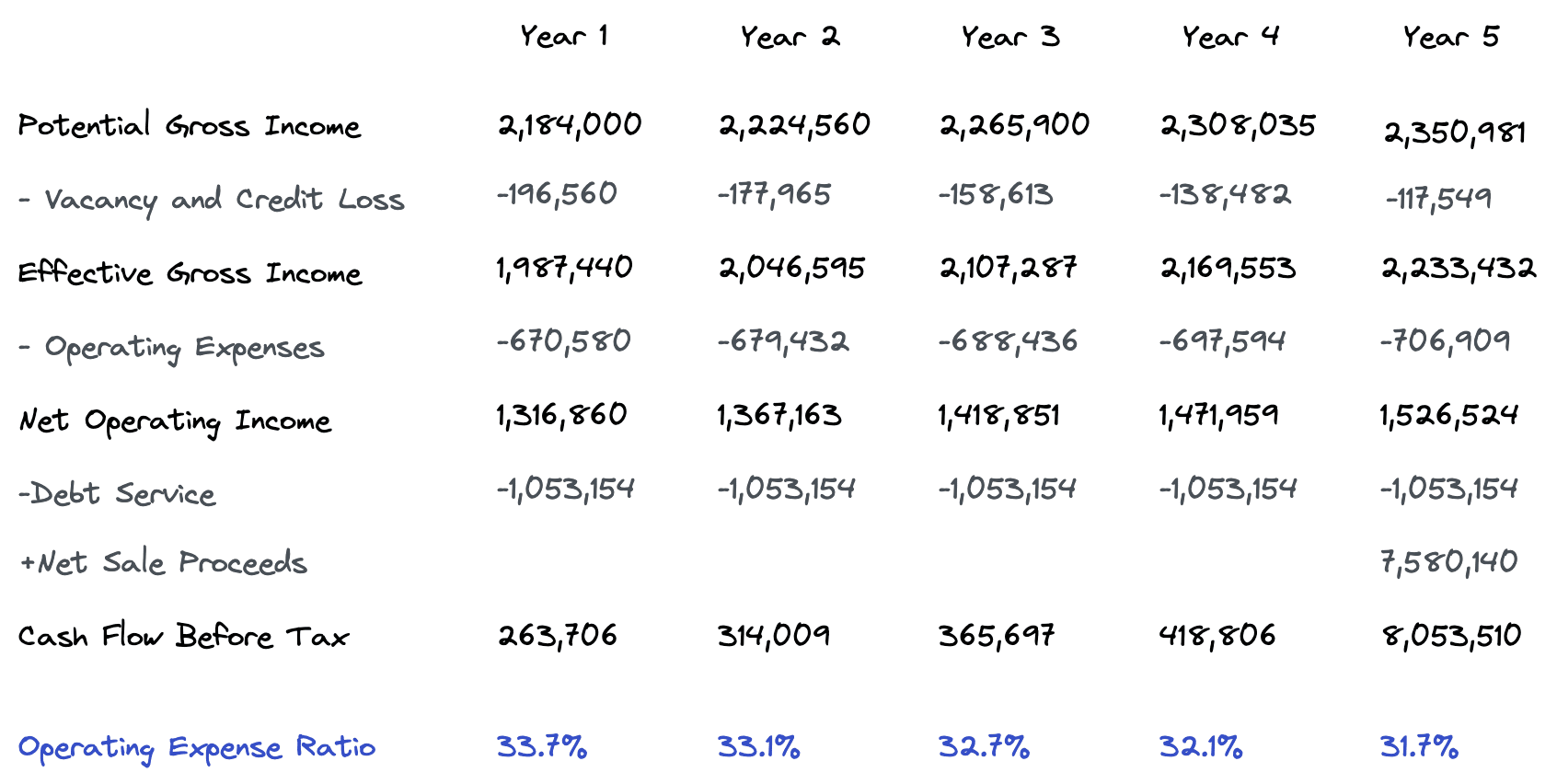
Notice how the OER is calculated annually. Tracking it year-over-year is a powerful way to spot trends. A rising OER could be an early warning sign of escalating costs or wasteful spending.
3. How to Interpret the OER
Calculating the OER is simple, but interpreting it requires context. A "good" OER is not a fixed number; it depends heavily on the property type, location, age, and even the specific lease structures in place.
Is a lower OER always better?
Generally, yes. A lower OER implies higher operational efficiency and, therefore, a higher Net Operating Income. However, a high OER isn't always a red flag. For an investor focused on "value-add" strategies, a property with a high OER might represent an opportunity. If you can identify the cause of the inefficiency—such as bloated management fees, outdated high-energy appliances, or deferred maintenance causing frequent repairs—you can implement changes to lower the OER and significantly increase the property's value.
Benchmarking OER
The most effective way to assess an OER is through comparison:
- Historical Trend: Compare the property's current OER to its performance in previous years.
- Comparable Properties: Compare it to similar properties in the same local market.
- Industry Benchmarks: Compare it to typical OERs for that specific asset class (e.g., residential, office, industrial).
Let's explore some of these benchmarks.
Everything you should know about the operating expense ratio in real estate
The BullpenRE article also provides typical OER ranges for different types of commercial real estate. This is crucial for the 'assess' part of our learning outcome.
Please read the sections from 'What is a good operating expense ratio in commercial real estate?' down to 'What is a typical operating expense ratio for hotels?'. Pay attention to how the ranges differ significantly between property types like multifamily, office, and industrial, and how lease types (e.g., triple net vs. gross) can influence the ratio.
After reading, you might notice that the typical OER for apartment buildings mentioned in the article (35%-45%) is higher than the ~22% we calculated for our Spanish examples. This highlights a critical point: benchmarks are a guide, not a rule. The provided ranges are for US commercial properties and can differ from the reality of a single residential unit in Spain due to different market conventions, tax structures (IBI vs. US property tax), and what expenses are typically passed on to tenants. The most accurate comparison is always against local, similar properties.
Test your understanding!
You are comparing two potential investments: a small office building and a block of four residential apartments.
- Office Building:
- Effective Gross Income (EGI): €150,000
- Total Operating Expenses (OpEx): €67,500
- Apartment Block:
- Effective Gross Income (EGI): €60,000
- Total Operating Expenses (OpEx): €21,000
- Calculate the OER for each property.
- Based solely on the OER, which property appears to be operating more efficiently?
- What could explain the difference in their OERs, drawing from what you've learned?
Show answer
-
Calculations:
- Office Building OER: €67,500 / €150,000 = 45%
- Apartment Block OER: €21,000 / €60,000 = 35%
-
Assessment: The Apartment Block appears more efficient, as only 35% of its income is used for operations, compared to 45% for the office building.
-
Explanation: There are several potential reasons for this difference.
- Property Type: As seen in the BullpenRE article, office buildings often have higher OERs than multifamily properties. This can be due to higher costs for common area maintenance, janitorial services, security, and utilities.
- Lease Structure: The office building might be under "gross" or "modified gross" leases where the landlord is responsible for most or all operating expenses. The apartments might have leases where tenants pay for their own utilities, lowering the landlord's OpEx and thus the OER.
- Management: The apartment block might be managed more efficiently, or it could be newer, requiring less maintenance.
Conclusion
You can now calculate and interpret the Operating Expense Ratio, a vital metric for gauging a property's financial health and management effectiveness.
Key Takeaways:
- The Operating Expense Ratio (OER) is calculated as
Total OpEx / EGI. - It measures the percentage of income consumed by a property's day-to-day running costs.
- A lower OER generally signifies higher efficiency and profitability (higher NOI).
- Interpreting OER requires context. It should be compared against the property's historical performance and benchmarks for similar properties in the same market and asset class.
Preview of the Next Lesson:
Throughout our discussions on Operating Expenses and the OER, we've consistently mentioned that certain major costs are excluded from the calculation—namely, Capital Expenditures (CapEx). Confusing regular operating expenses with long-term capital improvements is a common and costly mistake. In our next lesson, we will define and estimate capital expenditures (CapEx) and distinguish them from operating expenses, completing our foundational understanding of a property's full expense profile.