Recommended resources
The freely available resources this lesson will direct you to.
In our last lesson, we established the theoretical foundation for a successful DnB lead: it must occupy the mid-range of the frequency spectrum to be heard clearly. Today, we'll bridge the gap between that theory and practice. Your goal is to understand not just what to do, but why, and the best way to do that is to learn from the masters.
This lesson is dedicated to analyzing a reference track to identify the specific timbral and dynamic qualities that make a lead powerful and present. We will deconstruct the sound of a typical Dancefloor DnB lead, similar to those used by artists like Grafix or Fred V, to create a concrete blueprint for our own sound design later.
The Analyst's Toolkit: Ears and Eyes
Critical listening is your most important tool, but it can be enhanced with visual aids. Professional producers rely on two key visual tools for this task:
- Spectrum Analyzer: This plots frequency against amplitude in real-time, showing you exactly where a sound's energy is concentrated. It turns abstract concepts like "bright" or "muddy" into measurable data.
- Referencing Plugins: These are specialized tools that allow for level-matched, A/B comparison between your project and a commercial track. They often include advanced spectral and loudness analysis.
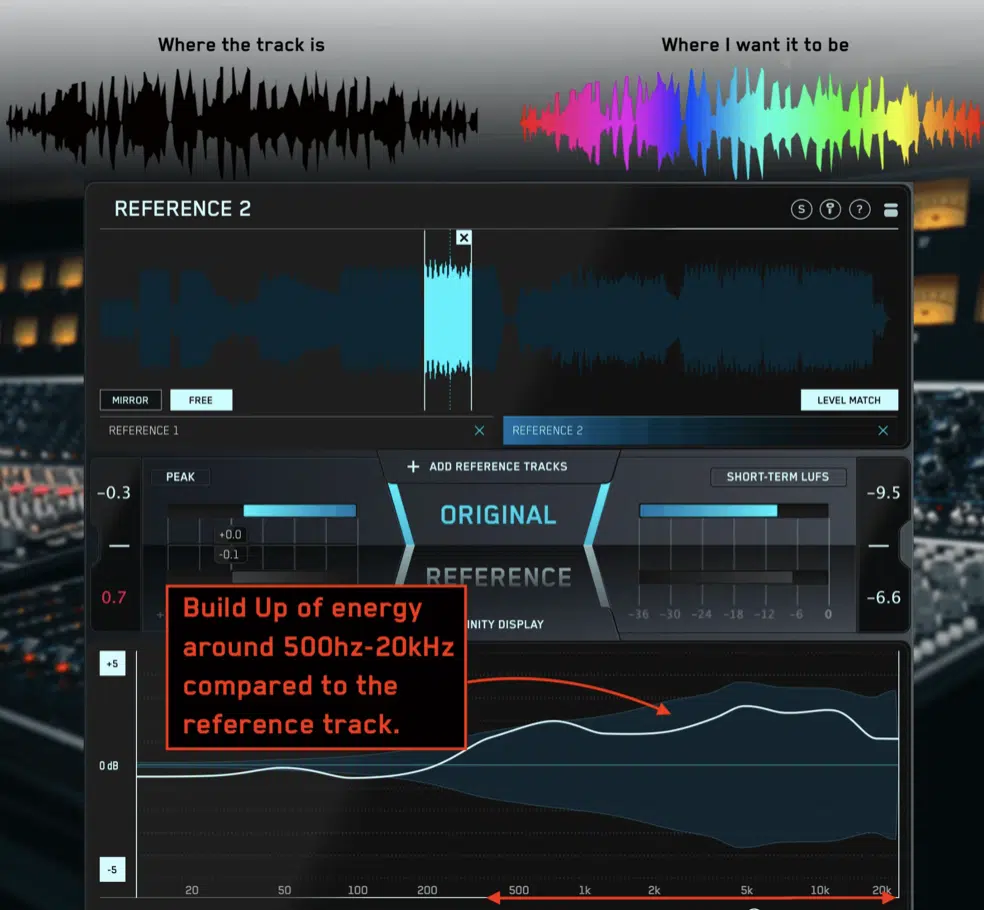
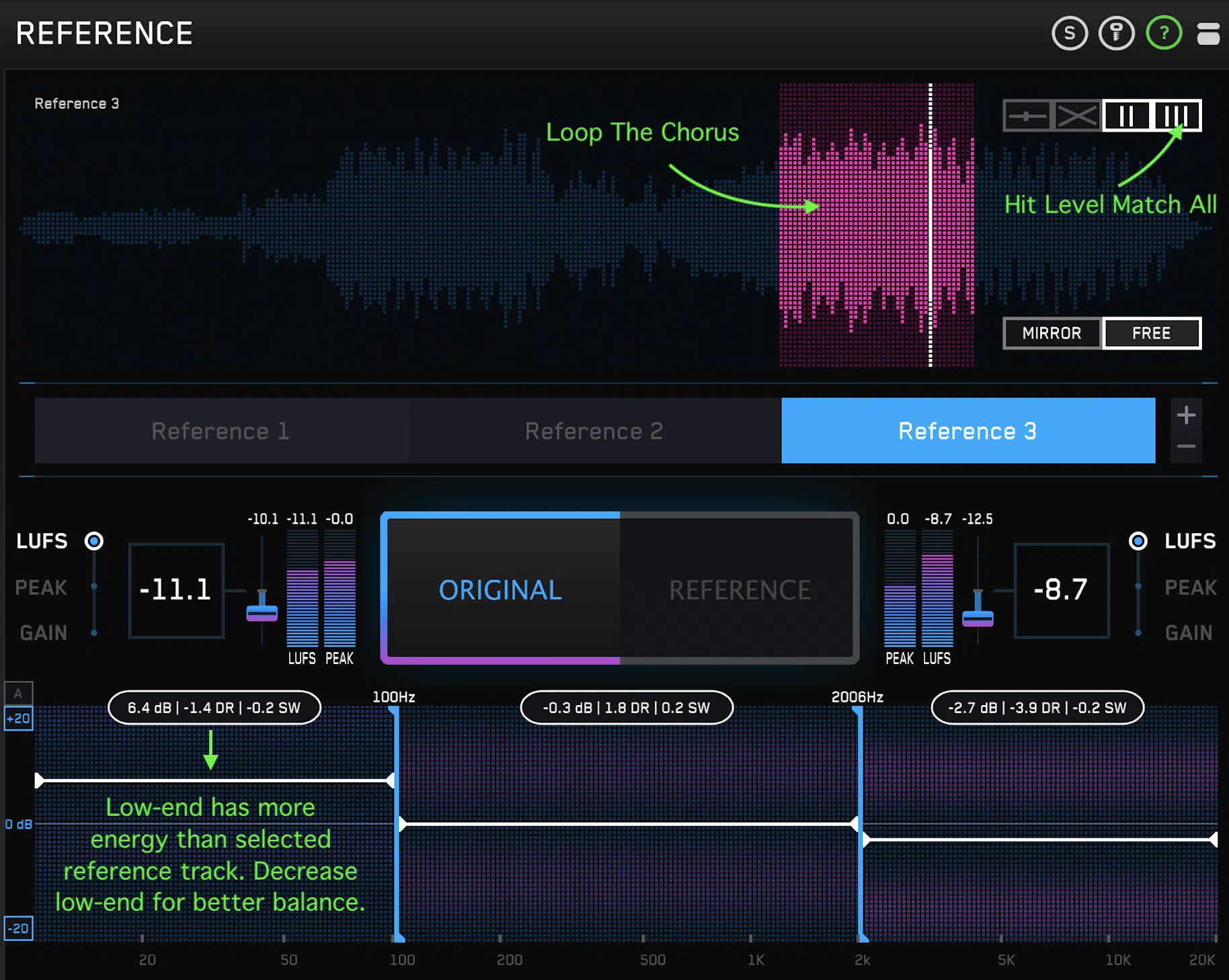
The images below show examples of such referencing tools. They are used to compare a work-in-progress track to a professional reference, highlighting differences in spectral balance and dynamics. This is the process we'll be simulating today.
Deconstructing the Lead: Timbral Qualities
Let's begin our analysis by focusing on timbre—the static spectral character or "tone color" of the lead sound. This is what makes a lead sound bright, gritty, wide, or metallic.
Imagine we've loaded a Grafix track into our DAW and have looped a section where the lead melody is prominent.
1. Critical Listening:
First, we listen. A typical Dancefloor lead will sound:
- Bright and Saturated: It has a rich, full sound that feels harmonically dense.
- Wide: It fills the stereo field, feeling much larger than a single point in the mix.
- Aggressive or Gritty: There's a certain "fizz" or "edge" to it that helps it slice through the other elements.
2. Spectral Analysis:
Now, we look at a spectrum analyzer. We would observe:
- No Sub-Bass: The signal would be cleanly cut off below ~150-200 Hz.
- Fundamental in the Low-Mids: The root note of the melody would create peaks somewhere between 200 Hz and 800 Hz.
- Dominant Body in the Mids: A large amount of energy would be concentrated from 800 Hz to 5 kHz. This is the core identity of the sound.
- Controlled Highs: We'd see energy extending up to 10-15 kHz, but it wouldn't be overpowering the hi-hats. This is the "air" and "sizzle."
These observations give us a sonic target. The video below provides an excellent practical demonstration of building a lead sound with exactly these timbral qualities. The creator is essentially performing this analysis in reverse—starting with a goal and making choices to achieve it.
How To make DANCEFLOOR LEADS like NETSKY, SMOOTH | SERUM TUTORIAL
Watch this tutorial from DNB Academy on making a Dancefloor lead. Focus not on copying the settings, but on the reason for each step and how it contributes to the final timbre.
Notice how grit is introduced by modulating the oscillator's fine tuning with a very fast LFO. This isn't for vibrato; it's to create a buzzy, aggressive texture. See how a second oscillator and unison are used to add richness and body. This directly addresses the need for a dense, wide sound. Pay close attention to the use of EQ as a sound design tool. The producer explicitly states that boosting around 5 kHz makes the lead "really aggressive" and helps it "cut through the mix." This is a perfect example of intentional timbral shaping.
From this, we can distill a recipe for the timbre of a powerful Dancefloor lead:
- Source: Harmonically rich waveforms (saws, squares).
- Density: High unison counts with moderate detuning for width and body.
- Texture: Added grit via fast LFO pitch modulation, noise, or distortion.
- Focus: A prominent mid-range, often with a specific EQ boost in the upper-mids (2-5 kHz) to enhance aggression and clarity.
Deconstructing the Lead: Dynamic Qualities
Next, we analyze the lead's dynamics—how its volume and character change over time. In a fast-paced DnB track, a lead's dynamic shape is just as crucial as its timbre for cutting through.
1. Critical Listening:
Returning to our reference track, we listen to the lead's rhythm and articulation.
- Attack: Does the note start instantly (a "stab" or "pluck"), or does it swell in? Most Dancefloor leads have a fast, defined attack to punch through drum transients.
- Sustain & Release: Do the notes sustain as long as the key is held, or do they decay quickly? In DnB, short, controlled notes are common to prevent melodic phrases from smearing into each other and creating mud.
- Movement: Is there any internal movement? This could be a filter opening and closing, a rhythmic pulse, or a slide between notes.
2. Visual Analysis (Waveform/Oscilloscope):
If we looked at the lead's waveform, we'd likely see sharp, defined transients at the start of each note, followed by a quick decay in volume.
The video you just watched also provides clues about crafting these dynamics.
How To make DANCEFLOOR LEADS like NETSKY, SMOOTH | SERUM TUTORIAL
Let's revisit the DNB Academy video to examine the dynamic and performance aspects.
At the very beginning, the producer enables mono, legato, and portamento. This is a dynamic performance choice. Legato ensures a smooth connection between overlapping notes, and portamento (glide) creates the energetic slides common in this style. Later in the effects chain, multiband compression (OTT) and reverb are added. The compressor manages the sound's dynamic range, ensuring it stays consistently present. The reverb, while adding space, is likely kept short to avoid washing out the sound. Finally, listen to the A/B comparison between the reference and the recreation. Try to hear the similarities in both the timbre (brightness, width) and the dynamics (the plucky, sliding articulation).
This analysis gives us our dynamic recipe:
- Envelope: A fast attack to cut through, a low-to-medium sustain level, and a relatively short decay and release to maintain clarity at high tempos. This is typically defined by an amplitude envelope (ADSR).
- Performance: The use of legato and portamento (glide) is essential for the fluid, energetic feel of many Dancefloor melodies.
- Control: Multiband compression is often used to clamp down on the dynamics, keeping the lead consistently "in your face."
Key Takeaways
- Analyzing a reference track involves deconstructing its timbral (spectral) and dynamic (temporal) qualities.
- Timbral analysis reveals the lead's harmonic content, width, and texture. A typical Dancefloor lead is bright, wide, and has upper-mid frequency aggression to cut through the mix.
- Dynamic analysis reveals the lead's shape over time. A fast attack and short decay are crucial for clarity in a dense, high-tempo DnB track.
- This process of listening and visualizing provides a concrete sonic goal, turning sound design from guesswork into an intentional engineering process.
In the next lesson, we will expand on the concept of dynamics. We will explore precisely how the high tempo and rhythmic density of DnB constrain our choices for a lead's envelope, particularly its decay and release times, and why getting this right is critical to a clean and powerful mix.