Recommended resources
The freely available resources this lesson will direct you to.
Hello and welcome to your course on DnB lead sound design. We're going to start not by twisting knobs in Serum, but by establishing the foundational context for any great lead sound: its place in the mix. Your goal is to understand the "why" behind sound design choices, and this lesson is the first and most critical "why"—why a lead must occupy a specific sonic space to be effective.
Today, we'll address the typical frequency range and spectral characteristics that allow a lead to cut through the dense, high-energy environment of a Drum and Bass track. We will explore how to think about sound in terms of frequency, harmonics, and density, so you can make intentional decisions from the very first oscillator you choose.
The Sonic Space of a DnB Mix
A Drum and Bass track is a crowded sonic environment. At speeds of 170-175 BPM, you have powerful sub-bass, complex and transient-heavy drums, and often atmospheric pads or other layers all competing for attention. For a lead melody to be clear and impactful, it cannot simply be "louder." It needs its own space in the frequency spectrum. This practice is often called frequency slotting.
To visualize this, let's look at the entire range of human hearing.
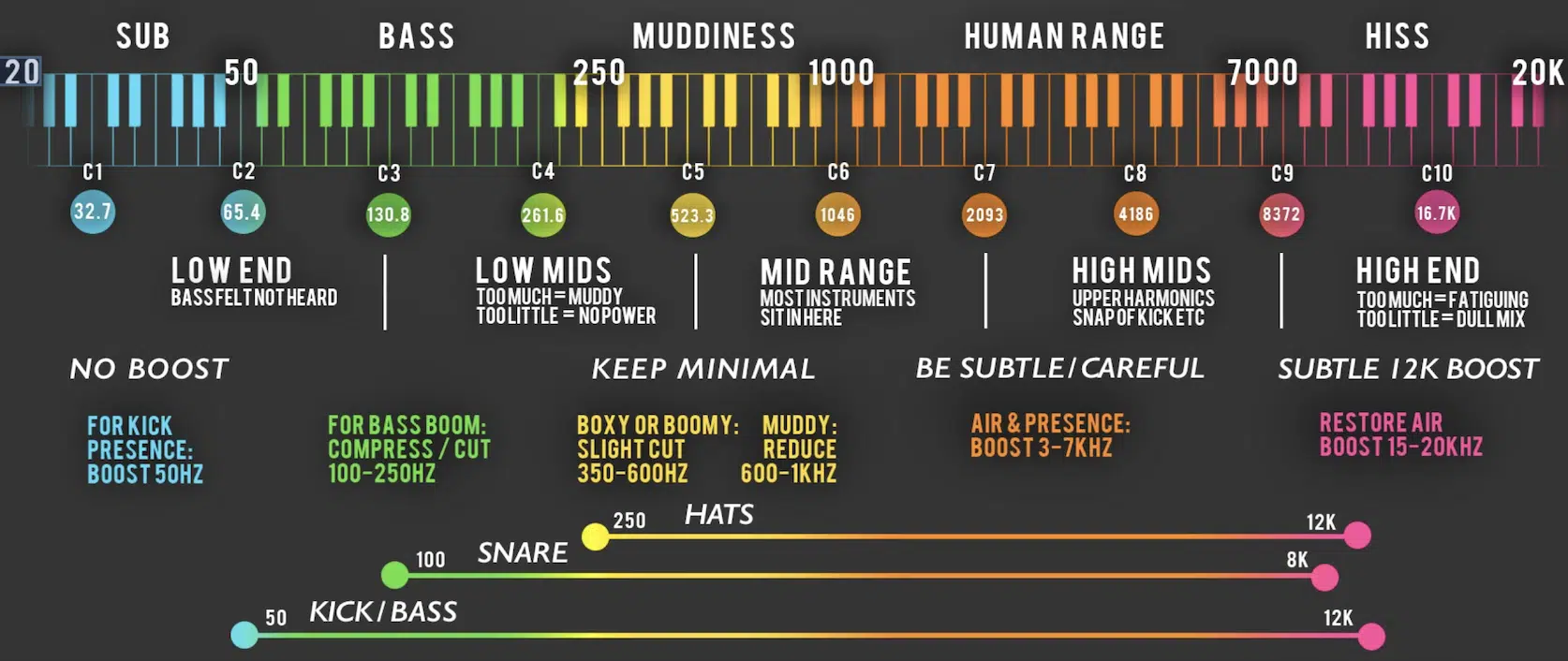
Here’s how a typical DnB mix carves up this space:
- Sub-Bass (20-60 Hz): This is sacred ground, reserved almost exclusively for the fundamental frequency of the sub-bass. A lead sound should have virtually no energy here. A high-pass filter is the tool for this job, and its use is non-negotiable.
- Bass (60-250 Hz): This region contains the "punch" of the kick drum and the harmonically richer "mid-bass" layers that sit on top of the sub. While a lead's fundamental note might fall here, an excess of energy will create "muddiness" and conflict directly with the bassline, robbing the track of its power and clarity.
- Mid-Range (250 Hz - 5 kHz): This is the lead's home. This broad area is where our ears are most sensitive and where the core identity—the timbre, melody, and character—of most instruments is defined. A lead that is strong in this range will feel present and intelligible.
- High Frequencies (5 kHz+): This is the domain of hi-hats, cymbals, and the "air" or "sizzle" of the mix. A lead needs some high-frequency content to sound bright and exciting, but too much will sound harsh and clash with the percussive elements, leading to a cluttered and fatiguing top end.
The "Human Information" Range
The concept of the mid-range being the most critical area for melodic content is a core principle of mixing. Fox Stevenson, an artist you're interested in, has a great tip that illustrates this perfectly.
Watch this short clip where he discusses the power of focusing exclusively on the mid-range to make better mixing decisions.
TUTORIAL - Fox Stevenson's Top 5 Production Tips
In this clip from a tutorial by Fox Stevenson, pay attention to his rationale for temporarily filtering out the extreme low and high frequencies of his entire track.
Watch his explanation of working in "band pass" mode. He calls the range from 200 Hz to 5 kHz the home of "human information." This is precisely the space where your lead sound needs to dominate and be well-defined.
This exercise highlights that the core musicality of a track lives in the mids. When you design a lead, you are fundamentally sculpting energy in this range to create something memorable.
What Defines a Lead's Spectral Character?
Beyond just its frequency location, a lead's effectiveness comes from its spectral characteristics. This refers to the texture and complexity of its sound, which we can break down into a few key components:
- Harmonic Content: The foundation of timbre. A simple sine wave is a single frequency (the fundamental). A saw wave, the classic starting point for many leads, is rich in both even and odd harmonics, making it sound bright and full right away.
- Density and Width: A single oscillator can sound thin. By using unison—stacking multiple copies (voices) of the oscillator and slightly detuning them—we create a dense, rich sound. The slight pitch variations between voices cause phase cancellations and reinforcements that thicken the sound and, when panned, create a wide stereo image. This is the essence of the "supersaw" sound.
- Texture and Aggression: Clean waveforms can sound sterile. We add character using tools that introduce new harmonic and inharmonic content, such as:
- FM (Frequency Modulation): Adds metallic or complex textures.
- Distortion/Saturation: Adds new harmonics, making the sound "grittier" or "warmer."
- Noise: A layer of white or colored noise can add "fuzz" and high-frequency energy.
Let's watch a practical example of a producer building the spectral characteristics of a Dancefloor DnB lead. You don't need to absorb every single step; instead, focus on how each choice adds a new layer to the sound's frequency profile.
How Andromedik made that HUGE lead in "First to go" - Serum Tutorial
This video from How to DNB deconstructs a lead sound in the style of Andromedik. We'll look at a few key moments where the core spectral character is shaped.
First, watch the section on building the foundation. Notice how saw waves are immediately combined with high unison counts and panning to create a wide, dense starting point. Next, see how FM from the sub oscillator is used. The goal isn't to create a wobbly bass, but to add a "dirty" texture to the main saw waves. Finally, observe the post-processing stage, particularly the EQ boost around 1kHz. The producer explicitly mentions this is done because it's a key part of the vocal range, making the lead sound "richer" and more present.
This demonstrates an intentional process: starting with a harmonically rich source (saws), thickening it with unison, adding textural complexity with FM, and finally using EQ to emphasize the most important frequency range for a lead.
Managing the Boundaries
Just as important as occupying the mid-range is staying out of other areas. We've discussed high-passing the sub-bass region. The high end requires similar discipline.
Let's return to Fox Stevenson for his philosophy on managing the high frequencies.
TUTORIAL - Fox Stevenson's Top 5 Production Tips
In this first tip from the same video, Fox Stevenson explains his approach to high-frequency management.
Watch his tip to "hi cut stuff." His strategy is to start by removing the top end from almost everything and only adding it back where it's truly necessary. For a lead, this means ensuring its brightness serves the sound without creating a "mess" that competes with the hi-hats and cymbals.
This "subtractive" approach is a powerful mindset. By default, keep your lead's high-end controlled. A low-pass filter can be used to gently roll off the highest frequencies, ensuring the lead has brightness but doesn't add unnecessary harshness or clutter.
To tie these concepts together, please read the following short text, which summarizes the essential building blocks of classic lead sounds.
This text from Polarity Music provides a concise overview of how classic synth sounds are constructed, reinforcing the concepts we've discussed.
Please read the sections titled "Unison Leads and EDM Plucks" and "Rave Bandpass Leads." These describe the use of unison, detuning, and filters. Then, review the "Key Takeaways" at the end. It serves as an excellent summary of how oscillators, unison, and effects work together to shape the spectral character of a sound.
Key Takeaways
- A DnB lead must be carefully placed in the frequency spectrum to be effective. Its primary energy should be in the mid-range (approx. 250 Hz - 5 kHz).
- It is critical to use a high-pass filter to remove sub-bass frequencies and avoid conflict with the kick and bassline.
- The high frequencies should be controlled to ensure the lead is bright but doesn't clash with percussion or sound overly harsh.
- The spectral character of a lead is built from its harmonic content (oscillator choice), density (unison and detuning), and texture (FM, distortion, noise).
In our next lesson, we will apply this knowledge by analyzing a reference track from Grafix. We'll use a spectrum analyzer to see exactly where the lead sits in the mix and identify the timbral qualities that make it work so well.