Recommended resources
The freely available resources this lesson will direct you to.
Welcome back! In our previous lesson, we deconstructed a dancefloor DnB lead, analyzing its timbral and dynamic qualities to understand what makes it effective. We saw that successful leads are typically bright, wide, and possess a fast attack with a controlled decay.
Today, we'll explore the "why" behind those dynamic choices. This lesson focuses on how the core characteristics of Drum and Bass—its high tempo and dense rhythmic structure—create specific constraints on your sound design. Understanding these limitations is the key to moving from copying presets to designing sounds with intention, a core part of your goal. By the end of this session, you'll be able to explain precisely why choices about a lead's decay time and complexity are so critical for a powerful and clean DnB mix.
The Tyranny of the Clock: Time in a DnB Track
Drum and Bass is fast, typically hovering around 170-175 BPM. At this speed, the duration of musical notes becomes incredibly short. Let's look at the numbers for a typical tempo of 174 BPM:
- Whole Note: ~1.38 seconds
- Half Note: ~690 milliseconds (ms)
- Quarter Note: ~345 ms
- Eighth Note: ~172 ms
- Sixteenth Note: ~86 ms
These aren't just abstract numbers; they represent the tiny, finite time slots your lead sound has to live and breathe before the next sound—be it another melodic note or a powerful drum hit—demands the listener's attention. Every sound design decision must be made within this unforgiving temporal framework.
Constraint 1: Decay & Release — Avoiding Melodic "Smear"
In the last lesson, we noted that effective leads often have a short decay and release. The reason for this is to avoid what's known as temporal masking or "smear." When the tail of one note bleeds into the beginning of the next, the individual notes of a melody lose their definition, and the entire phrase can turn into an incoherent wash of sound.
The punch and impact of a sound are carried by its initial, high-energy transient. If the tail of a previous note overlaps this transient, the impact is softened, and the mix loses clarity.
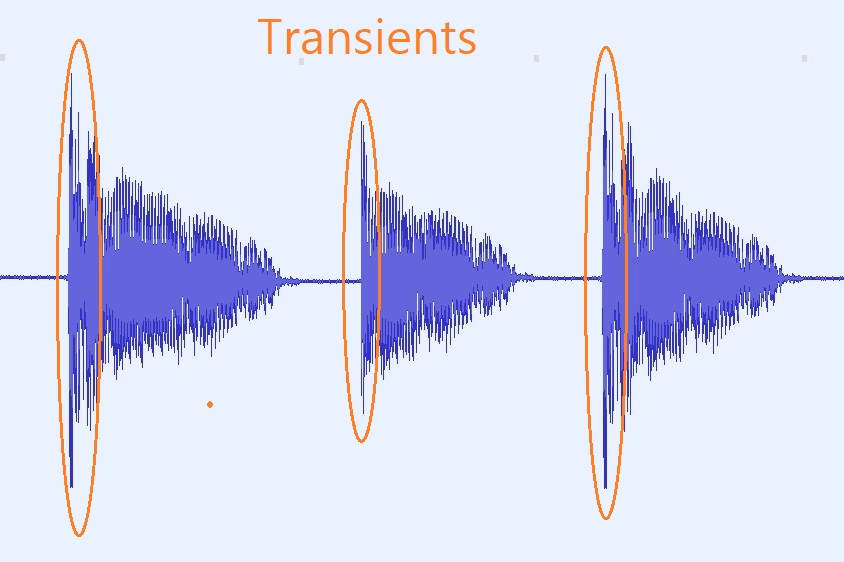
The following video provides a perfect practical demonstration of this principle in action.
2 DANCE LEADS LEADS LIKE SUB FOCUS, DIMENSION, DARUDE! | Serum Drum and Bass Tutorial
The producer, STRANJAH, creates two different lead stabs and explicitly points out the short note lengths required in a DnB context.
First, watch how he programs the melody for the sawtooth lead. He states that the key is to use eighth-note lengths. Next, for the more aggressive square wave stab, he demonstrates an even faster melody using sixteenth notes.
As you saw, the rhythmic patterns are built from these very short notes. Now, let's consider the envelope settings.
2 DANCE LEADS LEADS LIKE SUB FOCUS, DIMENSION, DARUDE! | Serum Drum and Bass Tutorial
Revisit the first part of the STRANJAH video where he sets the amplitude envelope.
Focus on the section where he adjusts the release time. It begins around the 2:05 mark, where he says "you may want to add some release to the amplitude envelope."
STRANJAH suggests a release time of around 200-400 ms. How does this fit with our note durations?
- A 400ms release is longer than a quarter note (~345 ms) and much longer than an 8th or 16th note.
- This means if you were playing a rapid-fire 16th-note melody, a 400ms release would be far too long, causing significant smear.
- However, for a sparser melody with quarter notes or longer gaps, this release time could add a nice sense of space without causing issues.
This highlights a crucial point: the appropriate decay/release time is directly related to the rhythmic density of the part you are writing. A core skill in intentional sound design is tailoring your envelope to the specific melodic phrase. When in doubt, start short and increase the release time until you just begin to notice a smooth connection between notes, without losing the punch of the next transient.
Constraint 2: Complexity — Managing Timbral Evolution
It's not just the volume envelope that's constrained by time; the evolution of the sound's timbre is as well. A complex patch with multiple LFOs creating slow, evolving filter sweeps or wavetable movements might sound incredible in isolation. However, in a fast DnB melody where notes last less than 200ms, that slow evolution will never be heard. The complexity is wasted and can even contribute to a messy, unfocused sound.
There are two main strategies to create leads that are texturally interesting but fit within DnB's temporal constraints.
Strategy A: Front-load the Complexity
Instead of a sound that evolves over time, create a sound that is harmonically rich and texturally interesting from the very first millisecond. Its complexity is static. This is achieved through techniques you'll explore later in this course, like:
- Stacking harmonically rich oscillators.
- Using FM synthesis to add metallic or aggressive overtones.
- Applying distortion to generate new harmonics.
The stab sounds from the STRANJAH video are excellent examples of this approach. They are punchy, rich, and full of character, but they don't change much over their short duration.
Strategy B: Tame Complexity with Resampling
A more advanced workflow, famously used by artists like Emperor and Noisia, is to embrace complexity but control it through resampling.
The process is:
- Create a highly complex, long, evolving sound in a synthesizer. This is often done in a separate "sound design" session, free from the constraints of a full track.
- Record a long piece of audio of yourself modulating the synth's parameters.
- Listen back to the recording and cut out the most interesting short moments—the "happy accidents."
These short audio clips, or resamples, contain all the timbral complexity of the original patch but are now locked into a manageable, short duration that can be easily sequenced in a dense track.
Masterclass | Emperor - Sound Design Process
In this masterclass, the producer Emperor explains his workflow, which is heavily based on this resampling technique.
Watch from this section where he describes recording long passages of synth modulation and then cutting out small, usable chunks. He notes, "it kind of limits you but it's a good thing for me anyway I find."
This workflow allows you to get the best of both worlds: incredibly detailed and unique textures, delivered with the punch and precision required for DnB.
Constraint 3: The Rhythmic Framework — Making Space for Drums
Finally, the sheer rhythmic density of DnB, dominated by the kick and snare, imposes another constraint. For the drums to maintain their impact, other elements must dynamically get out of their way.
This is most commonly enforced during the mixing stage using sidechain compression, where the volume of the lead is automatically lowered for a fraction of a second every time the kick or snare hits.
Masterclass | Emperor - Sound Design Process
Emperor briefly explains the importance of this technique.
Pay attention to his statement around "in drum and bass specifically pretty much everything should be sidechain because you're just making sure that the kick and snare is just really clean coming through every time."
While sidechaining is a mixing tool, it's essential to consider it during sound design. If you design a lead with a very aggressive, punchy transient that occurs at the same time as a snare, they will fight for attention and likely result in a harsh, unpleasant sound, even with sidechaining. A well-designed lead either has its notes placed in the gaps between drum hits or has a slightly softer attack that allows the drum transient to cut through more easily before the body of the lead sound is heard.
Conclusion
You now have a framework for understanding why DnB leads are designed the way they are. The genre's fundamental properties dictate the rules of the game.
Key Takeaways:
- Time is the primary constraint: At ~174 BPM, you have very small time windows (86-172ms) for individual melodic notes.
- Control your tails: A lead's decay and release times must be short enough to prevent notes from smearing into one another, preserving melodic clarity and rhythmic punch. The right length is context-dependent on the rhythm of the melody.
- Manage complexity: Either design sounds that are instantly gratifying and harmonically rich ("front-loaded complexity") or use resampling to capture short, interesting moments from a more complex, evolving patch.
- Respect the drums: The relentless kick and snare pattern in DnB requires that lead sounds make space, a principle often enforced by sidechain compression that you should be mindful of during sound design.
In our next lesson, we will begin the practical process of sound design, starting with the heart of any synth patch. Now that you know the "box" you need to fit your sound into, you'll learn how to select and manipulate wavetables in Serum to create the core timbre that will serve as the foundation for your lead.