Recommended resources
The freely available resources this lesson will direct you to.
Introduction
Welcome to the first lesson of our module on Market Failures and Government Intervention. In the previous module, we concluded by comparing the efficiency of different market structures. We established that only perfect competition achieves both productive and allocative efficiency, serving as an ideal benchmark. We saw that market power, as held by monopolies and other imperfectly competitive firms, is a primary source of market failure, leading to inefficient outcomes where price exceeds marginal cost.
Today, we will explore another fundamental cause of market failure: externalities. These are the hidden costs and benefits that spill over from economic activities and affect people who aren't directly involved in the transaction. By the end of this lesson, you will be able to define what externalities are and identify positive and negative externalities using real-world examples. Understanding externalities is crucial because they are pervasive in modern economies—from the pollution emitted by factories to the societal benefits of education—and often justify government intervention.
Defining Externalities: The Spillover Effect
At its core, a market transaction involves a buyer and a seller who agree on a price. The supply and demand model we've studied assumes that all the costs and benefits of this transaction are contained between these two parties. However, what happens when the production or consumption of a good affects a third party? This "spillover" effect is called an externality.
To build a solid foundation for this topic, let's start with a formal definition and introduce some key terminology.
5.1 Externalities – Principles of Microeconomics
The following resource, '5.1 Externalities' from the 'Principles of Microeconomics' textbook, provides a clear introduction to this concept. It distinguishes between the private costs/benefits that market participants see and the broader social costs/benefits that include these spillovers.
Please read the first two main sections: 'Externalities' and 'Enriching Our Model'. Focus on understanding the definition of an externality as a spillover and the distinction between private costs/benefits and social costs/benefits.
The reading introduces two critical sets of terms:
- Private Cost/Benefit: The costs and benefits experienced directly by the buyers and sellers in a transaction. The demand curve represents the marginal private benefit (MPB), and the supply curve represents the marginal private cost (MPC).
- Social Cost/Benefit: The total costs and benefits to society as a whole. This includes the private costs/benefits plus any costs or benefits experienced by third parties.
- Marginal Social Cost (MSC) = Marginal Private Cost (MPC) + Marginal External Cost (MEC)
- Marginal Social Benefit (MSB) = Marginal Private Benefit (MPB) + Marginal External Benefit (MEB)
An externality exists whenever there is a difference between the private and social costs or benefits. This discrepancy causes the free market to produce an inefficient quantity of the good, leading to market failure.
Negative Externalities: Unseen Costs
A negative externality occurs when the production or consumption of a good imposes a cost on a third party. In this case, the Marginal Social Cost (MSC) is greater than the Marginal Private Cost (MPC).
Let's watch a short video to see this in action.
Externalities in Economics | Think Econ | Externalities Explained
This video from Think Econ offers a concise explanation of externalities, starting with a core definition and then providing a clear example of a negative externality.
Watch from the beginning until 01:06. Pay close attention to the definition of an externality and the example of factory pollution.
As the video explains, pollution is the classic example of a negative externality. A factory producing steel incurs private costs for labor, materials, and energy (its MPC). However, if its production process releases pollutants into a river, it imposes a cost on the surrounding community (e.g., contaminated drinking water, harm to fisheries). This external cost is not reflected in the market price of steel.
Since you have an IT background, consider the e-waste generated from discarded electronics. The private cost is just the price you paid for the device. The social cost includes the environmental damage from improper disposal of heavy metals and plastics, a cost borne by society at large.
Here are more common examples of negative externalities:
- Noise pollution: Your neighbor's loud party keeps you awake. The neighbor enjoys the party (private benefit), but you bear a cost (lack of sleep).
- Second-hand smoke: A smoker's habit imposes health risks on nearby non-smokers.
- Traffic congestion: When one more person decides to drive during rush hour, they slightly increase travel time for everyone else on the road.
Externalities can arise from either production or consumption.
- Negative Production Externality: A factory polluting a river. The externality is a by-product of the production process.
- Negative Consumption Externality: A person playing loud music in a public park. The externality is a by-product of the consumption (or use) of the good.
Positive Externalities: Unseen Benefits
A positive externality is the flip side: it occurs when the production or consumption of a good confers a benefit on a third party. Here, the Marginal Social Benefit (MSB) is greater than the Marginal Private Benefit (MPB).
Let's continue with the same video to see an example.
Externalities in Economics | Think Econ | Externalities Explained
Now let's look at the section on positive externalities from the same video.
Watch from 01:06 to 01:25 and then from 03:04 to 03:36. These clips discuss the examples of home improvements and higher education.
The video provides two excellent examples:
- Home Renovations: When your neighbor landscapes their garden, they enjoy the private benefit of a beautiful yard. However, you and the rest of the neighborhood also receive a benefit: a more attractive street and potentially higher property values.
- Higher Education: You pursue a degree to gain skills and increase your future earnings (private benefit). However, society also benefits. A more educated population can lead to greater innovation, lower crime rates, and more informed civic participation (external benefits).
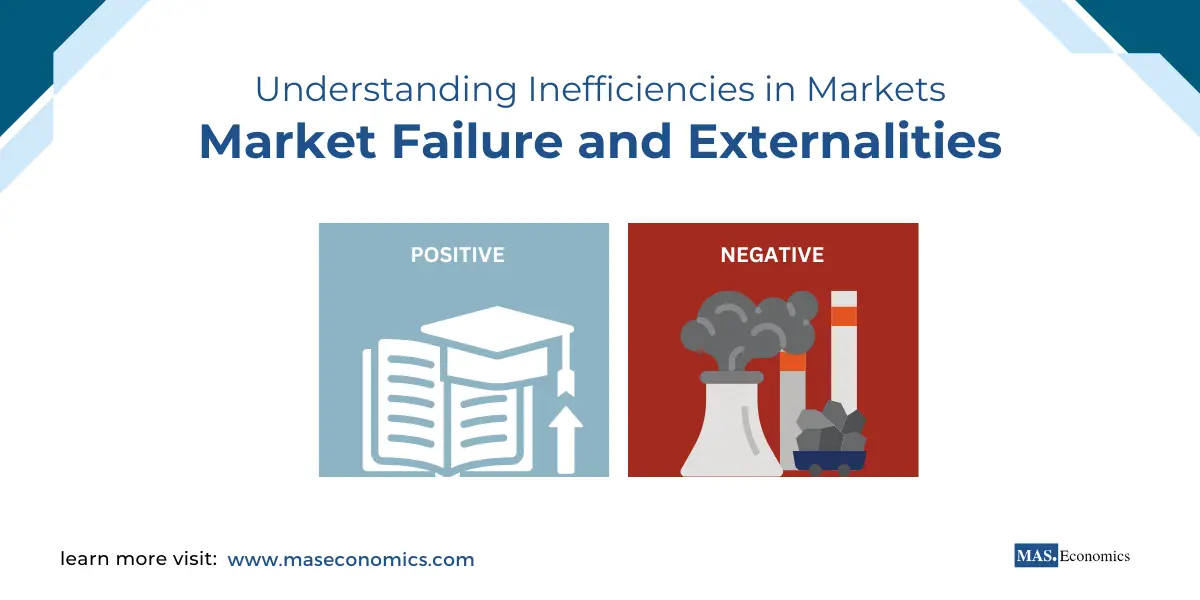
The image below provides a simple visual summary of these two types of externalities.
Here are some other powerful examples of positive externalities:
- Vaccinations: When you get a flu shot, you get the private benefit of not getting sick. You also create an external benefit for others by reducing the risk of them getting infected. This is a key reason why vaccinations are often subsidized or mandated.
- Research & Development (R&D): A tech company that invents a new algorithm may patent its specific application, but the underlying knowledge it generates can inspire other innovations across the industry.
- Restored Historic Buildings: The owner of a beautifully restored historic building enjoys living or working in it, while passersby and the city as a whole benefit from its beauty and cultural value.
Check Your Understanding
To make sure these concepts are clear, consider the following scenarios. Is there an externality? If so, is it positive or negative?
- A beekeeper keeps bees for their honey. The bees also pollinate the surrounding orchards of neighboring farms, increasing their fruit yield.
- A student in a crowded library decides to take a phone call, forcing others to listen to their conversation.
- You purchase a new laptop from an online retailer. The laptop is delivered to your home.
Click to reveal the answers
- Positive Externality. The beekeeper's private transaction is selling honey. The pollination of neighboring orchards is an external benefit that the orchard owners receive for free.
- Negative Externality. The student's phone call imposes a cost (distraction, noise) on the other library patrons, who are third parties to the conversation.
- No Externality. This is a standard market transaction. Assuming the delivery is quiet and the laptop's production and disposal have no un-accounted-for effects in this simplified scenario, all costs and benefits are contained between you (the buyer) and the retailer (the seller).
Conclusion
In this lesson, we introduced the concept of externalities as a key source of market failure. We established that these spillovers occur when a market transaction imposes costs or confers benefits on third parties who are not directly involved.
Key Takeaways:
- An externality is the uncompensated impact of one person's actions on the well-being of a bystander. It represents a failure of the market to account for all social costs and benefits.
- A negative externality exists when the social cost of an activity exceeds the private cost (e.g., pollution, noise). Markets tend to overproduce goods with negative externalities.
- A positive externality exists when the social benefit of an activity exceeds the private benefit (e.g., vaccinations, education). Markets tend to underproduce goods with positive externalities.
So far, we have focused on defining and identifying these effects. The crucial next step is to analyze their impact on market outcomes. In our next lesson, we will use supply and demand diagrams to visualize exactly how externalities lead to inefficiency and create a deadweight loss for society. We will also begin to explore the policy solutions, like taxes and subsidies, that governments can use to correct these market failures.