Recommended resources
The freely available resources this lesson will direct you to.
Welcome to the second module of our course, "Mastering High-Cardinality & Categorical Data." In the previous module, we established the high-level principles of feature engineering, culminating in a look at how these principles are tested in ML system design interviews. A key takeaway was the critical importance of building robust, reliable data pipelines that avoid subtle bugs like training-serving skew and data leakage.
Today, we begin our first deep dive into a specific, challenging, and common feature engineering problem: handling categorical features with many unique values. This lesson directly addresses the learning outcome: Implement and contrast target encoding strategies (including leave-one-out and cross-validation) to prevent data leakage.
We will explore target encoding, a powerful technique that creates highly predictive features from categorical data. However, as you'll see, its power comes with a significant risk of data leakage. We'll dissect this problem and then systematically implement and compare the standard industry solutions—cross-validation and leave-one-out encoding—to build robust and effective features.
The Power and Peril of Target Encoding
When faced with a categorical feature like city or product_brand, a common approach is one-hot encoding. However, if the feature has thousands of unique values (high cardinality), this creates thousands of new columns, often leading to performance issues due to the curse of dimensionality.
Target encoding offers an elegant solution. It replaces each category with a single number: the average of the target variable for all data points belonging to that category.
Let's watch a short video from StatQuest to build a solid intuition for this.
One-Hot, Label, Target and K-Fold Target Encoding, Clearly Explained!!!
This segment from "One-Hot, Label, Target and K-Fold Target Encoding, Clearly Explained!!!" introduces the fundamental idea of target encoding.
Please watch from the main idea. Notice how the categorical color feature is replaced not by an arbitrary number, but by a value directly related to the prediction target, loves Troll 2.
As you can see, this method creates a single, powerful feature that directly captures the relationship between the category and the target. This is especially useful for tree-based models and is a go-to technique for high-cardinality data.
However, the simple method shown in the video has a critical flaw.
Unmasking Data Leakage
The problem with the naive approach is that to calculate the encoding for a given row, we use its own target value. The model is, in effect, getting a peek at the answer during training. This is a classic example of data leakage. It leads to overly optimistic performance on the training set and a disappointing drop in performance on unseen test data.
This concept is so fundamental that it's a frequent topic in data science interviews. Let's briefly watch the next segment of the same video, which explains this problem.
One-Hot, Label, Target and K-Fold Target Encoding, Clearly Explained!!!
This part of the video clearly defines why the simple approach leads to data leakage and overfitting.
Watch the section from explaining data leakage. This connects directly to the system design principles of building robust pipelines we discussed in the last lesson.
To solidify this concept, let's turn to a well-written article that breaks down the issue.
Categorical Encoding: One-Hot vs Label vs Target
This article provides a practical guide to various encoding methods. We'll focus on its explanation of target encoding and the associated leakage problem.
First, read the section on basic target encoding to see a concrete example. Then, jump to the "Frequently Asked Interview Questions" and read the question and answer for "How does target encoding cause data leakage...".
Interview & Business Context Alert
The question you just read is a staple of ML interviews. A strong answer must not only define the problem (using a row's own target to encode its features) but also propose the solution (using out-of-fold statistics), which we will cover next. Demonstrating this understanding shows you can build models that generalize, rather than just memorize the training data.
Mitigating Leakage: Regularization and Structural Fixes
There are two main families of solutions to the target leakage problem. The first is a "soft" fix called smoothing, and the second involves more "structural" changes to how the encoding is calculated.
1. Smoothing (Regularization)
Imagine a category that appears only once in your dataset. Its target encoding will be exactly equal to its own target value—a perfect leak! For categories with few samples, the calculated mean is noisy and unreliable.
Smoothing, also known as regularization, addresses this by blending the category's local mean with the global mean of the entire target variable.
Here, is the mean for the category, is the overall mean, and is a weighting factor that depends on the number of samples in the category. If is large, approaches 1, and we trust the category's mean. If is small, approaches 0, and we fall back towards the more robust global mean.
This is a form of Bayesian reasoning, where the global mean acts as a "prior" belief that we update with category-specific data. The StatQuest video has an excellent segment that describes this as a "weighted mean".
One-Hot, Label, Target and K-Fold Target Encoding, Clearly Explained!!!
This segment explains the intuition behind using a weighted average to make the encoding more robust for rare categories.
Watch from weighted mean. Notice the connection drawn to Bayesian methods, where you combine a prior belief with observed data.
For a more formal definition and implementation details, let's refer back to our article.
Categorical Encoding: One-Hot vs Label vs Target
This section provides the mathematical formulation for smoothing and shows how to implement it.
Read the part on Smoothing to understand the formula. Then, look at the section Proper implementation to see how straightforward it is using the category_encoders library. Note that smoothing is a crucial hyperparameter (smoothing in TargetEncoder) to tune.
While smoothing helps, it doesn't fully solve the leakage problem. For that, we need to ensure a row's target is never used in its own encoding calculation.
2. K-Fold Target Encoding
This is the industry-standard structural fix. The idea is to mimic cross-validation during the feature engineering step. Here's how it works:
- Split the training data into K folds (e.g., K=5).
- For each fold
k, calculate the target means for every category using data from the other K-1 folds only. - Use these "out-of-fold" means to encode the data in fold
k. - Once all folds are encoded, the K encoded sets are concatenated back together.
- To encode the test set, the target means calculated from the entire training set are used.
This process guarantees that a data point's target value is never seen during the creation of its own features.

This image illustrates the K-fold target encoding process. For each fold (highlighted in blue), the target means for its categories are calculated using data from all other folds, thus preventing the model from seeing the target values of the data it is currently encoding.
Let's see this in action. The StatQuest video provides a clear, step-by-step walkthrough.
One-Hot, Label, Target and K-Fold Target Encoding, Clearly Explained!!!
This segment walks through a 2-fold target encoding example, making the process very concrete.
Watch from k-fold encoding. Follow the calculations for the 'blue' category across the two subsets to see how leakage is prevented.
For a deeper dive into the implementation, the article "Representing Categorical Data with Target Encoding" provides a full Python class that performs cross-fold target encoding.
Representing Categorical Data with Target Encoding
This article provides excellent from-scratch implementations of these encoders, which is great for understanding the mechanics.
Read the section on Cross-Fold Target Encoding. Pay attention to the TargetEncoderCV class. Notice how it iterates through folds and uses a separate TargetEncoder for each split. This is a practical demonstration of the logic. Also, note the important distinction in how the test data is handled.
Fortunately, you rarely need to implement this from scratch. As of version 1.3, scikit-learn's sklearn.preprocessing.TargetEncoder does this for you automatically when you call .fit_transform(), using cv=5 by default. This is a critical detail for practical application.
3. Leave-One-Out (LOO) Encoding
Leave-One-Out (LOO) encoding is a special, more extreme case of K-fold encoding where K is equal to the number of samples in the dataset.
For each row, the target encoding for its category is calculated by taking the mean of the target for all other rows of the same category, excluding the current row itself.
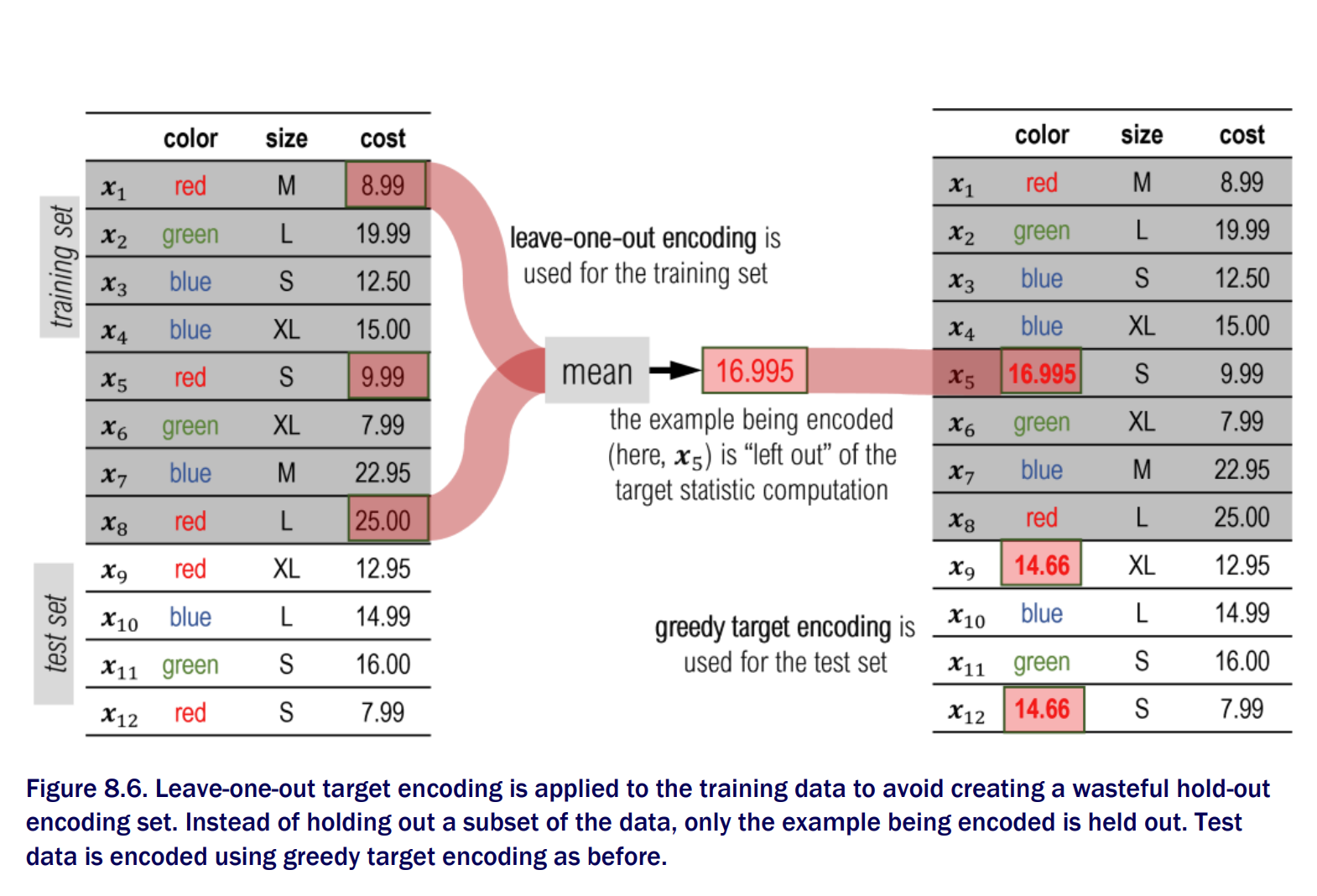
This image demonstrates Leave-One-Out (LOO) target encoding on a training set. To encode a specific sample (e.g., x5), its own target value is excluded from the calculation of the category's mean target. This helps to mitigate overfitting by preventing a sample's feature from being directly influenced by its own label.
While it sounds computationally intensive, there's an efficient trick. You can pre-calculate the overall sum and count for each category. Then, for each row, the LOO mean is simply:
Where and are the pre-calculated sum of targets and count for the row's category , and is the target of the current row. Your background in algorithms and low-level optimization should make the efficiency of this approach apparent.
Let's return to our implementation-focused article for a detailed breakdown.
Representing Categorical Data with Target Encoding
This section provides a from-scratch implementation of LOO encoding and contrasts its performance with the K-Fold approach.
Read the entire section on Leave-one-out Target Encoding. The TargetEncoderLOO class and the explanation of the efficient computational trick are particularly valuable. Note the performance comparison at the end, which shows LOO can be faster than a K-Fold implementation.
Contrasting the Strategies
Let's summarize the leakage-prevention strategies:
| Strategy | Description | Pros | Cons |
|---|---|---|---|
| Smoothing | Blends category mean with global mean. | Simple, reduces variance from rare categories. | A supplement, not a full solution to leakage. |
| K-Fold Encoding | Encode each fold using means from other folds. | Robust, industry standard, less prone to overfitting. | More computationally complex than naive. K is a hyperparameter. |
| Leave-One-Out (LOO) | Encode each row using means from all other rows. | Uses maximum data for each estimate. Can be computationally efficient. | Can still overfit, especially for categories with only 2 members. Creates higher variance features. |
In practice, a combination of K-Fold (or LOO) encoding with smoothing is the most robust approach. The category_encoders library provides implementations like TargetEncoder and LeaveOneOutEncoder that have parameters for smoothing (smoothing in the former, sigma for adding noise in the latter), making this combination easy to implement.
A Glimpse of an Alternative: CatBoost Encoding
Before we conclude, it's worth mentioning a more advanced technique that avoids the complexity of cross-validation altogether: CatBoost encoding. Developed for the CatBoost gradient boosting library, it works by first randomly shuffling the data. Then, it iterates through the rows sequentially. To encode the category in row i, it uses only the target values from rows 0 to i-1 that belong to the same category.
This "ordered" approach ensures by construction that no future information leaks backward. We will cover this in more detail in a future lesson, but it's a great example of the "out-of-the-box" thinking you're interested in.
Conclusion
In this lesson, we tackled one of the most important aspects of handling categorical data: creating powerful predictive features while rigorously preventing data leakage. We saw how naive target encoding introduces a subtle but critical bug and then explored the two primary industrial-strength solutions to fix it.
Key Takeaways:
- Target Encoding is a powerful technique for high-cardinality features, but the naive implementation leaks information from the target, causing overfitting.
- K-Fold Target Encoding is the standard solution, where each fold is encoded using statistics from the other folds.
- Leave-One-Out (LOO) Encoding is a variant where each sample is encoded using all other samples, which can be computationally efficient but may have higher variance.
- Smoothing is a crucial complementary technique that regularizes the estimates for rare categories by pulling them toward the global mean.
- Robust implementation is key. Libraries like
scikit-learnandcategory_encodersprovide built-in functionalities to handle these complexities correctly.
What's Next?
Having mastered target-based encoding methods, we will continue our deep dive into categorical features in the next lesson. We will explore Weight of Evidence (WoE) and Information Value (IV). These techniques, born from the credit scoring industry, provide a framework not only for encoding variables but also for quantifying their predictive power, making them invaluable for feature selection and model interpretation.