Recommended resources
The freely available resources this lesson will direct you to.
In our last lesson, we deconstructed sound into its fundamental physical properties: frequency, amplitude, wavelength, and harmonics. You learned that any sound, no matter how complex, is a collection of vibrations. Now, we move from understanding the nature of these vibrations to exploring how they interact with the world and with each other. This is where the physics of sound begins to meet the psychology of experience.
This lesson focuses on the crucial phenomenon of resonance and its manifestation as sympathetic vibration. Understanding this principle is the key to unlocking the central question of your study: how can an external sound, like a mantra or a raga, have a profound effect on our internal state? We will see that resonance is not just a curious acoustic trick; it's a fundamental principle that governs interactions from musical instruments to the very fabric of the quantum world.
The Principle of Resonance: Natural Frequency and Amplification
Every physical system, from a simple pendulum to a complex bridge or even an atom, has a set of natural frequencies. These are the specific frequencies at which the system "prefers" to oscillate if it's disturbed and then left alone. In the previous lesson, the fundamental frequency of a vibrating string was an example of its primary natural frequency.
Resonance occurs when you apply a periodic force to a system at one of its natural frequencies. When the timing of the applied force perfectly syncs up with the system's inherent tendency to vibrate, the energy transfer becomes exceptionally efficient. Each push adds to the existing motion, causing the amplitude of the vibration to grow dramatically.
The article "How the Physics of Resonance Shapes Reality" from Quanta Magazine provides an excellent introduction to this concept.
How the Physics of Resonance Shapes Reality | Quanta Magazine
This article explains resonance as a fundamental property of the universe. As you read, focus on the core concepts of "natural frequency" and how driving a system at this frequency leads to amplified motion.
Please read the section that begins with a simple definition and uses the examples of a playground swing and a wineglass to illustrate the idea of natural frequency.
The classic analogy is pushing someone on a swing. If you time your pushes to match the swing's natural back-and-forth rhythm, even small shoves will make the swing go higher and higher. If your timing is off, your pushes will be ineffective and might even work against the swing's motion. Resonance is simply this principle of "perfect timing" applied to vibrations.
The following video provides one of the best explanations of how this energy buildup works. The presenter, Steve Mould, uses a device called a Rubens' tube to visualize the process.
A better description of resonance
This video, "A better description of resonance," provides a fantastic visual and conceptual model for how resonance works by building up energy in a system.
Watch the following key segments: First, watch the explanation from the beginning, where he describes resonance as "getting the timing just right" for energy to add up, using the analogy of a pressure pulse in a tube. Next, see how this creates a standing wave with nodes (points of no vibration) and antinodes (points of maximum vibration) from 3:27 to 3:45. Finally, watch the stunning visualization of this effect from 6:31 to 7:03, where flames reveal the invisible standing pressure wave inside the tube. The low flames are at the nodes, and the high flames are at the antinodes.
The concept of a standing wave, with its stable points of minimum and maximum vibration, is a direct result of resonance within a confined space. This is precisely what happens inside musical instruments to produce a stable, sustained note.
Sympathetic Vibration: Resonance Across Space
Now that we understand resonance as the amplification of vibration through timed energy input, we can explore its most fascinating manifestation: sympathetic vibration (or sympathetic resonance).
This occurs when two separate objects share the same natural frequency. If one object starts vibrating, it sends out sound waves through the air. When these waves reach the second object, they act as the small, periodic "pushes" we discussed. Since the timing of these pushes (the frequency of the sound wave) perfectly matches the natural frequency of the second object, it begins to absorb the energy and starts vibrating "in sympathy," without ever being touched.
This is the physical mechanism for action at a distance through sound. The classic demonstration involves two identical tuning forks.

The following short video demonstrates this principle first with pendulums and then with a guitar, bringing the concept directly into the realm of music.
Demonstrating Sympathetic Vibrations - A Video Project by Bobby
The "Flipping Physics" channel provides a clear, practical demonstration of sympathetic vibrations.
Watch the full video. Pay close attention to: The introduction and the pendulum demonstration from the start. Notice how only the pendulum with a similar length (and thus a similar natural frequency) begins to oscillate strongly. The application to a guitar from 1:54 to the end. This shows how strings you don't pluck still contribute to the overall sound through sympathetic resonance.
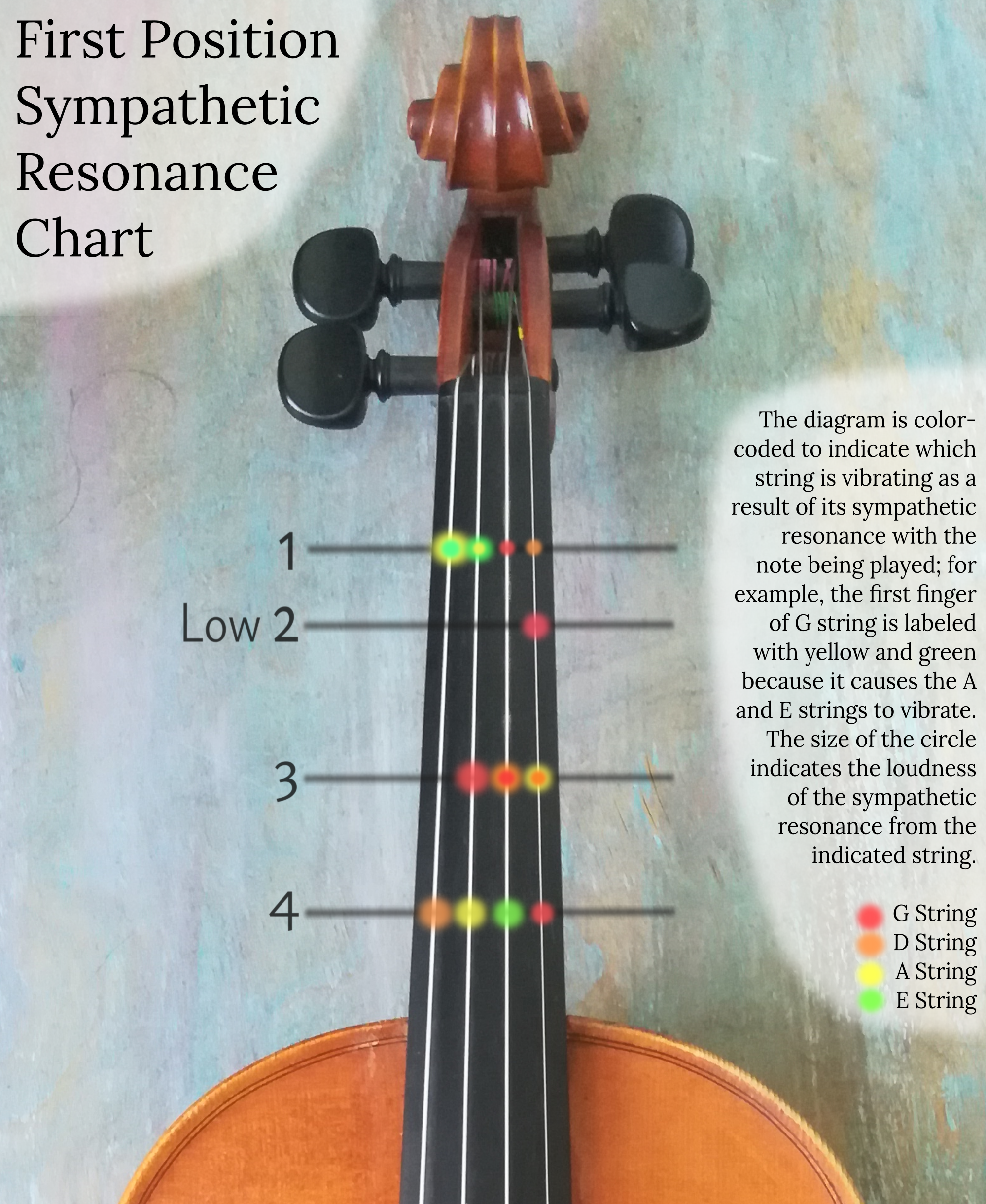
This phenomenon is not a minor acoustic detail; it is fundamental to the richness of music. When a note is played on an instrument, other components of the instrument—and even other nearby instruments—resonate sympathetically, adding depth, complexity, and volume to the sound. This is what gives an instrument its full, vibrant timbre.
From Physics to Metaphysics: Resonance and Mantra
Here, we arrive at the heart of your inquiry. The principles of resonance and sympathetic vibration provide a scientific framework for understanding how mantras can work. The ancient seers may have used different terminology, but they were observing a real physical phenomenon.
The core idea is that the human body, its organs, and even its subtle energy systems (like the nadis and chakras you may encounter in spiritual texts) can be viewed as complex resonators, each with their own natural frequencies. A mantra, when chanted with the correct pronunciation and intonation, is a precisely structured pattern of sound vibrations.
The following article, "मंत्र सुनने के पीछे का विज्ञान" (The Science Behind Listening to Mantras), connects these ideas beautifully. As you are comfortable with Hindi, this text offers a direct bridge from the physics we've just discussed to the spiritual application you are exploring.
मंत्र सुनने के पीछे का विज्ञान
This article explicitly applies the concept of resonance (अनुनाद) to the practice of listening to mantras. It explains how the vibrations of a mantra can align with the body's own natural rhythms.
Please read the following sections: Start with the section "What is Resonance?", which uses the same guitar analogy we saw in the video to define the concept. Continue with "How do Mantras Create Resonance?", which proposes that mantra vibrations can align with biological rhythms like heartbeat and brainwaves. Finally, read the section "Why do Focus and Faith Matter?", which introduces the crucial role of the practitioner's internal state (bhav) in facilitating resonance.
This article makes a pivotal point: the effectiveness of resonance depends on the state of the receiver. If the system is "open" and receptive, the energy transfer is efficient. This aligns with the emphasis in all contemplative traditions on focus, intention (bhav), and receptivity. From a physical perspective, distraction or resistance could be seen as introducing 'noise' into the system, preventing a clear resonant lock.
Your background as a software developer might offer a useful analogy here. Think of the mantra as a specific API call. For the call to work, the receiving system (your body-mind) must have the corresponding endpoint ready and listening. If the system is busy, crashing, or configured to reject the call, the message won't get through, no matter how perfectly it is sent.
The Universal Nature of Resonance
To conclude our exploration, it's worth appreciating just how fundamental resonance is. It's not limited to sound and mechanics. The Quanta Magazine article we started with explains that resonance is at the very heart of modern physics.
How the Physics of Resonance Shapes Reality | Quanta Magazine
This article extends the concept of resonance into the quantum realm, showing its universal importance.
Please read the final two sections, which discuss resonance in the context of quantum mechanics and particle physics. Focus on these two key ideas: The section on quantum mechanics explains how atoms absorb and emit light (photons) at specific resonant frequencies. Read from this paragraph. The final section explains that in quantum field theory, particles themselves are essentially resonant excitations of underlying fields. Read from this paragraph</to the end of the main text.
The fact that particles—the building blocks of matter (pudgal)—are themselves described as resonances of underlying fields is a profound concept that resonates deeply with philosophical ideas like Nada Brahma (the universe as sound), which we will explore soon.
Conclusion
In this lesson, we have built a critical bridge between the physical properties of sound and its potential to influence a system—including a human being—from a distance.
Here are the essential takeaways:
- Natural Frequency: Every object has inherent frequencies at which it naturally vibrates.
- Resonance: When an external force applies vibrations at an object's natural frequency, the object's own vibrations are dramatically amplified.
- Sympathetic Vibration: This is resonance in action, where a vibrating object transmits its energy via sound waves, causing a second, non-touching object with the same natural frequency to also start vibrating.
- The Mantra-Resonance Model: This physical principle provides a scientific basis for how the specific vibrational patterns of a mantra or musical piece can induce corresponding vibrations and states within the body and mind.
You now have the primary physical tool needed to analyze the effects of sound. We have firmly established the science of ahata nada, or "struck sound." In our next lesson, we will take our first step into the metaphysical side of this inquiry by contrasting this with the concept of anahata nada—the "unstruck sound" of Indian philosophy—and begin to connect these physical vibrations to the nature of consciousness itself.