Recommended resources
The freely available resources this lesson will direct you to.
- Is the Anahata Sound same as Brahman? | Swami Sarvapriyanandawww.youtube.com
- || अनहद नाद के साथ अंतर्यात्रा कैसे करें? || स्वामी शैलेंद्र सरस्वती ||www.youtube.com
- Nada Yoga and Spirituality: The Transformative Power of ...sangeetgalaxy.co.in
- Ahata - Anahata - Semantic Daniélouwww.semantic-danielou.com
Hello! In our previous lesson, we explored the fascinating world of resonance and sympathetic vibration, establishing a solid physical basis for how sound works. We saw how "struck" sounds, or ahata nada, can transfer energy and influence objects from a distance. This provided the scientific groundwork for understanding how a mantra or a musical piece can have a tangible effect.
Today, we will take a significant step from the physical to the metaphysical. Building on your foundation in physics, philosophy, and spirituality, we will now contrast the external, struck sound with its esoteric counterpart: anahata nada, the "unstruck sound." This distinction is absolutely central to Indian philosophy and Nada Yoga (the Yoga of Sound), and it forms the bridge between the science of acoustics and the spiritual science of consciousness you wish to explore. Understanding this duality is key to seeing how external music can lead to internal peace.
The Two Poles of Sound: Ahata and Anahata
Indian thought categorizes the entire phenomenon of sound, or Nada, into two fundamental types.
-
Ahata Nada (आहत नाद): The Struck Sound
This is the sound we know from our daily lives and from the study of physics. The word ahata means "struck" or "beaten." This sound is produced by the collision or friction of two or more objects. It is physical, has a definite beginning and end, and is perceived through our sensory organs, primarily the ears. Every sound we discussed in our previous lessons—the vibration of a guitar string, the sound wave from a tuning fork, the human voice—is a form of ahata nada. It is the sound of the manifest, external world. -
Anahata Nada (अनाहत नाद): The Unstruck Sound
Anahata means "unstruck" or "unbeaten." This is a sound that is not caused by any physical friction or collision. It is described as a subtle, internal sound that is not heard with the ears but is perceived directly by the consciousness in deep states of meditation and stillness. It is considered to be the primordial, ever-present vibration of the universe, a constant hum beneath the noise of the physical world.
To grasp this distinction more deeply, let's turn to a clear overview from the article "Nada Yoga and Spirituality."
Nada Yoga and Spirituality: The Transformative Power of ...
This text provides a foundational definition of Nada and then clearly distinguishes between its two types, Ahata and Anahata.
Please read the part of the introductory section that explains this division. Start from the paragraph beginning with "The Nada idea is classified..." and read until the end of the paragraph. Pay close attention to the core definitions and the qualities associated with each type of sound.
As the text explains, ahata nada is accessible to everyone, while anahata nada can only be recognized through practices like intense meditation. This frames our study perfectly: we learn to use the structured, physical sounds of ahata nada (like mantras and ragas) as a means to tune our awareness to the subtle, internal vibration of anahata nada.
Spiritual Perspectives on Anahata Nada
Different spiritual traditions have described this internal sound in various ways, all pointing to the same transcendental experience. The famous Zen koan, "What is the sound of one hand clapping?" is a question designed to push the mind beyond the logic of ahata nada towards the experience of anahata nada.
The following video, delivered in Hindi by Swami Shailendra Saraswati, offers a beautiful and accessible explanation. He connects the concept directly to various traditions, including Jainism.
|| अनहद नाद के साथ अंतर्यात्रा कैसे करें? || स्वामी शैलेंद्र सरस्वती ||
In this discourse, the speaker eloquently contrasts the sounds of the external world with the inner, divine sound, providing rich context and analogies.
Please watch the following segments: First, the introduction where he contrasts outer sounds with the inner one: "Listen to the unheard melody." Next, his direct definition of Ahata and Anahata, where he explains 'Ahata' requires a strike (चोट): defining the two sounds. Crucially, watch the part where he links this concept to Jain terminology like Jin Vani and Divya Dhwani: "Names in different religions." Finally, listen to his description of the subjective quality of this sound: describing the sound.
The connection to Jin Vani (the speech of the Jinas) and Divya Dhwani (the divine sound) is particularly relevant to your goals. In Jain cosmology, the Tirthankara's sermon is not ordinary speech; it is a divine, omni-directional sound that is miraculously understood by all beings in their own language. The scriptures and mantras we use (ahata nada) are considered a reflection or a pointer, guiding the practitioner to experience that original, internal Divya Dhwani (anahata nada) for themselves.
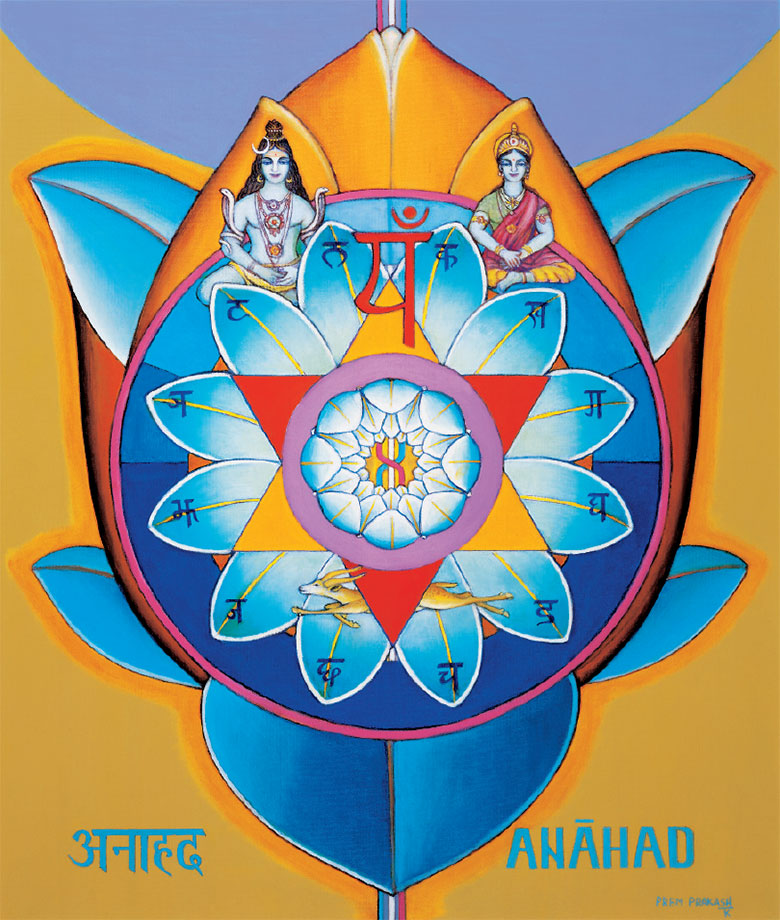
The fourth primary energy center, or chakra, located at the heart, is named the Anahata Chakra precisely because it is considered the seat where this unstruck sound can be perceived.
The Philosophical Underpinnings
From a philosophical standpoint, particularly in the Vedanta tradition, anahata nada is seen as a representation of the ultimate reality, Brahman. It's not Brahman itself, but it's the most subtle manifestation of it in the realm of experience.
Swami Sarvapriyananda, a modern Vedantic thinker, clarifies this subtle but important point.
Is the Anahata Sound same as Brahman? | Swami Sarvapriyananda
This video provides a precise philosophical take on Anahata Nada, clarifying its role in the path to enlightenment from an Advaita Vedanta perspective.
Watch the segment from 00:45 to 01:41, where the Swami defines Anahata and explains its relationship to the ultimate reality, Brahman. He describes it as the "eternal background vibration of the universe."
This perspective helps frame anahata nada not just as a neurological curiosity but as a profound spiritual milestone. It's the "background vibration," a concept that might resonate with your interest in cosmology, akin to a cosmic hum that is always present but usually drowned out by the "signal" of our senses and thoughts. The practice of meditation and mantra is the process of reducing the signal's noise to become aware of this universal background hum.
The Synthesis: How the Audible Reveals the Inaudible
We have now established a clear duality:
| Feature | Ahata Nada (Struck Sound) | Anahata Nada (Unstruck Sound) |
|---|---|---|
| Nature | Physical, external, caused by collision. | Metaphysical, internal, spontaneous. |
| Perception | Through the ears and sensory system. | Through refined inner awareness in meditation. |
| Source | Interaction of objects in the world. | The foundational vibration of existence itself. |
| Role | The tool for spiritual practice (e.g., mantra, raga). | The goal of the practice; a sign of deep communion. |
This might seem to suggest that we should abandon the external world of ahata nada entirely. However, the deepest wisdom lies in understanding their relationship. The audible is not just a distraction from the inaudible; it is the key to it.
The following text beautifully articulates this synthesis.
Ahata - Anahata - Semantic Daniélou
This short, poetic text captures the essence of the relationship between the two types of sound.
Read the section titled “Ahata-Anahata”. Focus on this central idea: "The secret power of 'Anahata' (the Inaudible) is incorporated within 'Ahata' (the Audible), and this is one of the reasons that the 'Audible' carries within it the power to reveal the 'Inaudible'."
This is the central operating principle for our entire course. Think of it in terms of your software development background. Anahata nada is like the fundamental clock cycle of the CPU—the core pulse that enables all computation, yet is completely inaccessible to a user. Ahata nada, in the form of a well-crafted mantra or raga, is like a highly specific debugging tool or a kernel-level command. It's a piece of code from the "user space" that is specifically designed to hook into and reveal the functioning of the deep, underlying system. We use the audible to make ourselves resonate with the inaudible.
Conclusion
In this lesson, we have journeyed from the physics of struck sound to the metaphysics of the unstruck sound, drawing a crucial distinction that is core to Indian spiritual traditions.
Key Takeaways:
- Ahata Nada is the physical, external sound produced by collision, which we perceive with our ears. It is the realm of acoustics, music, and speech.
- Anahata Nada is the metaphysical, internal sound that is "unstruck." It is the ever-present cosmic vibration perceived in deep states of meditation. In Jainism, this corresponds to the concept of Divya Dhwani.
- The fundamental goal of practices like Nada Yoga and mantra sadhana is to use structured ahata nada (the tool) to quiet the mind and train the consciousness to perceive the subtle anahata nada (the goal).
You now have a conceptual map that includes both the physical mechanism of sound (resonance) and the philosophical framework of its two types (Ahata/Anahata).
In our next lesson, we will expand on this framework by exploring the profound concept of Nada Brahma—the idea that the entire universe is sound. We will then connect this grand vision to the specific Jain metaphysical theory of pudgal (matter), bringing us even closer to a unified theory of sound, spirit, and reality.