Recommended resources
The freely available resources this lesson will direct you to.
Welcome to the first lesson of our course. Your journey to understand the science of mantra and its power to elevate consciousness begins here, with the very foundation of sound itself. Before we can explore the subtle effects of ragas or the metaphysical nature of sound in Jain philosophy, we must first build a solid, scientific understanding of what sound is.
This lesson will address the physical properties of sound. We will define and explore four key characteristics that form the language of acoustics: frequency, amplitude, wavelength, and harmonics. Mastering these concepts is the essential first step, providing the physical framework we will later use to connect ancient wisdom with modern science, from the vibrations of a mantra to their effects on your mind.
The Nature of Sound: A Physical Vibration
At its core, sound is a form of energy that travels as a wave. Imagine dropping a stone into a still pond; ripples spread out from the point of impact. Sound works in a similar way, but instead of water, the "ripples" are disturbances that travel through a medium like air, water, or a solid. These disturbances are called sound waves.
In air, a vibrating object—like a guitar string, your vocal cords, or a speaker cone—pushes and pulls on the air molecules around it. This creates alternating areas of high pressure (compressions) and low pressure (rarefactions). The sound wave is this pattern of pressure changes propagating through the air.
To formalize this, please read the following brief introduction from a standard text on the physics of sound.
[PDF] The Physical Nature of Sound - SBE.org
This document provides a clear, physics-based introduction to sound. As you read, focus on how it defines sound as a physical disturbance and distinguishes between a simple pulse and a periodic, repetitive sound wave.
Please read the introduction and the section on sound waves. This covers the text from the beginning of Chapter 1.1.1.
The simplest type of periodic sound wave is a pure tone, which can be visualized as a smooth, repeating S-shaped curve known as a sine wave. While rare in nature, pure tones are the fundamental building blocks of all other, more complex sounds.
The Four Pillars of Sound
Every sound wave, from the simplest tone to the most complex musical passage, can be described by four fundamental properties. A great way to visualize these is to imagine a graph of the sound wave, where the vertical axis represents the pressure or displacement of air molecules, and the horizontal axis represents time.
The Khan Academy video below provides an excellent visual and auditory explanation of these core concepts.
Sound Properties (Amplitude, Period, Frequency, Wavelength) | Physics | Khan Academy
This video, "Sound Properties," clearly breaks down the main characteristics of a sound wave using animation.
Watch the entire video. Pay close attention to: Amplitude and its relation to loudness, from the beginning. Period and Frequency, and how they determine pitch, explained between 01:06 and 02:55. Wavelength, and the crucial distinction between a time-based graph (showing period) and a space-based graph (showing wavelength), from 2:55 to the end.
Let's solidify those concepts:
-
Amplitude: This is the "height" of the wave, representing the maximum displacement or pressure change from the equilibrium position. Perceptually, we experience amplitude as loudness or volume. A larger amplitude corresponds to a louder sound. The energy of a sound wave is proportional to the square of its amplitude.
-
Frequency: This is the number of complete cycles (compressions and rarefactions) that occur in one second. It is measured in Hertz (Hz). Perceptually, frequency corresponds to pitch. A high frequency means more vibrations per second, which we hear as a high-pitched note. A low frequency results in a low-pitched note. The range of human hearing is typically between 20 Hz and 20,000 Hz.
-
Wavelength (): This is the physical distance the wave travels during one complete cycle. It's the distance between two consecutive points of compression or rarefaction. Don't confuse this with the period (), which is the time it takes for one cycle.
-
Speed of Sound (): This is the speed at which the wave propagates through the medium. It depends on the medium's properties (like temperature, density, and elasticity), not on the properties of the sound wave itself.
These three properties—frequency (), wavelength (), and speed ()—are elegantly related by the formula:
This means that for a given medium (where is constant), high-frequency sounds have short wavelengths, and low-frequency sounds have long wavelengths.
Since you are comfortable with Hindi, you might find it helpful to review these core concepts in this article from IIT Kanpur's SATHEE portal. It defines the same terms using Hindi technical words like आयाम (aayaam) for amplitude, आवृत्ति (aavritti) for frequency, and तरंगदैर्ध्य (tarangdairdhya) for wavelength.
This article provides concise definitions of the properties of sound in Hindi.
Review the sections titled "Properties of Sound Waves" and the more detailed descriptions under "Characteristics of Sound Waves" (points 1-5). Also, note the summary formula at the very end of the page under "Key Concepts".
From Simple Tones to Rich Timbre: Harmonics
So far, we've discussed pure tones (sine waves). But the sounds we hear in daily life—a voice, a musical instrument, a bell—are much more complex. What makes a violin sound different from a flute when they both play the same note (i.e., the same fundamental frequency)?
The answer is harmonics.
Almost every sound is a composite, made up of a primary frequency called the fundamental (which determines the note's pitch) and a series of quieter, higher-frequency tones called harmonics or overtones. These harmonics are integer (whole-number) multiples of the fundamental frequency.
- If the fundamental frequency is ,
- The 2nd harmonic is .
- The 3rd harmonic is .
- The 4th harmonic is , and so on.
The unique combination and relative loudness of these harmonics for any given sound source creates its distinctive character, or timbre (pronounced "tam-ber"). Timbre is the "quality" or "color" of a sound.
The physical basis for harmonics can be seen in a vibrating string. It vibrates along its entire length (producing the fundamental) and simultaneously vibrates in halves, thirds, quarters, and so on, producing the harmonic series.

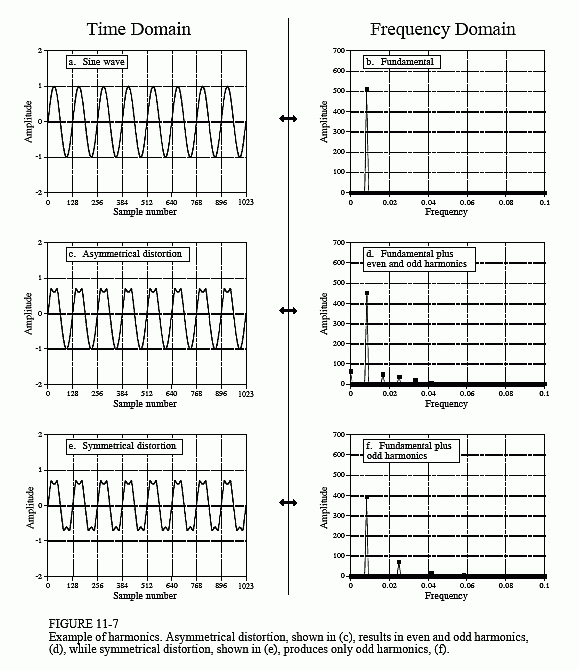
Given your background in software development, this concept has a direct parallel in Fourier Analysis, which states that any complex, periodic waveform can be deconstructed into a sum of simple sine waves at different frequencies and amplitudes. The sound we hear is the complex wave; the fundamental and its harmonics are the constituent sine waves.
The following image illustrates this relationship. On the left, you see waveforms in the time domain (what an oscilloscope would show). On the right, you see their corresponding spectra in the frequency domain (what a spectrum analyzer would show), revealing the underlying harmonics.
The next video offers a fantastic and musically intuitive explanation of the harmonic series and its role in creating timbre.
The most mind-blowing concept in music (Harmonic Series)
In "The most mind-blowing concept in music," Andrew Huang explains and demonstrates the harmonic series.
Please watch these key segments: From 00:25 to 01:32, for an introduction to the harmonic series as integer multiples of a frequency. From 01:32 to 03:26, to see how harmonics are physically produced and how their different strengths (timbre) distinguish a clarinet from a guitar. From 04:14 to 05:26, for the explanation that harmonics are pure sine waves, and any musical sound can be built by adding them together (additive synthesis).
Conclusion
In this foundational lesson, we have established the physical basis of sound. You now have a working vocabulary to describe any sound wave in terms of its core properties.
Here are the key takeaways:
- Sound is a mechanical wave, a vibration traveling through a medium as compressions and rarefactions.
- The four primary properties of a sound wave are:
- Amplitude, which we perceive as loudness.
- Frequency, which we perceive as pitch.
- Wavelength, the spatial length of a wave cycle.
- Speed, which is determined by the medium.
- Most natural sounds are complex and composed of a fundamental frequency and a series of harmonics (integer multiples).
- The specific "recipe" of these harmonics—their presence and relative amplitudes—determines the sound's unique timbre, or tone color.
This understanding of sound as a complex structure of vibrations is our launchpad. We have described the shabda (sound) in the language of physics. In our next lesson, we will explore the principle of resonance, which explains how these vibrations can transfer energy and influence other objects. This will be our first major step in bridging the physical world of sound with its potential effects on the body and mind, moving us closer to the heart of your inquiry.