Recommended resources
The freely available resources this lesson will direct you to.
- How to Master Anything: PEAK by Anders Ericsson | Core Messagewww.youtube.com
- Practice More Efficiently | Deliberate Practice & Skill Improvementwww.youtube.com
- Get Better at Anything: 6 Steps of Deliberate Practice - Crossoverwww.crossover.com
- Peak by Anders Ericsson and Robert Pool - Steve Andersonwww.steve-anderson.co
Hello! Welcome to your next lesson in the module "From Theory to Practice: Knowledge Transfer."
In our previous lessons, we've focused on how to better understand and connect new ideas. We explored using concrete examples to make abstract concepts tangible, and then we learned how to build analogies to bridge the gap between your existing design expertise and new domains like data analysis or coding. These are strategies for building your knowledge base.
Today, we shift from knowing to doing. Our learning outcome is to describe the key components of deliberate practice: specific goals, focused effort, immediate feedback, and repetition. This isn't just about practicing more; it's about practicing smarter. Understanding this framework is fundamental to your goal of improving how you apply new knowledge and turning theory into skillful execution.
What is Deliberate Practice?
You've likely heard the "10,000-hour rule," which suggests that it takes 10,000 hours of practice to achieve mastery. However, the research behind this idea, led by psychologist Anders Ericsson, is more nuanced. It's not just the quantity of hours that matters, but the quality of that practice.
Simply repeating a task you can already do well doesn't lead to much improvement. This is "naive practice." Deliberate practice, in contrast, is a systematic and highly structured activity designed specifically to improve performance. It's the engine that drives expertise.
To get a clear sense of this distinction, let's watch a short video that summarizes the core message of Ericsson's foundational book, "Peak."
How to Master Anything: PEAK by Anders Ericsson | Core Message
This video, based on Anders Ericsson's book 'Peak,' introduces the crucial difference between merely 'doing' something for a long time and engaging in deliberate practice. It also introduces the concept of 'mental representations,' which is what experts build through this type of practice.
Watch the first 2 minutes and 30 seconds (00:00 - 02:30). Pay close attention to the contrast between simply putting in hours and the focused approach of deliberate practice.
As the video explains, what sets experts apart is their highly developed mental representations. These are sophisticated cognitive structures that allow them to process information more effectively. For a UX designer, this might be an intuitive understanding of how different navigation patterns affect user behaviour, or the ability to instantly see the flaws in a proposed user flow. Deliberate practice is the process you use to build these rich mental models.
The Four Key Components of Deliberate Practice
So, what does this "right sort of practice" look like? It can be broken down into four essential components. The infographic below provides a great overview, which we'll then explore in detail.
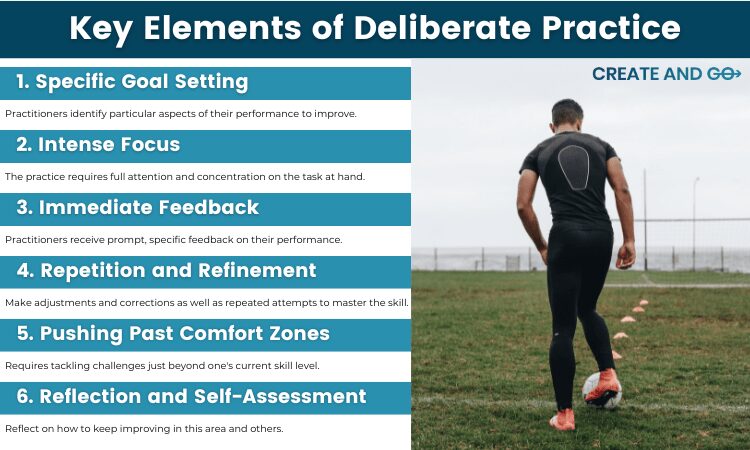
Let's break these down one by one.
1. Specific Goals
Deliberate practice requires a tightly defined, specific goal, not a vague desire to "get better." The goal should be small enough to be tackled in a single practice session.
- Vague Goal: "I want to get better at Figma."
- Specific Goal: "I want to reduce the time it takes me to build a responsive card component with auto-layout from 15 minutes to 10 minutes, with no errors."
This specificity is crucial because it allows you to design a focused practice activity and measure your progress.
Get Better at Anything: 6 Steps of Deliberate Practice
This article from Crossover provides excellent, practical advice on goal-setting within deliberate practice.
Read section 2, 'Set specific, realistic goals.' The example of the golfer breaking down the general goal of 'improving their handicap' is a perfect illustration of this principle.
2. Focused Effort (Outside Your Comfort Zone)
This is perhaps the most critical—and most difficult—part of deliberate practice. It requires you to operate just at the edge of your current abilities, in a state of intense, undistracted focus. If an activity feels easy, you're not improving; you're just performing. If it's impossibly hard, you'll become frustrated and give up. The sweet spot is where the task is challenging but achievable.
This directly relates to the concept of 'desirable difficulties' we discussed in the first module. True improvement feels like a struggle.
The following segment of the video on "Peak" gives a powerful case study of this principle in action.
How to Master Anything: PEAK by Anders Ericsson | Core Message
The same video provides a powerful case study of a student named Steve Faloon, who dramatically increased his memory for digits. His experience perfectly illustrates the components of deliberate practice.
Now watch from 02:30 to 05:56. As you watch, identify how each of the four components was present in Steve's practice: What was his specific goal? How was his effort focused? What was his feedback? How was he pushed out of his comfort zone?
As you saw, Steve's practice was:
- Goal-oriented: His goal was always to recall one more digit than his previous record.
- Focused: For one hour, his entire attention was on that single task.
- Feedback-driven: He got immediate feedback—he either recalled the string correctly or he didn't.
- Challenging: He was constantly pushed to the boundary of what he thought was possible, experiencing frustration before each breakthrough.
3. Immediate Feedback
How can you improve if you don't know what you're doing wrong? Immediate, specific feedback is the compass that guides your practice. Without it, you risk practicing and reinforcing mistakes.
This feedback can come from several sources:
- An expert: A coach, teacher, or senior colleague who can observe you and point out exactly where to adjust. In a design context, this is a senior designer reviewing your wireframes.
- The task itself: When learning to code, the program either runs or it produces an error. This is objective feedback. When prototyping, a component either behaves as expected or it doesn't.
- Self-evaluation: Experts develop the ability to monitor their own performance and identify errors. This is a skill in itself, built by comparing your work against examples from other experts.
Peak by Anders Ericsson and Robert Pool - Steve Anderson
For another perspective, let's look at some concise notes from the book 'Peak'. This section emphasizes the non-negotiable role of feedback.
In this text, scroll down to the heading '✍️ My Top 3 Quotes' and read the list of bullet points under the heading '📒 Summary, Highlights, & Notes'. Find the points starting with 'Purposeful practice involves feedback' and 'Purposeful practice requires getting out of one’s comfort zone'. Notice how feedback is framed as essential for identifying shortcomings.
4. Repetition and Refinement
This final component ties everything together. Deliberate practice is not about mindless repetition. It's about repeating a task with the goal of refining it based on feedback. Each repetition is an opportunity to make a small adjustment and improve.
Think of it as an iterative cycle, much like the design process:
- Set a specific goal (Define).
- Attempt the task (Prototype).
- Receive feedback (Test).
- Identify the error and adjust your approach (Analyze & Ideate).
- Repeat.
This cycle, performed with intense focus and consistency over time, is what builds skill and develops those expert mental representations.
Test your understanding!
Imagine you want to get better and faster at creating complex, responsive components using Figma's auto-layout. Currently, you find it a bit clumsy and time-consuming.
Briefly describe how you could apply the four components of deliberate practice to improve this specific skill.
- Specific Goal: What would be a narrow, measurable goal?
- Focused Effort: What specific task would push you beyond your comfort zone?
- Immediate Feedback: How would you know if you're succeeding or failing?
- Repetition & Refinement: How would you repeat and refine the process?
Show answer
Here's one possible approach:
- Specific Goal: "To accurately recreate a complex card component from a professional UI kit (like Untitled UI) in under 8 minutes, using nested auto-layouts."
- Focused Effort: I would turn off all notifications, set a timer for 8 minutes, and attempt the task without consulting any tutorials. The challenge is to do it within the time limit and to solve the nesting problems on my own, which is outside my current comfort zone of taking my time and looking things up.
- Immediate Feedback: The feedback is twofold. First, the timer: did I finish in 8 minutes? Second, the result: I can place my version side-by-side with the original professional component. Does it match perfectly? Does it respond to resizing in the exact same way? The difference between my component and the expert one is my feedback.
- Repetition & Refinement: After the first attempt, I'd analyze where I struggled. Maybe I fumbled with the
Hug contentsvs.Fill containersettings. On the next attempt, I'd focus specifically on getting that part right from the start. I would repeat this task once a day, trying to beat my time and improve the accuracy, perhaps with a slightly different card design each day to ensure I'm generalizing the skill.
Conclusion
Today we've defined the structure of effective practice. Deliberate practice is not a magic bullet, but it is a proven method for systematically building skill and moving from novice to expert. It transforms practice from a passive, time-based activity into an active, goal-driven process of improvement.
Key Takeaways:
- Practice quality > quantity: Simply putting in hours is not enough; you need deliberate practice.
- Specific Goals: Break down large ambitions into small, measurable, and highly specific tasks.
- Focused Effort: Practice must be mentally demanding and push you just beyond your current abilities.
- Immediate Feedback: You need a way to know, instantly, if you are succeeding and where you are going wrong.
- Repetition & Refinement: Practice is an iterative cycle of attempt, feedback, adjustment, and repeat.
What's Next?
Now that you can describe the theory of deliberate practice, our next and final lesson in this module will focus on application. You will use these four components to design a deliberate practice session to improve a specific UX skill or coding concept that is relevant to your personal learning goals.