Recommended resources
The freely available resources this lesson will direct you to.
- Cinematographer Explains 3 Different Camera Lenses | Vanity Fairwww.youtube.com
- Ultimate Guide to Camera Lenses — Every Type of Camera Lens Explained [Shot List Ep. 7]www.youtube.com
- Wide Angle Lens vs. Telephoto Lens: What’s the Difference?tamron-americas.com
- The Role of Lenses in Filmmaking: Types, Uses, and Iconic Examples - Raindanceraindance.org
Welcome to the fifth lesson in our "Foundations of Visual Design" module. In our journey so far, you've learned to compose a frame using principles like the rule of thirds, control the narrative distance with shot types, and manipulate emotion with camera angles. You are building a solid directorial vocabulary.
This lesson introduces the final core element of cinematic camera control: the lens. If the camera is the eye, the lens is its pupil and cornea, shaping everything it sees. The choice of lens is not just a technical detail; it is a fundamental artistic decision that dramatically alters an image's perspective, sense of space, and emotional feel. For your goal of creating high-end, commercial-quality AI visuals, mastering the language of lenses is what separates a simple "picture" from a "cinematic image."
By the end of this lesson, you will be able to explain the function of wide-angle, normal, and telephoto lenses and describe precisely how they impact perspective, allowing you to create specific visual effects in your AI-generated advertisements.
1. Focal Length: The DNA of a Lens
Before we can understand different lens types, we must understand the single variable that defines them: focal length. Measured in millimeters (mm), focal length determines two crucial things: the angle of view (how much of the scene is captured) and the magnification (how large subjects will appear).
- A short focal length (e.g., 18mm, 24mm) results in a wide angle of view, capturing a broad scene.
- A long focal length (e.g., 85mm, 200mm) results in a narrow angle of view, magnifying a small part of the distant scene.
The cinematographer Tom Sigel provides an excellent and concise explanation of this concept in his Vanity Fair video. Pay close attention to how he defines focal length and demonstrates how changing it affects how much of the background we see, even when the subject's size in the frame remains the same.
Cinematographer Explains 3 Different Camera Lenses | Vanity Fair
Start watching at the beginning of the video, where Tom Sigel introduces the three main lens types. Focus on the segment from focal length explanation. He provides a clear definition and a practical demonstration of how a lens's focal length determines its angle of view.
Now that you have a grasp of focal length, let's explore the three main families of lenses that are defined by it.
2. The Three Families: Wide, Normal, and Telephoto
Almost every lens you will use or specify in a prompt falls into one of three categories. Each has a distinct visual signature and serves a different storytelling purpose.
The image below starkly illustrates the difference between the two extremes: a wide-angle lens and a telephoto lens. Notice how the man's facial features are stretched and distorted by the 15mm lens, while the 800mm lens creates a much more compressed and flattened, yet conventionally flattering, portrait.
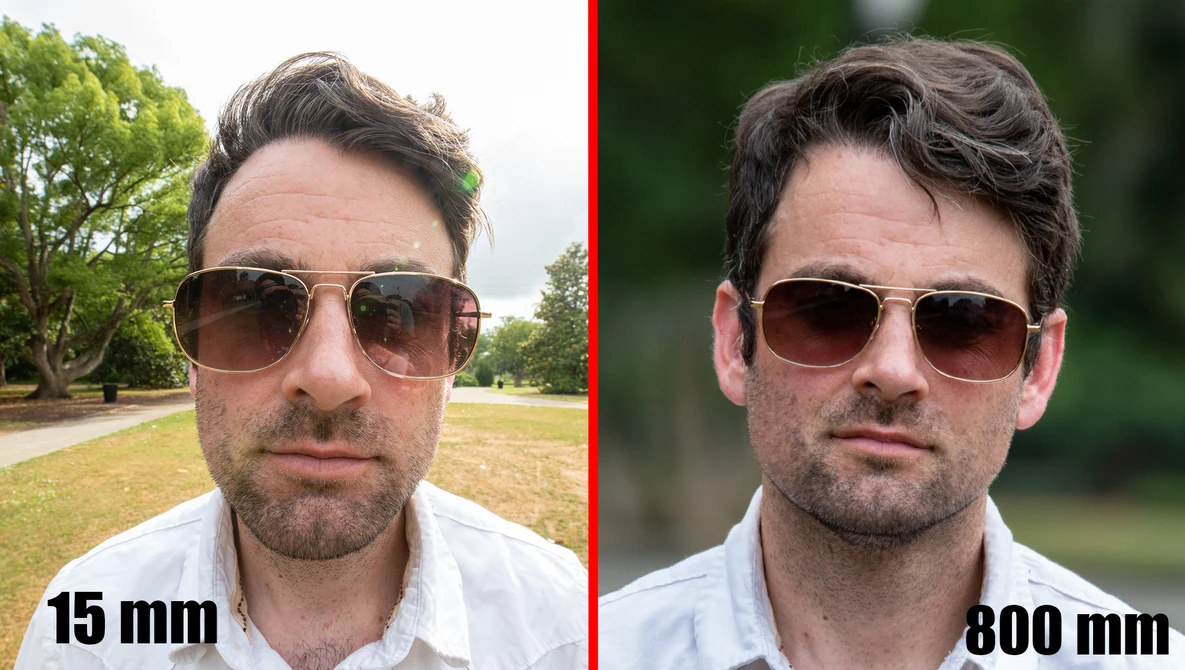
Let's break down each category. For a comprehensive written overview, the article "Wide Angle Lens vs. Telephoto Lens" from Tamron is an excellent resource.
Wide Angle Lens vs. Telephoto Lens: What’s the Difference?
This article provides a thorough breakdown of the characteristics and uses of wide-angle and telephoto lenses. As you read, focus on the core definitions and the visual effects each lens type produces.
Read the following sections to build a strong foundational knowledge: Start with the introduction to get the core distinction: the simplest answer. Then, read the section "What Are Wide Angle Lenses?" focusing on how they affect perspective. Next, read "What Are Telephoto Lenses?" and pay close attention to the explanation of how they compress distance. Finally, study the section on "How Do Telephoto Lenses Affect Perspective and Compression?" specifically the concept of lens compression and how it relates to shooting distance. The summary table in the "What's the Difference?" section is also a great recap.
Wide-Angle Lenses (e.g., 18mm - 35mm)
As you've read, wide-angle lenses capture a broad field of view. This has a powerful effect on perspective: they exaggerate depth, making foreground elements seem larger and more important, while pushing background elements further away.
- Visual Effect: Expansive feel, stretched perspective, potential for "barrel" distortion (straight lines bowing outwards).
- Emotional Impact: Can create a sense of grandeur, immersion, or subjectivity (placing the viewer inside the action). It can also create unease or tension by distorting reality.
- Advertising Use: Ideal for showing off large spaces like real estate interiors, making a car feel spacious, creating dynamic action shots, or establishing a product within an epic landscape.
Watch how cinematographer Tom Sigel uses wide-angle lenses in the film Drive to create a sense of distance between characters while simultaneously creating intimacy with the audience.
Cinematographer Explains 3 Different Camera Lenses | Vanity Fair
Watch the segment from the "Drive" clip to see a practical application of a wide-angle lens for character-driven storytelling.
Telephoto Lenses (e.g., 85mm - 300mm+)
Telephoto lenses do the opposite of wide-angles. They have a narrow field of view that magnifies distant subjects. Their most famous and sought-after characteristic is compression. By shooting from far away, a telephoto lens makes the background appear to be stacked right up behind the subject, flattening the sense of depth.
- Visual Effect: Flattened space, background "compression," shallow depth of field (blurring the background).
- Emotional Impact: Creates a sense of observation or voyeurism. Isolates the subject, directing the viewer's attention precisely. It can feel intimate and focused, or distant and clinical.
- Advertising Use: Perfect for flattering portraits in beauty and fashion ads, creating heroic product shots that stand out from their environment, and capturing action from a distance (like in sports).
Notice how the use of a telephoto lens in The Graduate makes the character's running seem desperate and futile. The compression effect means that even though he is running hard, he appears to make little progress against the flattened background.
Ultimate Guide to Camera Lenses — Every Type of Camera Lens Explained [Shot List Ep. 7]
Watch the segment on telephoto lenses from Telephoto Lens Explained. It provides excellent examples, including the famous running scene from The Graduate, which powerfully demonstrates the effect of lens compression.
Normal Lenses (e.g., 40mm - 50mm)
Sitting between the two extremes is the "normal" or "standard" lens. Its perspective is the closest to that of the human eye. It doesn't dramatically distort or compress space, making it feel realistic and grounded.
- Visual Effect: Natural perspective, minimal distortion.
- Emotional Impact: Creates a feeling of authenticity, neutrality, and realism. The viewer feels like they are simply "there."
- Advertising Use: Excellent for documentary-style commercials, authentic testimonials, and any scene where you want to build trust and relatability without stylized visuals.
The StudioBinder video explains how a normal lens provides a natural, grounded presentation, making the audience feel like they are seeing with their own eyes.
Ultimate Guide to Camera Lenses — Every Type of Camera Lens Explained [Shot List Ep. 7]
Watch the section on the standard lens from The Standard Lens. Note the discussion of the film Call Me By Your Name, which was shot entirely on one 35mm lens to achieve a straightforward, naturalistic feel.
3. Practical Exercise: Directing Perspective with AI
Now it's your turn to be the cinematographer. This exercise is designed to give you a tangible feel for how specifying a lens type or focal length in a prompt can fundamentally alter the output.
Your Task: Create three images of the same subject in the same location, but prompt for a different focal length each time. The goal is to observe the change in perspective and background compression.
Subject & Location: A stylishly dressed person standing in the middle of a pedestrian crosswalk in a bustling city like New York or Tokyo. The background should be filled with tall buildings and city lights.
-
The Wide-Angle Shot (25 minutes):
- Prompt Goal: Generate an image using a 24mm wide-angle lens.
- What to look for: The person may appear relatively small. The street should feel vast, and the lines of the crosswalk should seem to stretch dramatically toward the viewer. The buildings in the background may appear far away and lean in a slightly distorted, dramatic way.
- Example Prompt Keywords:
photograph, 24mm wide-angle lens, stylish person on a city crosswalk, street level view, exaggerated perspective, deep focus, cinematic...
-
The Normal Shot (25 minutes):
- Prompt Goal: Generate the same scene using a 50mm normal lens.
- What to look for: The image should feel like a natural, well-composed photograph. The relationship between the person and the background buildings should look balanced and realistic, similar to how your eyes would perceive the scene if you were standing there.
- Example Prompt Keywords:
photograph, 50mm normal lens, stylish person on a city crosswalk, eye-level shot, natural perspective, realistic lighting, cinematic...
-
The Telephoto Shot (25 minutes):
- Prompt Goal: Generate the same scene using a 200mm telephoto lens.
- What to look for: This is where you should see compression. The person will be the clear subject, but the buildings in the background, which might be a block away in reality, should appear stacked up right behind them, creating a dense, graphic, and dramatic background. The background should also be softly out of focus (shallow depth of field).
- Example Prompt Keywords:
photograph, 200mm telephoto lens, stylish person on a city crosswalk, lens compression effect, background buildings appear large and close, shallow depth of field, bokeh city lights, cinematic...
Compare the three images. Note how you, as the director, have completely changed the story and feeling of the shot just by changing the virtual "lens." Add these three images to your portfolio, perhaps as a triptych with a short explanation of the technique.
Conclusion
You've now added the final piece of the camera-control puzzle to your toolkit. You understand that the lens is not just a piece of glass, but a powerful storytelling tool.
Here are your key takeaways:
- Focal Length is Key: The focal length (in mm) of a lens determines its angle of view and its effect on perspective.
- Wide-Angle Lenses (<35mm): Exaggerate space and depth. Use them to immerse the viewer in a scene or to make an environment feel vast and epic.
- Normal Lenses (~50mm): Mimic human vision. Use them for a natural, realistic, and trustworthy feel.
- Telephoto Lenses (>85mm): Compress space and isolate subjects. Use them for flattering portraits and to create a dramatic, graphic relationship between a subject and their background.
- Prompting with Intent: Specifying focal length or lens type (e.g.,
24mm wide-angle,200mm telephoto with lens compression) in your AI prompts gives you direct creative control over the final image's perspective and mood.
In our previous lessons, we've touched upon the idea of focus and blur. We've seen that telephoto lenses tend to create a blurry background. In our next lesson, we will demystify this effect by diving into Depth of Field. You'll learn how it's controlled not just by the lens, but by the aperture, and how you can use it to masterfully guide your audience's eye exactly where you want it.