Recommended resources
The freely available resources this lesson will direct you to.
- Learn Depth of Field in 6 Minutes (With Real Examples)www.youtube.com
- Depth of Field Explained: Ultimate Guide to Camera Focus [Shot List Ep. 4]www.youtube.com
- The Essential Guide to Depth of Field [with Examples] - StudioBinderwww.studiobinder.com
- Your Guide to Understanding Different Types of Camera Focus | Sony Cinesony-cinematography.com
Hello! Welcome to the sixth lesson in our module on the Foundations of Visual Design.
In our last session, you learned how to direct perspective and emotion using different camera lenses—from the expansive feel of a wide-angle to the compressed, intimate view of a telephoto. We noted that longer lenses tend to create a soft, blurry background. This lesson delves into that very effect, a cornerstone of cinematic imagery known as Depth of Field (DOF). Understanding and controlling DOF is one of the most powerful tools a visual artist has for guiding the viewer's eye and establishing a professional, high-end look.
Your goal is to create compelling advertising visuals. In advertising, every element in the frame must serve a purpose. Depth of field is your primary tool for telling the audience, "Look here. This is what matters."
By the end of this lesson, you will be able to define depth of field and explain how you can manipulate it to direct focus and achieve a cinematic aesthetic in your AI-generated images.
1. What is Depth of Field?
At its simplest, depth of field is the zone within your image that appears acceptably sharp. It's not a binary "in-focus" vs. "out-of-focus" switch, but rather a range of sharpness that extends in front of and behind your main point of focus.
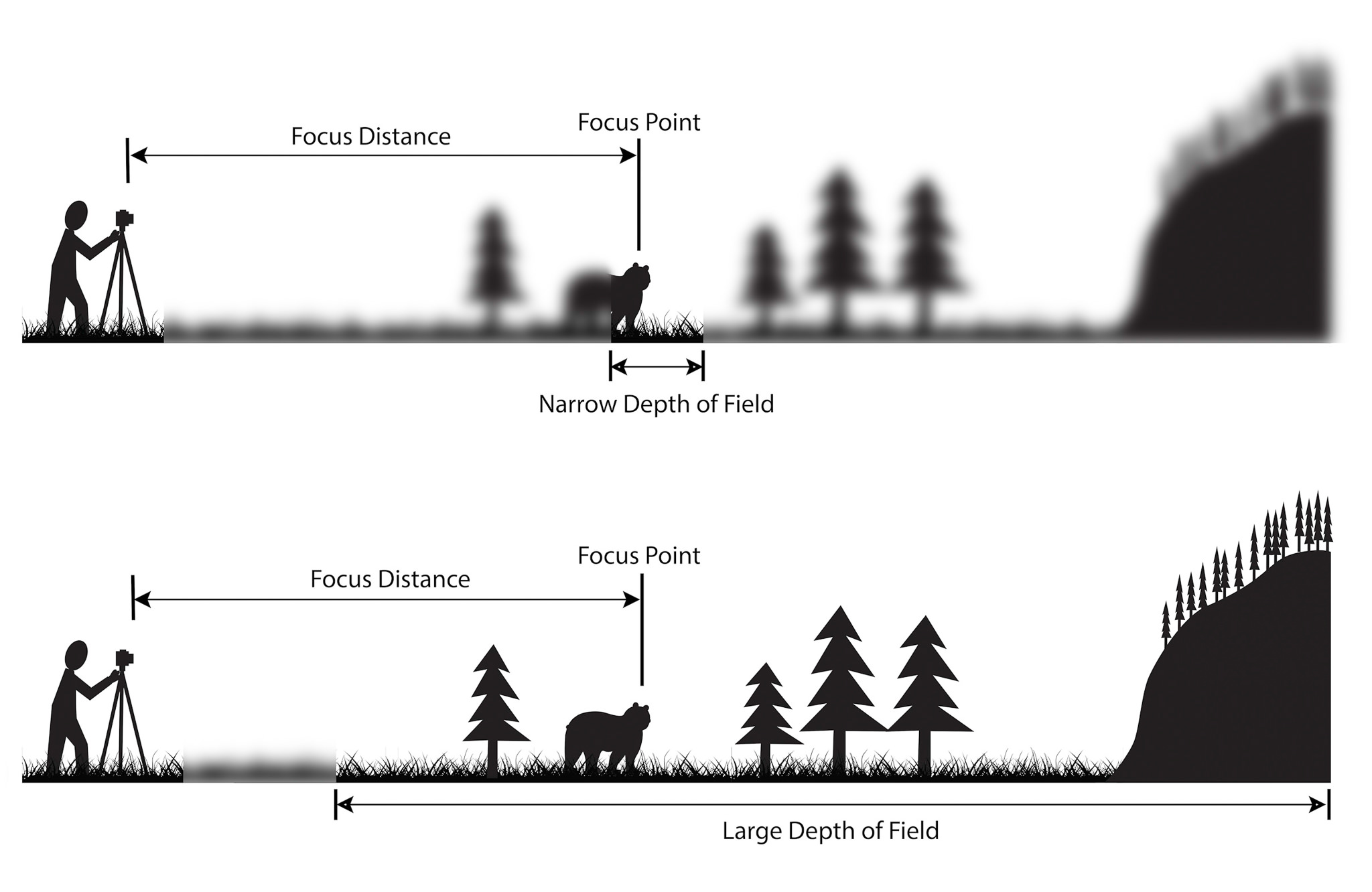
Look at the image below. The top diagram shows a narrow or shallow depth of field. Only the bear, the subject, is sharp. The foreground and background are blurred, isolating the subject. The bottom diagram shows a large or deep depth of field, where everything from the foreground grass to the distant hills is in focus.
To get a more formal understanding of this concept, let's turn to a detailed guide from StudioBinder.
The Essential Guide to Depth of Field [with Examples] - StudioBinder
This article provides a solid definition and uses helpful analogies to make the concept intuitive.
Please read the first two main sections. Start with the definition of DOF, which introduces the key terms plane of focus and point of focus. Then, continue to the section "UNDERSTANDING DEPTH OF FIELD" and read the analogies involving a hallway and drinking glasses. These will help you visualize the "depth" part of the term.
As you've just read, the depth of field is essentially the size of the "sharpness zone" along the z-axis (the axis of depth, pointing away from the camera). A shallow DOF means this zone is small, while a deep DOF means it's large.
2. The Creative Power of DOF: Shallow vs. Deep Focus
Controlling depth of field is a crucial storytelling choice. By deciding what is sharp and what is soft, you are telling the audience where to look and what to feel. The two primary approaches are shallow focus and deep focus.
The StudioBinder channel has an excellent video that breaks down these techniques using memorable film examples. Watching this will help you connect the technical concept of DOF to its emotional and narrative impact.
Depth of Field Explained: Ultimate Guide to Camera Focus [Shot List Ep. 4]
This video illustrates how professional cinematographers use deep and shallow focus for storytelling.
First, watch the segment on deep focus, which shows how keeping everything sharp can immerse the viewer in the environment. Then, watch the explanation of shallow focus, paying close attention to how it isolates subjects and guides attention.
Let's summarize the key uses for each, especially in the context of advertising:
-
Shallow Focus (Narrow DOF):
- Purpose: To isolate a subject from its background. This immediately draws the viewer's eye to what's important—your product, a model's face, a specific feature.
- Aesthetic: It creates a premium, "cinematic" look. The soft, blurry background lights, known as bokeh, are often associated with high-end photography and film.
- Ad Use Cases: Hero shots of products (watches, perfumes, smartphones), flattering portraits in fashion and beauty campaigns, food photography that makes the dish look irresistible.
-
Deep Focus (Large DOF):
- Purpose: To show a subject within its context. It keeps the foreground, mid-ground, and background all sharp.
- Aesthetic: It creates a sense of realism, grandeur, or transparency. It invites the viewer to explore the whole scene.
- Ad Use Cases: Travel and automotive ads showing a car in a vast, epic landscape; real estate photography displaying an entire room; any ad where the environment is part of the product's story (e.g., an outdoor gear ad).
3. The Three Controls of Depth of Field
Now for the most important part for your AI prompting work: how do you actually control the depth of field? There are three main variables you can manipulate in a real camera, and these are the same variables you will specify in your prompts.
The video below gives a fantastic, concise overview of these three factors.
Learn Depth of Field in 6 Minutes (With Real Examples)
This short video clearly explains and demonstrates the three factors that control depth of field.
Watch the segments explaining the three main controls: aperture, distance to subject, and focal length.
As the video demonstrated, the three controls are:
-
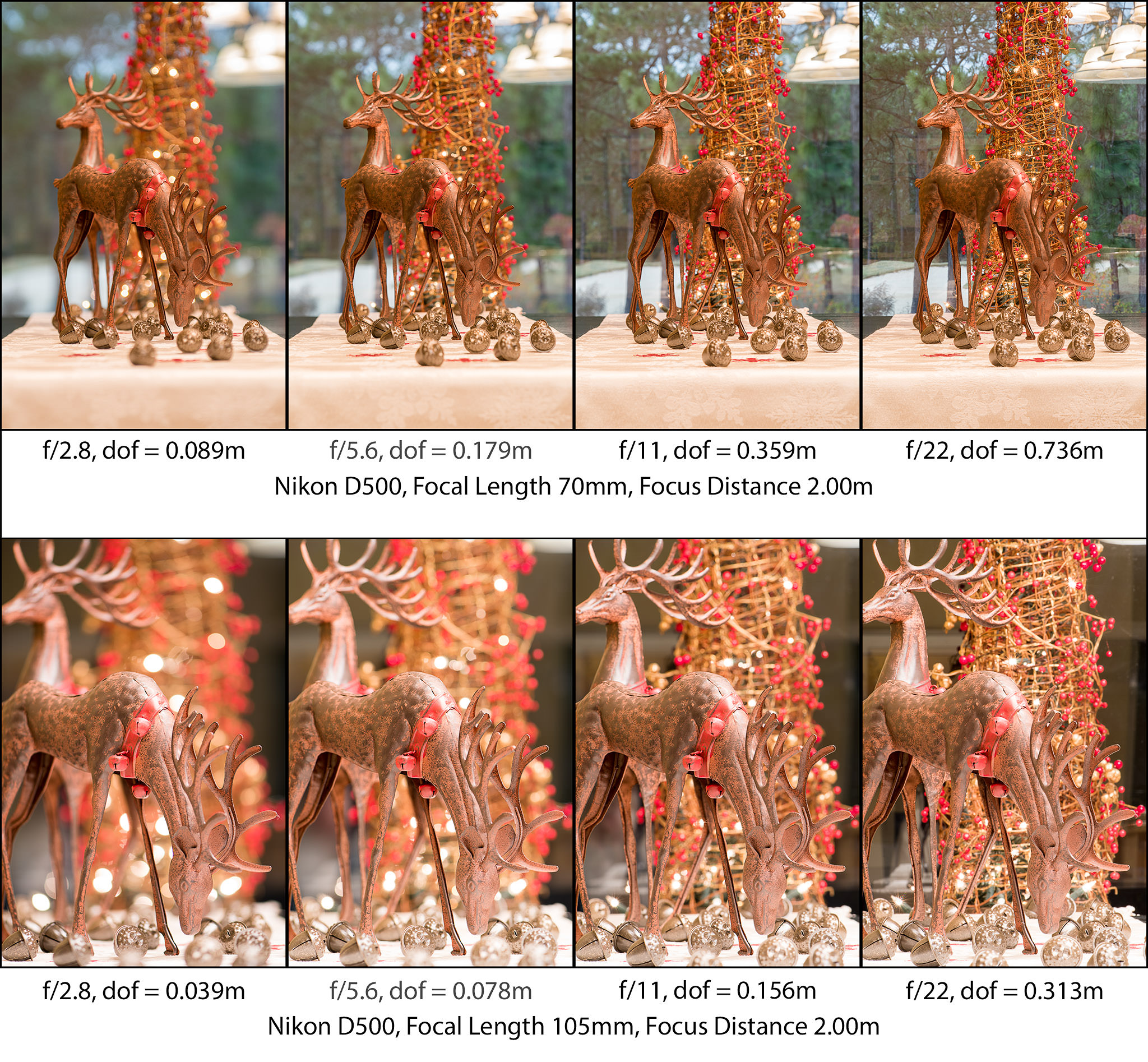
Aperture (F-stop): This is the opening in the lens that lets light in. It's the most direct way to control DOF. The key relationship is inverse:
- Wide Aperture = Small f-number (e.g., f/1.8, f/2.8) = Shallow DOF (more background blur).
- Narrow Aperture = Large f-number (e.g., f/11, f/22) = Deep DOF (more of the scene is sharp).
-
Distance to Subject: The closer your camera is to the subject you're focusing on, the shallower the depth of field will be. This is why macro (extreme close-up) photography almost always has a very blurry background.
-
Focal Length: This connects directly to our last lesson. Longer focal lengths (telephoto lenses) will produce a shallower depth of field than wider focal lengths, assuming you frame the subject similarly. They magnify the background and enhance the blur and compression effects.
The image below provides a perfect illustration of these principles.
4. Practical Exercise: Directing Focus on a Product
It's time to put this theory into practice. Your task is to create two distinct advertisements for the same product, using depth of field as your primary creative tool. This will be a great piece for your portfolio.
Subject: A high-end, elegant perfume bottle on a reflective black surface.
-
The "Premium Isolate" Shot (Shallow DOF - 30 minutes):
- Goal: Create a classic luxury product shot that makes the perfume bottle the undeniable hero. The feeling should be sophisticated and focused.
- Prompt Strategy: Use a low f-stop number, specify a longer focal length, and describe the focus being on the bottle itself.
- Example Prompt Keywords:
product photography, elegant perfume bottle on a reflective surface, **shallow depth of field, f/1.8**, cinematic lighting, **100mm macro lens**, soft **bokeh** highlights in the background, extremely detailed, commercial advertisement - What to look for: The perfume bottle should be perfectly sharp, but the background and even parts of the reflective surface should fall off into a soft, pleasing blur.
-
The "In-Situ" Shot (Deep DOF - 30 minutes):
- Goal: Create a lifestyle shot that shows the perfume as part of an elegant scene. The feeling should be more contextual and story-driven. Place the bottle on a marble vanity next to a silver jewelry tray and a single white rose.
- Prompt Strategy: Use a high f-stop number and describe a scene where all elements are sharp and clear.
- Example Prompt Keywords:
lifestyle product photography, elegant perfume bottle on a marble vanity next to a silver jewelry tray and a white rose, **deep depth of field, everything in focus, f/16**, bright and clean lighting, wide angle, commercial advertisement - What to look for: The perfume bottle, the rose, the jewelry tray, and the texture of the marble vanity should all be clearly visible and sharp. The image tells a broader story about the kind of person who uses this perfume.
Compare your two results. See how you, as the creative director, have created two completely different ads with different messages, just by controlling the depth of field.
Conclusion
You have now demystified one of the most significant aspects of professional photography and cinematography. By mastering depth of field, you are no longer just generating an image; you are directing the viewer's eye with intent.
Here are your key takeaways:
- Depth of Field (DOF) is the zone of acceptable sharpness in an image, extending in front of and behind the point of focus.
- Shallow DOF (achieved with a wide aperture like f/1.8) isolates your subject, creating a professional, cinematic look and directing viewer attention.
- Deep DOF (achieved with a narrow aperture like f/11) keeps the entire scene in focus, providing context and creating a sense of realism or grandeur.
- DOF is controlled by three main factors: Aperture (f-stop), distance to the subject, and focal length. These are the keywords you will use in your prompts to control this effect.
In our lessons so far, we've focused entirely on the camera—composition, angles, lenses, and focus. But a camera only captures light. In our next lesson, we will move on to shaping that light itself. You'll learn about the foundational three-point lighting setup, the system used in film and advertising to sculpt subjects and create mood.