Recommended resources
The freely available resources this lesson will direct you to.
- Ultimate Guide to Camera Angles: Every Camera Shot Explained [Shot List, Ep. 3]www.youtube.com
- How to Tell a Story With CAMERA ANGLESwww.youtube.com
- Mastering Angles of Camera Shots for Powerful Storytelling | Prac Skills Blogwww.pracskills.co.nz
- Different types of shots and camera angles in filmwww.adobe.com
Welcome to the next lesson in our "Foundations of Visual Design" module. In our previous session, you learned to master cinematic shot types—the art of controlling the distance between the camera and the subject to establish context, reveal action, or create intimacy. You now have the vocabulary to describe whether you're looking at a wide, medium, or close-up shot and can explain the strategic purpose of each in an advertisement.
This lesson adds another critical layer to your directorial toolkit: camera angles. If shot type determines what we see, camera angle determines how we feel about it. By simply changing the camera's vertical position or tilting it, you can make a subject appear powerful or vulnerable, trustworthy or menacing. For your ambition of creating high-end AI advertising, understanding this "emotional grammar" is essential. It's how you make a running shoe look heroic, a cup of coffee feel comforting, or a new piece of technology seem revolutionary.
By the end of this lesson, you will be able to classify the common camera angles and explain precisely how they manipulate viewer emotion and perception to serve a narrative or commercial goal.
1. The Power of Perspective: High, Low, and Eye-Level
The vertical placement of the camera is one of the most powerful and subconscious tools in visual storytelling. Three foundational angles form the bedrock of this technique: the high-angle shot, the low-angle shot, and the eye-level shot. Each one establishes a distinct power dynamic between the viewer and the subject.
The article "Mastering Angles of Camera Shots for Powerful Storytelling" provides an excellent, practical introduction to this concept, framing these angles as the "primary colors" of your visual palette.
Mastering Angles of Camera Shots for Powerful Storytelling | Prac Skills Blog
This article explains the psychological impact of camera angles in a clear, straightforward way. It's perfect for understanding not just what the angles are, but why they work.
Start by reading the introduction to understand how camera angles function as emotional grammar. Then, focus on the sections that break down the three foundational angles. Pay close attention to the summary table, as it's a great cheat sheet. Read the detailed explanations for the Eye-Level Shot, the High-Angle Shot, and the Low-Angle Shot. Finally, jump to the FAQ section and read the answer to the question "How Do I Choose the Right Angle to Create a Specific Emotion?" to solidify your understanding.
To see these principles in action, the following video from StudioBinder offers a superb visual guide, complete with examples from iconic films that make the emotional impact of each angle immediately clear.
Ultimate Guide to Camera Angles: Every Camera Shot Explained [Shot List, Ep. 3]
This video breaks down the core camera angles using dynamic film clips, which will help you internalize their effects much faster than with static images alone.
Watch the segment on the low angle shot to see how it's used to create power. Next, watch the explanation of the high angle shot to understand how it conveys vulnerability. Finally, watch the section on the eye-level shot to see how it establishes a neutral, direct connection.
Let's summarize how these apply directly to advertising:
- Low-Angle Shot: This is your go-to for the "hero shot." By looking up at a product—be it a car, a sneaker, or a bottle of perfume—you instantly make it appear dominant, desirable, and larger-than-life. It elevates the product from a mere object to an aspirational icon.
- High-Angle Shot: This angle is perfect for setting up a problem that your product will solve. A high-angle shot looking down on a person struggling with a task makes them seem vulnerable and overwhelmed. When the product is introduced, the camera angle can shift to eye-level or a low-angle, visually signaling the transfer of power and control.
- Eye-Level Shot: This is the angle of trust and authenticity. When you want to portray a brand as relatable, honest, and approachable, the eye-level shot is your best tool. It puts the viewer on the same plane as the subject (e.g., a customer enjoying the product), creating a sense of connection and empathy.
2. Advanced Angles for Dramatic Effect
Beyond the foundational trio, filmmakers use more specialized angles to create specific moods and dramatic tension. These are less about simple power dynamics and more about shaping the psychological state of the scene.
This image provides a great overview of some of these angles, showing how they are used in famous movie scenes.
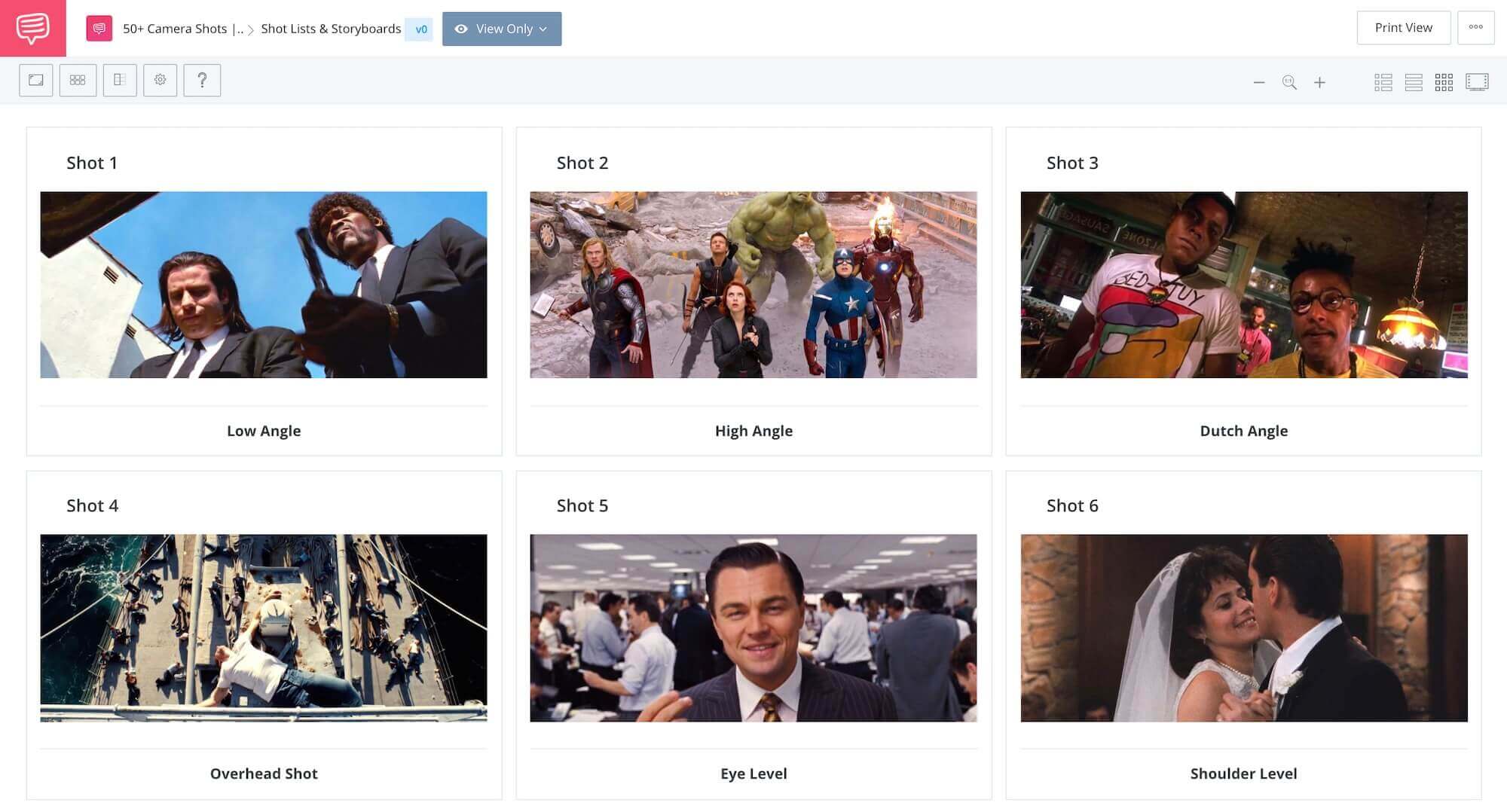
Let's explore two of the most impactful ones: the overhead shot and the Dutch angle.
The Overhead Shot (or Bird's-Eye View)
As the name suggests, this shot places the camera directly above the subject, looking straight down. This "God's-eye" perspective is useful for several reasons:
- Geography and Scale: It can reveal the layout of a scene, like a car navigating a complex cityscape or the organized chaos of a busy kitchen.
- Pattern and Design: It's often used in food and product commercials to create beautiful, symmetrical compositions that highlight the aesthetic appeal of the subject.
- Isolation or Fate: It can make a subject seem small and isolated within a vast environment, or suggest that they are a pawn in a larger game, moved by forces beyond their control.
The Dutch Angle (or Canted Angle)
This is a technique where the camera is tilted on its roll axis, skewing the horizontal line. This immediately creates a sense of imbalance and disorientation. Our brains are wired to expect a level horizon, and when that's disrupted, it signals that something is wrong, unstable, or out of the ordinary. In advertising, this can be used to:
- Create Tension or Excitement: For a sports drink or action movie trailer, a Dutch angle can heighten the sense of dynamic, chaotic energy.
- Signal Disruption: A tech company wanting to portray itself as a "disruptor" might use subtle Dutch angles to visually communicate that they are changing the status quo.
- Portray a "Before" State: Similar to a high-angle shot, a Dutch angle can be used to show a character's uneasy or chaotic state of mind before a product brings them clarity and balance.
The StudioBinder video you watched earlier also contains excellent explanations for these more dramatic angles.
Ultimate Guide to Camera Angles: Every Camera Shot Explained [Shot List, Ep. 3]
Now, let's revisit the same video to see how these advanced angles are used to create specific moods.
Watch the section on the overhead shot to understand its use for showcasing movement and creating a sense of detachment. Then, review the segment on the Dutch angle to see how it effectively generates unease and tension.
This diagram helps visualize the physical camera placements for these different angles.

3. Practice Exercise: Directing Emotion with Angles
Now it's time to put theory into practice. This exercise will sharpen your ability to choose angles with intention and to translate emotional concepts into effective AI art prompts.
Part 1: Analysis (15 minutes)
Find a professional commercial for a car on YouTube. Car commercials are famous for their masterful use of camera angles to evoke feelings of power, freedom, and prestige.
Watch the ad several times. Identify at least three distinct camera angles used. For each one, write down:
- Angle Type: (e.g., Low Angle, High Angle, Eye-Level, Dutch Angle).
- Subject: What is the focus of the shot? (e.g., the front grille of the car, the car driving on a winding road, the driver's face).
- Emotional Goal: Why did the director choose this angle? What feeling were they trying to evoke in the viewer? (e.g., "The low-angle shot of the grille makes the car look aggressive and powerful," "The overhead shot of the car on the empty road creates a sense of freedom and escape").
Part 2: Creation (25 minutes)
Your task is to tell two completely different stories about the same product, using only a change in camera angle. Choose a simple object, like a pair of boots, a watch, or a coffee cup.
Using your preferred AI image generator, create two images:
- Image 1: The "Powerful" Shot. Use a low angle to make the object look heroic, strong, and dominant. Your prompt should be built around this angle.
- Image 2: The "Vulnerable" or "Contextual" Shot. Use a high angle to make the object look like part of a larger scene, or to evoke a sense of quietness or solitude.
Example Idea:
- Product: A rugged leather hiking boot.
- Prompt for Image 1 (Low Angle):
Cinematic low angle shot of a single, mud-splattered leather hiking boot planted firmly on a rocky mountain peak. The boot dominates the frame, looking heroic and indestructible against a dramatic, cloudy sky. Epic, adventurous mood. - Prompt for Image 2 (High Angle):
High angle, top-down shot of a pair of worn leather hiking boots resting on a wooden cabin floor next to a crackling fireplace. A steaming mug of coffee sits beside them. The mood is peaceful, cozy, and restful after a long journey.
Execute your own idea. The goal is to see how dramatically the prompt low angle shot versus high angle shot can alter the entire narrative and emotional resonance of an image. This is a core skill for directing AI to produce specific commercial outcomes. Add the two resulting images to your growing portfolio.
Conclusion
In this lesson, you have unlocked another fundamental secret of visual language. You now understand that camera placement is not a passive choice, but an active tool for directing audience emotion.
Here are your key takeaways:
- Angles control power dynamics: Low angles empower the subject, high angles diminish them, and eye-level shots create a neutral sense of equality and trust.
- Angles create mood: Specialized angles like the overhead shot can establish scale and detachment, while the Dutch angle is a powerful tool for creating tension and unease.
- Angle choice is intentional: In advertising, every camera angle is a strategic decision designed to shape the viewer's perception of a product or brand, making it feel heroic, trustworthy, exciting, or comforting.
You have now explored how to compose elements within the frame (composition), how to choose the distance to your subject (shot type), and how to select the angle of the camera.
In our next lesson, we will complete this foundational set of cinematic tools by exploring camera lens types. You will learn how the choice of a wide-angle, standard, or telephoto lens can drastically alter perspective, distort space, and control the depth of field to create a truly professional and cinematic look.