Recommended resources
The freely available resources this lesson will direct you to.
- Demystifying NCCL An In depth Analysis of GPU Communication Protocols and Algorithms - Zhiyi Huwww.youtube.com
- MultiGPU + NCCL from the authorswww.youtube.com
- [PDF] xCCL: A Survey of Industry-Led Collective Communication Libraries ...jcst.ict.ac.cn
- Unpacking NCCL: A Deep Dive into Multi-GPU ...medium.com
Introduction
In our previous lesson, we established how GPU-Direct technologies create low-latency hardware pathways—like GPU-Direct RDMA—that allow GPUs to communicate directly with network cards and storage devices, bypassing the CPU. These mechanisms are the physical freeways for data. However, programming directly against this hardware, managing memory address translations, and orchestrating data movement across different interconnects like NVLink, PCIe, and InfiniBand is incredibly complex.
This brings us to a crucial software abstraction layer. This lesson's objective is to explain the role of collective communication libraries (e.g., NCCL) in abstracting these hardware communication details.
We will explore how libraries like the NVIDIA Collective Communications Library (NCCL) provide a simple, high-level API that allows developers to express common communication patterns, called "collectives," without needing to manage the underlying hardware. You will learn:
- Why specialized libraries like NCCL were developed for GPUs, as opposed to using existing standards like MPI.
- The core architectural concepts NCCL uses to achieve abstraction and high performance, such as communicators, channels, and logical topologies.
- How NCCL intelligently selects the optimal transport mechanisms (like GPU-Direct RDMA), protocols, and algorithms at runtime.
- How this abstraction enables developers to write portable, high-performance distributed code.
By the end of this lesson, you'll understand how NCCL acts as a sophisticated translation layer between the high-level intent of a distributed algorithm and the complex reality of the underlying hardware.
From Hardware Primitives to Collective Operations
In distributed computing, certain communication patterns are so common they are given specific names. These are called collective operations. They involve a group of processes (or GPUs) communicating in a coordinated way.
[PDF] xCCL: A Survey of Industry-Led Collective Communication Libraries ...
To start, let's review the most common collective operations. This survey paper on collective communication libraries provides a concise overview.
Please read Section 2, 'Collective Communication Routines' (pages 168-169). Familiarize yourself with the definitions of operations like Broadcast, All-Gather, All-to-All, and especially All-Reduce, which is fundamental to data-parallel training.
A developer training a neural network wants to think in these terms—for example, "average the gradients from all GPUs" (an All-Reduce operation). They do not want to write code that manually handles the specific interconnects available on a given machine.
This is the fundamental problem that collective communication libraries solve. They provide an API for these high-level operations, abstracting away the hardware implementation details.
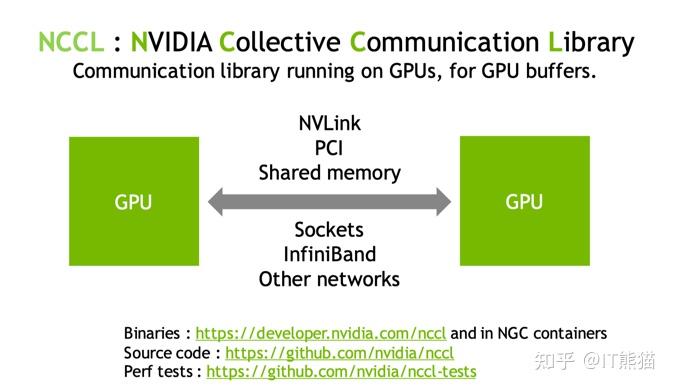
Why a New Library? NCCL vs. MPI
For someone with your background in computer science, a natural question arises: Collective communication is a well-understood problem, and libraries like the Message Passing Interface (MPI) have existed for decades. Why was it necessary for NVIDIA to create NCCL?
The answer lies in design philosophy and specialization. MPI was designed as a general-purpose standard for CPU-based high-performance computing. It is feature-rich, supporting complex data structures, flexible message matching (tags and wildcards), and multiple processes per device. While powerful, this generality introduces overhead and a programming model misaligned with the GPU's architecture.
NCCL, in contrast, was designed from the ground up with one goal: to be the most efficient implementation of collectives for NVIDIA GPUs. It makes several simplifying assumptions that are ideal for the GPU environment:
- Stream-based Execution: NCCL operations are enqueued on CUDA streams, allowing for natural synchronization and overlap with GPU compute kernels.
- Simple Data Model: It operates on contiguous blocks of data, avoiding the overhead of parsing complex data types.
- One Rank Per GPU: NCCL assumes a one-to-one mapping between a communicating process (a "rank") and a GPU, which drastically simplifies resource management and communication logic.
The following video from a principal engineer on the NCCL team at NVIDIA provides an excellent explanation of these differences.
MultiGPU + NCCL from the authors
In this segment, the speaker directly compares the feature sets of MPI and NCCL, explaining why MPI's generality is a poor fit for the GPU execution model.
Watch the section from 38:17 to 42:48. Pay close attention to the features of MPI that are omitted in NCCL (like underflow, complex data types, wildcards) and why that simplification leads to higher performance on GPUs.
In essence, NCCL sacrifices the generality of MPI for specialization, resulting in a lightweight, high-performance library purpose-built for the common patterns in deep learning.
Inside NCCL: An Architecture of Abstraction
So, how does NCCL achieve this powerful abstraction? It can be thought of as a dataflow compiler for collectives. When a user calls a function like ncclAllReduce, NCCL orchestrates a complex sequence of operations, automatically optimized for the specific hardware it's running on.
Let's break down its key architectural components.

1. The Communicator: Discovering the World
The first step in any NCCL program is creating a communicator. During this initialization (ncclCommInitRank), NCCL performs a critical discovery phase. It queries the system to learn the full hardware topology:
- How many GPUs are there?
- How are they connected (NVLink, PCIe)?
- What is the PCIe topology (which GPUs are on the same root complex)?
- What network interfaces are available, and do they support GPU-Direct RDMA?
This discovered topology is stored within the communicator object. This object now holds the map that NCCL will use to plan all future communication, making the discovery process a one-time cost.
2. Channels: Parallelizing Communication
To maximize bandwidth utilization, NCCL doesn't send a large message in one go. Instead, it splits the data into chunks and processes these chunks in parallel across multiple channels. A channel is essentially a dedicated execution context with its own set of resources. This allows NCCL to saturate multiple physical links (like multiple NVLink connections or NICs) simultaneously.
Demystifying NCCL An In depth Analysis of GPU Communication Protocols and Algorithms - Zhiyi Hu
This video provides a clear explanation of NCCL's internal architecture, starting with the concept of channels and logical topologies.
Watch from 04:37 to 06:00. This section explains how NCCL uses multiple virtual channels for parallel data processing and builds logical topologies (Ring or Tree) for each channel during communicator initialization.
3. Automatic Transport, Protocol, and Algorithm Selection
This is the heart of NCCL's abstraction. For every collective operation, NCCL dynamically makes a multi-level decision, completely hidden from the user.
-
Transport Selection: Based on the topology stored in the communicator, NCCL chooses the fastest available data path between any two GPUs.
- Intra-Node (within a server): It prioritizes the fastest path, typically NVLink, falling back to PCIe P2P, and finally to a path through shared host memory if direct P2P is not possible or performant (e.g., across NUMA nodes).
- Inter-Node (between servers): It will use GPU-Direct RDMA if the hardware supports it, allowing the NIC to talk directly to GPU memory. If not, it falls back to a standard TCP/IP path, which involves copying data through a CPU "bounce buffer." This directly leverages the technologies we discussed in the previous lesson.
-
Protocol Selection: On top of the transport, NCCL selects a communication protocol optimized for the message size.
- Simple Protocol: For large messages, to maximize bandwidth.
- Low Latency (LL / LL128) Protocols: For small messages, using atomic operations to minimize synchronization overhead.
-
Algorithm Selection: Finally, NCCL chooses a collective algorithm best suited to the operation and network characteristics.
- Ring Algorithm: Excellent for bandwidth-bound operations, as it can saturate the interconnect.
- Tree Algorithm: Better for latency-sensitive operations on small messages, as it requires fewer steps (
O(log k)vs.O(k)for the ring, wherekis the number of GPUs).
The following resources provide a fantastic deep-dive into how these choices are made.
Unpacking NCCL: A Deep Dive into Multi-GPU Communication
This article masterfully explains the different layers of NCCL's decision-making process, from transport mechanisms to protocols and algorithms.
Please read the sections 'How NCCL Communicates: Understanding Its Protocols', 'Intra- and Inter-Node Transport Mechanisms', 'Algorithm Implementations', and 'Protocol and Algorithm Selection'. This will solidify your understanding of how NCCL's layers of abstraction work together.
This automated, multi-layered optimization is what makes NCCL so powerful. The developer simply states their intent (e.g., AllReduce), and NCCL acts as the expert system architect, figuring out the best possible way to execute that intent on the given hardware.
Conclusion
In this lesson, we have seen how collective communication libraries, and NCCL in particular, serve as a critical abstraction layer that makes the power of modern interconnects accessible and programmable. Without this layer, every developer would need to be a hardware and systems expert, writing brittle, non-portable code for each specific machine configuration.
Key Takeaways:
- Abstraction is Key: Collective communication libraries like NCCL provide high-level APIs (e.g.,
AllReduce,Broadcast) that hide the enormous complexity of the underlying hardware interconnects (NVLink, PCIe, InfiniBand). - Specialization for Performance: NCCL outperforms general-purpose libraries like MPI for deep learning workloads because it is specifically designed for the GPU's stream-based execution model and makes simplifying assumptions, such as one rank per GPU.
- NCCL as a "Dataflow Compiler": NCCL achieves its performance and abstraction through a sophisticated, multi-layered decision process. At runtime, it automatically selects the optimal:
- Transport: Preferring direct paths like NVLink and GPU-Direct RDMA.
- Protocol: Choosing between bandwidth-optimized (Simple) and latency-optimized (LL/LL128) options based on message size.
- Algorithm: Selecting between topologies like Ring and Tree to match the workload's needs.
- Separation of Concerns: This architecture separates the logical dataflow of a collective from the physical implementation, allowing developers to write performant, portable code that runs efficiently across a wide range of hardware configurations.
Preview of the Next Lesson:
Now that we understand the role of NCCL as an abstraction layer, we will focus on the single most important collective operation for distributed training. In the next lesson, we will describe the AllReduce collective operation and its function in synchronizing gradients for data-parallel training, laying the groundwork for understanding how large models are trained across many GPUs.