Recommended resources
The freely available resources this lesson will direct you to.
Hello! Welcome to the third lesson in our module on advanced property valuation.
In our last two lessons, we explored the Sales Comparison Approach (SCA), mastering the art of "homogeneización" to value a property based on what similar ones have sold for. This is the most common method, but it has a significant limitation: it requires a market with recent, comparable sales.
So, what do you do when valuing a one-of-a-kind property, a brand-new building with no sales history, or a special-use property like a school or a fire station? The SCA falls short. This is where our next tool comes in. Today, your learning outcome is to explain the cost approach and when it is applicable for valuation.
We will deconstruct this method, which is based on the fundamental economic principle that a rational buyer won't pay more for a property than it would cost to build an equivalent one from scratch.
1. The Principle of the Cost Approach
The Cost Approach is another application of the Principle of Substitution. It determines a property's value by calculating what it would cost to replace it with a similar one, at current prices. The value is essentially the sum of the land value and the depreciated cost of the building and other improvements.
This method is particularly useful in specific scenarios. Let's see where it fits within the official Spanish valuation framework.
Impacto de la Reciente Modificación de la Orden ECO/805
The following resource provides a concise overview of the four official valuation methods in Spain. Pay attention to the summary table to understand the specific applicability of the Cost Approach.
First, read the section 'El Enfoque de Coste: Método del Coste (Artículos 17-19)' for a clear definition. Then, look at the summary table and locate the row for the 'Coste' method. Note its applicability: 'Todo tipo de edificios (en proyecto, construcción o terminados)'. This highlights its versatility, especially for properties where market or income data is unavailable.
As you saw, the Cost Approach is applicable for virtually any building type. It is the go-to method for:
- New constructions: where the cost is known and depreciation is minimal.
- Unique or special-purpose properties: like public buildings, churches, or custom-designed homes where no comparables exist.
- Insurance purposes: to determine the cost to rebuild a property after a loss.
The entire process can be visualized as a clear, four-step sequence.
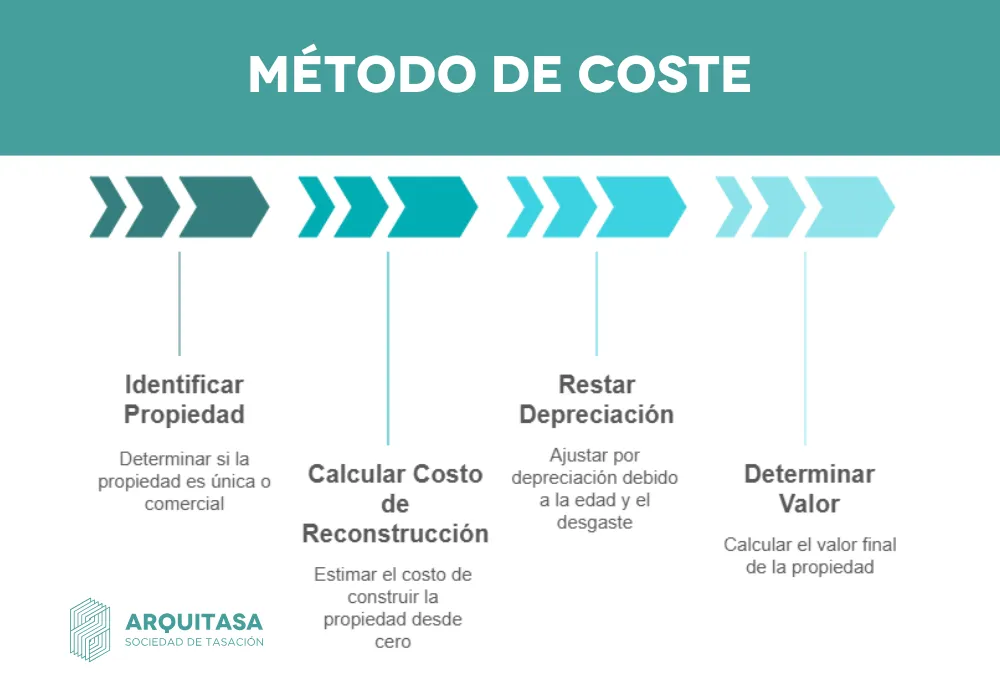
The final value derived from this method is called the Valor de Reemplazamiento (Replacement Value). Let's break down how it's calculated.
2. Calculating the Cost: VRB and VRN
The Cost Approach calculates two key values:
- Valor de Reemplazamiento Bruto (VRB) or Gross Replacement Value: The total cost to build the property new today.
- Valor de Reemplazamiento Neto (VRN) or Net Replacement Value: The VRB minus depreciation. This is the final value estimate.
Let's examine the components of the VRB first.
MÓDULO II: MÉTODOS DE CÁLCULO (Método del Coste)
This university guide on the Cost Method, from the 'Iniciación a la Valoración Inmobiliaria' course, provides a detailed breakdown of the calculation process. We will use it to understand the components of the VRB.
Read the sections '1. INTRODUCCIÓN', '2. DEFINICIÓN', and '3. CÁLCULO DE VALOR DE REEMPLAZAMIENTO', focusing on '3.1. Cálculo del Valor de Reemplazamiento Bruto (VRB)'. This will introduce you to the core formula and its three main components.
As the document explains, the formula for Gross Replacement Value is an additive process, much like summing up costs in a project budget:
Let's briefly touch on each component:
- Valor del Suelo (Land Value): The market value of the land as if it were vacant. This is often determined using the Sales Comparison Approach on recent sales of similar empty lots.
- Coste de Construcción (Construction Cost): This is the "hard cost" of building the structure. It includes everything from the foundation to the roof: materials, labor, and the contractor's general expenses and profit (
Gastos Generales y Beneficio Industrial). For estimations, appraisers often use standardized costs per square meter (€/m²) based on the building's type and quality. - Gastos Necesarios (Necessary Expenses): These are the "soft costs" required for the project. They include non-recoverable taxes (like a portion of IVA or ITP), architect and engineering fees, permits and licenses, and administrative costs for the developer. Crucially, as noted in the resource, the developer's profit is not included here, only their administrative overhead.
Once you have the VRB, you have the value of a brand-new, identical property. But most properties aren't new. The next step is to account for age and obsolescence.
3. Accounting for Wear and Tear: Depreciation
Depreciation is the loss in value due to a property's age, condition, and functionality. Think of it as the difference in value between a 2023 model car and an identical 2003 model. The Cost Approach accounts for three types of depreciation:
- Deterioro Físico (Physical Deterioration): The straightforward wear and tear from use and the elements. A leaky roof or peeling paint are examples.
- Obsolescencia Funcional (Functional Obsolescence): Loss in value from an outdated design or features that don't meet modern standards. A 5-bedroom house with only one bathroom is a classic example.
- Depreciación Económica (Economic Obsolescence): Loss in value from external factors, outside the property itself. For instance, if a noisy factory is built next to a residential building, the building's value may decrease due to economic obsolescence.
While understanding these types is important, for practical valuation in Spain, a simplified linear depreciation model is often used.
MÓDULO II: MÉTODOS DE CÁLCULO (Método del Coste)
Let's return to the 'Método del Coste' guide to learn how depreciation is calculated in practice.
Read the subsections '3.2. Cálculo del Valor de Reemplazamiento Neto (VRN)' and '3.2.1. Depreciación'. Then, focus carefully on '3.2.2. Sistema de Depreciación Lineal'. Understand the formula D = d x C and how to use the tables (Tabla 1 and Tabla 2) to find the inputs.
The key takeaway is the practical formula for the total depreciation percentage (D):
Where:
- d (Depreciación por antigüedad): This is the age-based depreciation, calculated as
d = Antigüedad / Vida útil.Antigüedad: The effective age of the building in years.Vida útil: The total expected economic life. The guide provides a table (Tabla 1) with standard values, e.g., 100 years for residential buildings.
- C (Depreciación por conservación): This is a correction factor based on the building's state of repair. The guide's table (Tabla 2) provides coefficients: 0.75 for "Good" condition (less depreciation), 1.00 for "Medium," and 1.25 for "Bad" (more depreciation).
Important: Depreciation is only applied to the building's value (Coste de Construcción + Gastos Necesarios), not to the land value. Land is assumed not to depreciate.
The final Net Replacement Value (VRN) is then:
Or, more simply:
Where Depreciación is the percentage D applied to the building cost. The complete example in section 5. EJEMPLO PRÁCTICO 1 of the document walks through this calculation step-by-step.
Test your understanding!
Let's calculate the Net Replacement Value (VRN) for a residential property with the following characteristics.
- Land Value: €100,000
- Total Construction Cost (including necessary expenses): €250,000
- Property Type: Residential Building
- Antiquity (Age): 40 years
- State of Conservation: Mala (Bad)
Calculate the VRN.
Show answer
-
Calculate the Gross Replacement Value (VRB):
-
Calculate the Depreciation Percentage (D):
- d (Antiquity factor): From Tabla 1, the
Vida útilfor a residential building is 100 years.
- C (Conservation factor): From Tabla 2, the coefficient for "Mala" conservation is 1.25.
- Total Depreciation (D):
- d (Antiquity factor): From Tabla 1, the
-
Calculate the Depreciation Amount:
This 50% is applied only to the building's cost. -
Calculate the Net Replacement Value (VRN):
The estimated value of the property using the Cost Approach is €225,000.
Here's how you could model this in a simple Python function:
def calculate_vrn(land_value, construction_cost, vida_util, antiquity, conservation_coeff):
    """Calculates the Net Replacement Value (VRN) for a property."""

    # 1. Calculate Gross Replacement Value (VRB)
    vrb = land_value + construction_cost

    # 2. Calculate Depreciation Percentage (D)
    d = antiquity / vida_util
    D = d * conservation_coeff

    # Ensure depreciation doesn't exceed 100%
    D = min(D, 1.0)

    # 3. Calculate Depreciation Amount
    depreciation_amount = construction_cost * D

    # 4. Calculate Net Replacement Value (VRN)
    vrn = vrb - depreciation_amount

    return vrn

# Our example
vrn_value = calculate_vrn(
    land_value=100000,
    construction_cost=250000,
    vida_util=100,
    antiquity=40,
    conservation_coeff=1.25
)

print(f"The Net Replacement Value (VRN) is: €{vrn_value:,.2f}")
# Output: The Net Replacement Value (VRN) is: €225,000.00
Conclusion
You have now added a second major valuation method to your analytical toolkit. Unlike the market-facing Sales Comparison Approach, the Cost Approach provides a value based on the intrinsic physical components of the property. Its procedural, additive nature makes it a very logical and transparent method, especially when market data is scarce.
Key Takeaways:
- The Cost Approach values a property based on the cost to build a replacement, following the Principle of Substitution.
- It is most applicable for new, unique, or special-purpose properties where market comparables are unavailable.
- The calculation starts with the Gross Replacement Value (VRB):
Land Value + Construction Cost + Necessary Expenses. - Depreciation (physical, functional, and economic) is subtracted from the building cost to account for age and obsolescence.
- The final value is the Net Replacement Value (VRN), which represents the depreciated cost of the asset.
Preview of the Next Lesson:
So far, we have two different ways to estimate a property's value: the SCA (what the market is paying) and the Cost Approach (what it would cost to build). A comprehensive appraisal often uses multiple methods. In our next lesson, we will learn how to reconcile valuation figures from the income, sales comparison, and DCF approaches to determine a final market value estimate, turning multiple data points into a single, defensible conclusion.