Recommended resources
The freely available resources this lesson will direct you to.
Hello! Welcome to your next lesson in the module on the taxation of Spanish real estate dispositions.
In the last few lessons, we've learned how to calculate the two main taxes on a property sale: the IRPF capital gains tax and the plusvalía municipal. Now, we'll dive into a crucial strategic element: time. The length of time you own a property—your holding period—can dramatically alter your final tax liability through a series of specific rules in Spanish tax law.
This lesson directly addresses the learning outcome: Analyze the impact of holding period on capital gains taxation in Spain. We will explore three distinct ways the holding period affects your taxes, moving from a common strategy for modern investments to a complex rule for very old properties, and finally recapping its effect on the local tax we just learned.
1. The 3-Year Rule: Unlocking the Reinvestment Exemption
One of the most powerful tax-saving mechanisms in Spain is the Exemption for Reinvestment in a Habitual Residence (Exención por Reinversión en Vivienda Habitual). This rule allows you to pay zero IRPF capital gains tax on the sale of your main home, provided you reinvest the full proceeds into a new main home.
The key question is: what qualifies as your "habitual residence" (vivienda habitual)? This is where the holding period is critical. For a property to be considered your habitual residence for tax purposes, you must have lived in it for a continuous period of at least three years.
There are exceptions (e.g., marriage, job relocation), but the 3-year rule is the standard benchmark. Holding a property for just under three years versus just over three years can be the difference between paying thousands in taxes and paying nothing.
The following video explains this rule, its conditions, and how it can be used strategically.
3 Formas para No Pagar NADA a Hacienda al Vender una Vivienda 🏘️
Watch this segment from the video '3 Formas para No Pagar NADA a Hacienda al Vender una Vivienda' by Jose Muñoz. It clearly explains the definition of a habitual residence, the 3-year holding requirement, and the timeframe for reinvestment.
Watch from 03:23 to 08:10. Focus on the two criteria for a 'vivienda habitual', the exceptions to the 3-year rule, and the 2-year window you have to reinvest the money.
As a software engineer, you can think of this as a critical if condition in your investment algorithm. If holding_period >= 3 years and is_habitual_residence, you can access a tax exemption function that reduces your IRPF liability to zero.
Test your understanding!
You buy an apartment in Madrid and live in it. After 2 years and 10 months, you receive a fantastic offer and sell it for a €100,000 profit. You immediately use all the sale proceeds to buy a new, larger apartment to live in. Will your €100,000 profit be exempt from IRPF tax?
Show answer
No, it will not be exempt. You did not meet the 3-year continuous residency requirement to have the property classified as your 'vivienda habitual' for tax purposes. Therefore, the reinvestment exemption does not apply, and you will have to pay IRPF capital gains tax on the €100,000 profit (unless an exception like a mandatory job relocation applies).
2. A Practical Strategy: "House Hacking," Spanish Style
Now let's connect this 3-year rule to a practical investment strategy. Given your interest in actionable methods, the concept of "House Hacking" is a perfect example of how to leverage tax rules. While the term is American, the strategy is perfectly adaptable to Spain.
The core idea is to:
- Buy a property with value-add potential (e.g., needs renovation) below market price.
- Renovate it and force appreciation.
- Live in it for at least 3 years, satisfying the 'vivienda habitual' requirement.
- Sell the property, realizing the profit from both your value-add work and market appreciation.
- Reinvest the full proceeds tax-free into your next, potentially larger or better-located, "house hack" project within two years.
By repeating this cycle, you can build equity and move up the property ladder using tax-free gains. The holding period of 3+ years is the linchpin of this entire strategy.
The next segment of the same video explains this concept.
3 Formas para No Pagar NADA a Hacienda al Vender una Vivienda 🏘️
Now, watch the next part of the video by Jose Muñoz, where he explicitly describes how to combine the reinvestment exemption with a value-add investment strategy—the Spanish version of 'House Hacking'.
Watch from 08:10 to 13:31. Pay attention to how buying below market, adding value, and respecting the 3-year holding period create a cycle of tax-free wealth generation.
3. The Transitional Regime for Pre-1994 Properties
Let's turn to a more complex, but potentially very lucrative, impact of the holding period. For properties acquired before December 31, 1994, a special transitional regime (Disposición Transitoria Novena of the IRPF law) allows for a significant reduction in the capital gains tax. This was designed to compensate for the high inflation in Spain in the 70s and 80s, which would otherwise lead to unfairly large taxable gains.
Here's how it works:
- Gain Proration: The total capital gain is split proportionally into two parts: the gain generated before January 20, 2006, and the gain generated after. This split is based on the number of days the property was held in each period.
- Reduction Application: Only the portion of the gain generated before Jan 20, 2006, is eligible for a reduction.
- Reduction Coefficients: This eligible gain is reduced by a certain percentage. For real estate, the reduction is 11.11% for every year (or fraction of a year) the property was held before December 31, 1994. The reduction is capped at 100%. This means any property held for 9 years or more before the end of 1994 gets a massive tax break.
- The €400,000 Limit: This is a crucial constraint added in 2015. The reduction can only be applied to a cumulative €400,000 of transmission value (sale price) per person across all assets sold since January 1, 2015. If a sale exceeds this limit, the reduction is applied proportionally.
This is a complex calculation. The following video provides an exceptionally clear explanation with worked examples.
…Y SI VENDO UNA VIVIENDA QUE ADQUIRÍ ANTES DEL 31-12-94. ¡REDUCCIÓN FISCAL MUY IMPORTANTE!.
The video '…Y SI VENDO UNA VIVIENDA QUE ADQUIRÍ ANTES DEL 31-12-94' from Coper Lorente is dedicated entirely to this transitional regime. It breaks down the rules and calculations step-by-step.
Watch from 00:27 to 08:31. This covers the introduction, the rules, and a complete worked example. Pay close attention to how the gain is split by date, how the reduction coefficient is calculated based on the pre-1994 holding period, and how the final tax is determined.
To solidify your understanding, you can also review the formal rules in the tax guide below.
For a formal, text-based reference, review the section on the transitional regime in the 'GUÍA PRÁCTICA DE LOS IMPUESTOS 2024'. This will reinforce the concepts from the video.
Find the section titled '2.4. Régimen transitorio (disposición transitoria novena, LIRPF)'. Read through this section to see the official breakdown of the calculation procedure. It can be a bit dense, but it's the legal source for the rules we've discussed.
4. Holding Period and Plusvalía Municipal (A Quick Recap)
Finally, as we covered in the previous lesson, the holding period also has a direct and straightforward impact on the plusvalía municipal tax.
When using the Objective Method to calculate this tax, the taxable base is found by multiplying the land's cadastral value by a coefficient. This coefficient is determined directly by the number of full years you've owned the property, as shown in the table below.
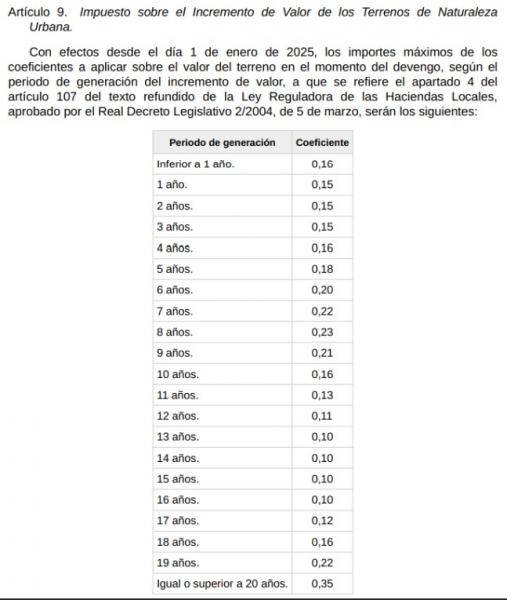
In this case, the impact is quantitative and linear (with some variance): a longer holding period generally means a higher coefficient and thus a higher potential tax base under this method.
Conclusion
In this lesson, we analyzed how the holding period is a critical variable in Spanish capital gains taxation. It's not just about your profit margin; it's about timing your sale to align with tax regulations.
Key Takeaways:
- The 3-Year Rule: Holding a property as your main home for at least 3 years is the key to unlocking the powerful reinvestment exemption for IRPF. This enables strategies like "house hacking" for tax-free equity growth.
- The Pre-1994 Rule: For properties acquired before 1994, the holding period prior to that date determines the size of a substantial tax reduction on gains generated up to 2006, subject to a €400,000 lifetime limit on sale values.
Plusvalía Municipal: The number of years you own a property directly determines the coefficient used in the objective calculation method for the local land value tax.
You have now completed the module on taxes related to property sales. You have a comprehensive view of how gains are calculated, taxed, and how those taxes can be legally minimized through strategic timing.
Preview of the Next Lesson:
We will now shift our focus from taxes triggered by transactions (buying/selling) to taxes you may pay simply for owning assets. In the next lesson, we will begin the module on Advanced Spanish Tax Structures by tackling the Wealth Tax (Impuesto sobre el Patrimonio) and how to calculate your liability for real estate holdings in Spain.