Recommended resources
The freely available resources this lesson will direct you to.
- Cómo Calcular la Plusvalía Municipal y Ahorrar en Impuestoswww.youtube.com
- Plusvalia municipal ✅ | Impuestos 2023| ¿Qué es el la plusvalía y cómo se calcula?www.youtube.com
- Plusvalía municipal: ¿Qué es y cómo se calcula?elderecho.com
- Definitive guide - Taxes on selling a property in Spain 2025www.zainoscapital.com
Hello! Welcome to the final lesson in our module on the taxation of Spanish real estate sales.
In our previous lessons, we've focused on the national-level tax on your profit, the IRPF. We learned how to calculate the taxable gain (Ganancia Patrimonial) and the final tax liability using the savings tax brackets. Today, we'll cover the second and final tax you'll encounter when selling a property: the local capital gains tax.
The learning outcome for this lesson is to calculate the plusvalía municipal (local capital gains tax) for a property sale. This tax is fundamentally different from the IRPF, as it's levied by the local town hall (Ayuntamiento) and is based on the increase in the value of the land the property occupies, not the overall profit from the sale.
By the end of this lesson, you will understand what the plusvalía municipal is, how to calculate it using two different methods, and how to choose the one that results in the lowest tax payment.
1. What is Plusvalía Municipal?
The plusvalía municipal, officially known as the Impuesto sobre el Incremento de Valor de los Terrenos de Naturaleza Urbana (IIVTNU), is a tax on the increase in the value of urban land from the moment you acquire it until you sell it.
Key distinctions to remember:
- What is taxed? Only the theoretical increase in the value of the land, not the building itself.
- Who collects it? The local Town Hall (
Ayuntamiento) where the property is located. - Who pays it? The seller of the property.
This video from Housfy provides an excellent introduction, defining the tax and clearly distinguishing it from the IRPF capital gains we've already studied.
Cómo Calcular la Plusvalía Municipal y Ahorrar en Impuestos
Watch the first part of the video “Cómo Calcular la Plusvalía Municipal y Ahorrar en Impuestos” to get a clear definition of the tax and the factors that influence the increase in land value.
Watch from the beginning until 01:51. Focus on understanding the conceptual difference between 'plusvalía municipal' and 'plusvalía patrimonial' (the IRPF capital gain).
As a result of a major legal reform in 2021, a crucial rule was established: if you sell a property for less than you paid for it, you do not have to pay this tax. You must still file the paperwork with the town hall, but you declare that no gain was made and are therefore not subject to the tax.
2. The Two Calculation Methods: Objective vs. Real
The 2021 reform also introduced two distinct methods for calculating the tax. As the seller, you have the right to calculate the tax using both methods and choose the one that results in a lower bill.
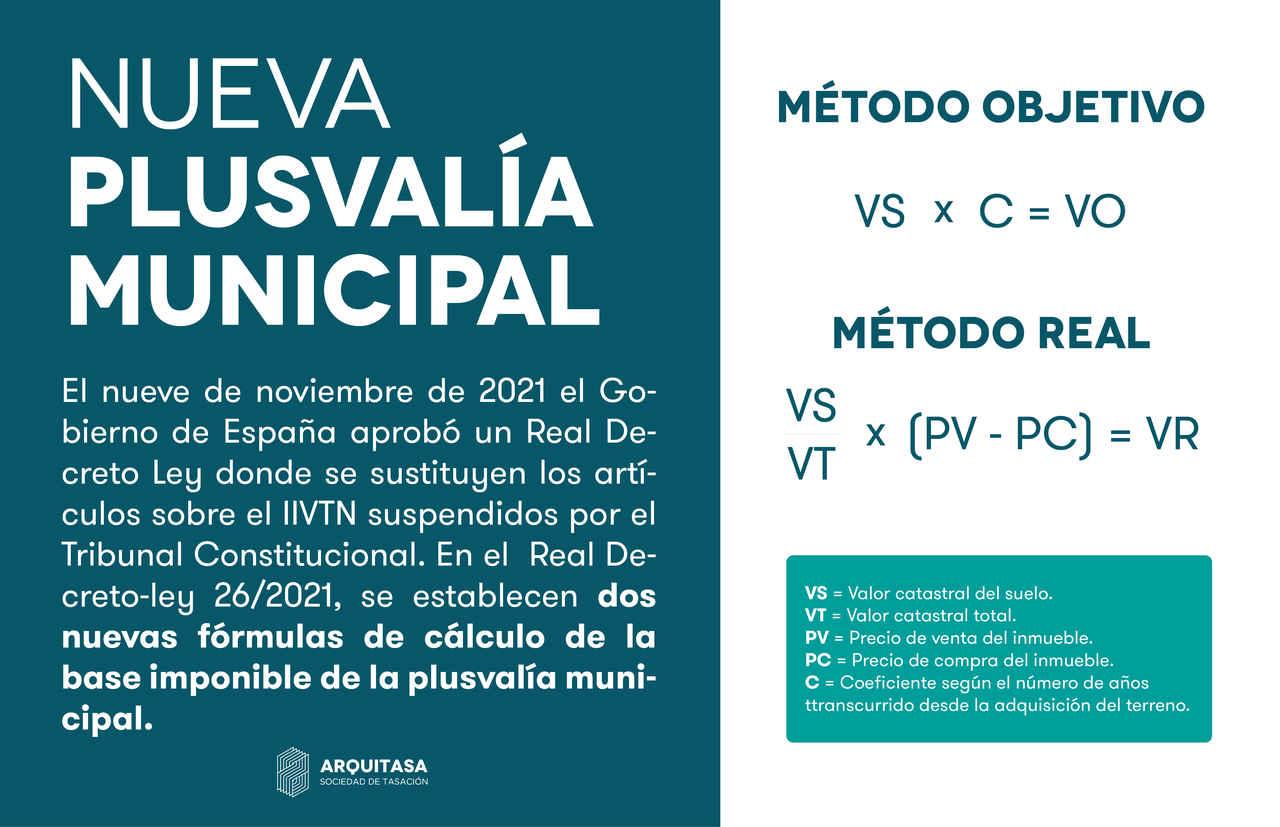
The infographic below provides a great high-level summary of the formulas for each method. We will break them down in detail in the following sections.
3. Method 1: The "Objective" Method
The objective method calculates the taxable base by applying a coefficient to the land's cadastral value. This method does not use the actual purchase or sale prices of the property.
The formula is:
- Taxable Base =
Valor Catastral del Suelo×Coeficiente - Tax Due =
Taxable Base×Tipo Impositivo
Let's break down the components:
Valor Catastral del Suelo(Cadastral Value of the Land): You can find this on your last Real Estate Tax (IBI) receipt.Coeficiente(Coefficient): This is a multiplier that depends on the number of full years you've owned the property. The central government sets maximum coefficients, and each municipality adopts them.Tipo Impositivo(Tax Rate): This is the percentage applied by the specific town hall to the taxable base. The legal maximum is 30%.
To understand this method in practice, let's first review a clear textual explanation with an example.
Definitive guide - Taxes on selling a property in Spain 2025
The article 'Definitive guide - Taxes on selling a property in Spain' provides a clear, step-by-step breakdown of both calculation methods. We'll start with the objective method.
Read the part of the article under the heading 'Municipal capital gains tax in detail', specifically focusing on 'Method 1: The “Objective” or “Royal Decree” Calculation' and its practical example. You can skip Method 2 for now.
Official Coefficients Table
The crucial piece of data for the objective method is the coefficient table. The following table is from the Royal Decree-Law 26/2021 that established the new system.
Plusvalía municipal: ¿Qué es y cómo se calcula?
The article 'Plusvalía municipal: ¿Qué es y cómo se calcula?' contains the official table of coefficients. This is the data we need to perform the objective calculation.
Scroll down to the section 'Cómo se calcula'. Familiarize yourself with the table showing 'Periodo de generación' and 'Coeficiente'. This is the lookup table you will use for the objective method.
For your reference, here is the table of coefficients:
| Holding Period | Coefficient |
|---|---|
| < 1 year | 0.14 |
| 1 year | 0.13 |
| 2 years | 0.15 |
| 3 years | 0.16 |
| 4 years | 0.17 |
| 5 years | 0.17 |
| 6 years | 0.16 |
| 7 years | 0.12 |
| 8 years | 0.10 |
| 9 years | 0.09 |
| 10 years | 0.08 |
| ... and so on, up to 20+ years | ... |
4. Method 2: The "Real" Method
The "real" method calculates the tax based on the actual gain obtained from the sale, but it isolates the portion of the gain attributable to the land.
The formula is:
- Taxable Base = (
Valor de Transmisión-Valor de Adquisición) ×% del Suelo sobre Valor Catastral Total - Tax Due =
Taxable Base×Tipo Impositivo
The components are:
Valor de Transmisión&Valor de Adquisición: The sale price and purchase price from the property deeds.% del Suelo sobre Valor Catastral Total: The proportion of the property's total cadastral value that corresponds to the land. You calculate this as:Valor Catastral del Suelo/Valor Catastral Total. Both values are on the IBI receipt.Tipo Impositivo: The same municipal tax rate used in the objective method.
Now, return to the article from Zainos Capital to see how this method is applied.
Definitive guide - Taxes on selling a property in Spain 2025
Let's go back to the 'Definitive guide' article to review the second method.
This time, read the section 'Method 2: The calculation of the “real surplus value”'. Pay close attention to the example and the final conclusion where the two methods are compared.
5. Comparing Methods: A Practical Demonstration
As you saw in the example, the difference between the two methods can be substantial. The seller in that case saved over €3,000 by choosing the objective method.
To see a live demonstration of just how significant this choice can be, the following video shows a real-time calculation using a town hall's online tool. The results are striking.
Plusvalia municipal ✅ | Impuestos 2023| ¿Qué es el la plusvalía y cómo se calcula?
This video by David Moure demonstrates how to use an online calculator to estimate the plusvalía, comparing the two methods for a specific property.
Watch the segment from 03:50 to 06:29. Notice the dramatic difference between the tax calculated by the 'método objetivo' (€2,498) and the 'método real' (€17,000). This highlights the importance of always calculating both.
Test your understanding!
An investor sells a property for €300,000 that they bought 5 years ago for €250,000. The cadastral value of the land is €50,000, and the total cadastral value is €125,000. The municipal tax rate is 25%. Which method should they choose?
Show answer
Let's calculate both:
1. Objective Method:
- Holding period: 5 years. The coefficient from the table is 0.17.
- Taxable Base =
Valor Catastral del Suelo×Coeficiente= €50,000 × 0.17 = €8,500. - Tax Due =
Taxable Base×Tipo Impositivo= €8,500 × 25% = €2,125.
2. Real Method:
- Actual Gain = €300,000 - €250,000 = €50,000.
- Land Value Proportion =
Valor Catastral Suelo/Valor Catastral Total= €50,000 / €125,000 = 40%. - Taxable Base =
Actual Gain×Land Value Proportion= €50,000 × 40% = €20,000. - Tax Due =
Taxable Base×Tipo Impositivo= €20,000 × 25% = €5,000.
Conclusion: The investor should choose the Objective Method, saving €2,875 in taxes.
6. Python Implementation
Let's integrate this logic into our Python model. We'll add a method calculate_plusvalia_municipal to our SpanishRentalProperty class. This function will compute the tax using both methods and return the lower of the two values, mirroring the decision-making process an investor must follow.
import math

class SpanishRentalProperty:
    # ... (all previous methods from last lesson: __init__, calculate_adjusted_acquisition_cost, etc.)

    def __init__(self, property_data: dict, owner_data: dict):
        self.property_data = property_data
        self.owner_data = owner_data
        self.results = {}

    # --- Previous methods from lesson 10.3 would be here ---

    def calculate_plusvalia_municipal(self, sale_price: float, holding_period_years: int, land_cadastral_value: float, total_cadastral_value: float, municipal_tax_rate: float) -> dict:
        """
        Calculates the plusvalía municipal by computing both objective and real methods
        and returning the most favorable (lower) tax amount.

        Args:
            sale_price (float): The final sale price of the property.
            holding_period_years (int): Number of full years the property was held.
            land_cadastral_value (float): The cadastral value of the land ('valor catastral del suelo').
            total_cadastral_value (float): The total cadastral value ('valor catastral total').
            municipal_tax_rate (float): The tax rate ('tipo impositivo') set by the municipality (e.g., 0.28 for 28%).

        Returns:
            dict: A dictionary containing the chosen method, the tax due, and the calculations for both methods.
        """
        purchase_price = self.property_data['purchase']['price']

        # Rule: No gain, no tax.
        if sale_price <= purchase_price:
            return {
                "chosen_method": "No Gain",
                "tax_due": 0.0,
                "details": "Property sold at or below purchase price. No plusvalía municipal is due."
            }

        # --- Method 1: Objective Calculation ---
        coefficients = {
            0: 0.14, 1: 0.13, 2: 0.15, 3: 0.16, 4: 0.17, 5: 0.17, 6: 0.16,
            7: 0.12, 8: 0.10, 9: 0.09, 10: 0.08, 11: 0.08, 12: 0.08, 13: 0.08,
            14: 0.10, 15: 0.12, 16: 0.16, 17: 0.20, 18: 0.26, 19: 0.36
        }
        # For periods >= 20 years, the coefficient is 0.45
        period_key = min(holding_period_years, 20) if holding_period_years >= 20 else math.floor(holding_period_years)
        # Use get for safety, with a fallback for periods > 20
        coefficient = coefficients.get(period_key, 0.45)

        objective_base = land_cadastral_value * coefficient
        objective_tax = objective_base * municipal_tax_rate

        # --- Method 2: Real Calculation ---
        actual_gain = sale_price - purchase_price
        land_proportion = land_cadastral_value / total_cadastral_value
        real_base = actual_gain * land_proportion
        real_tax = real_base * municipal_tax_rate

        # --- Compare and Decide ---
        if objective_tax <= real_tax:
            chosen_method = "Objective"
            tax_due = objective_tax
        else:
            chosen_method = "Real"
            tax_due = real_tax

        return {
            "chosen_method": chosen_method,
            "tax_due": round(tax_due, 2),
            "calculations": {
                "objective_method": {"taxable_base": round(objective_base, 2), "tax": round(objective_tax, 2)},
                "real_method": {"taxable_base": round(real_base, 2), "tax": round(real_tax, 2)}
            }
        }

# --- Example Usage ---
# Using data from the Zainos Capital article example
if __name__ == '__main__':
    property_data_example = {
        "purchase": {"price": 320000.00}
    }

    # We don't need owner_data for this specific calculation
    property_investment = SpanishRentalProperty(property_data=property_data_example, owner_data={})

    plusvalia_result = property_investment.calculate_plusvalia_municipal(
        sale_price=350000.00,
        holding_period_years=10,
        land_cadastral_value=80000.00,
        total_cadastral_value=130000.00,
        municipal_tax_rate=0.28
    )

    print("--- Plusvalía Municipal Calculation ---")
    print(f"Chosen Method: {plusvalia_result['chosen_method']}")
    print(f"Final Tax Due: €{plusvalia_result['tax_due']:,}")
    print("\nCalculation Details:")
    print(f"  - Objective Method Tax: €{plusvalia_result['calculations']['objective_method']['tax']:,}")
    print(f"  - Real Method Tax: €{plusvalia_result['calculations']['real_method']['tax']:,}")
Running this code produces the following output, which matches the conclusion from the article:
--- Plusvalía Municipal Calculation ---
Chosen Method: Objective
Final Tax Due: €2,016.0

Calculation Details:
  - Objective Method Tax: €2,016.0
  - Real Method Tax: €5,166.15
Conclusion
This lesson completes our analysis of the taxes due upon the sale of a property in Spain. You are now equipped to calculate both the national-level IRPF on the capital gain and the local plusvalía municipal on the land value increase.
Key Takeaways:
Plusvalía Municipalis a local tax on the increase in land value, collected by the town hall.- If you sell at a loss, you do not pay this tax.
- There are two calculation methods: Objective (based on cadastral value and coefficients) and Real (based on actual gain attributable to the land).
- You have the right to calculate both and pay the lower amount, a critical optimization step.
- Our Python model can now automate this comparison to identify the most tax-efficient choice.
Preview of the Next Lesson:
We have now concluded the module on taxes related to property transactions (purchase and sale). In the next module, "Advanced Spanish Tax and Ownership Structures," we will begin exploring taxes related to simply holding assets. Our first lesson will be on calculating the wealth tax (Impuesto sobre el Patrimonio) liability for real estate holdings in Spain. This is an annual tax levied on your net worth, and real estate is a major component for many investors.