Recommended resources
The freely available resources this lesson will direct you to.
Hello. Last time, you traced cash raised from or returned to lenders and shareholders through financing cash flow and the balance sheet. Depreciation requires a different kind of trace: it reduces profit and the carrying value of an asset, but recording the expense does not itself use cash.
This lesson focuses on a common interview prompt: “What happens if depreciation increases?” You will follow an incremental increase through the income statement, cash flow statement, and balance sheet, using an assumed tax rate and checking that the statements still balance.
First, separate depreciation from the asset purchase
When a company buys equipment, the cash purchase is recorded as a capital expenditure in investing cash flow, and the equipment is added to property, plant and equipment (PP&E). Depreciation allocates the asset’s cost to expense over its useful life. The expense belongs to the period in which it is recognized; it is not another payment for the equipment.
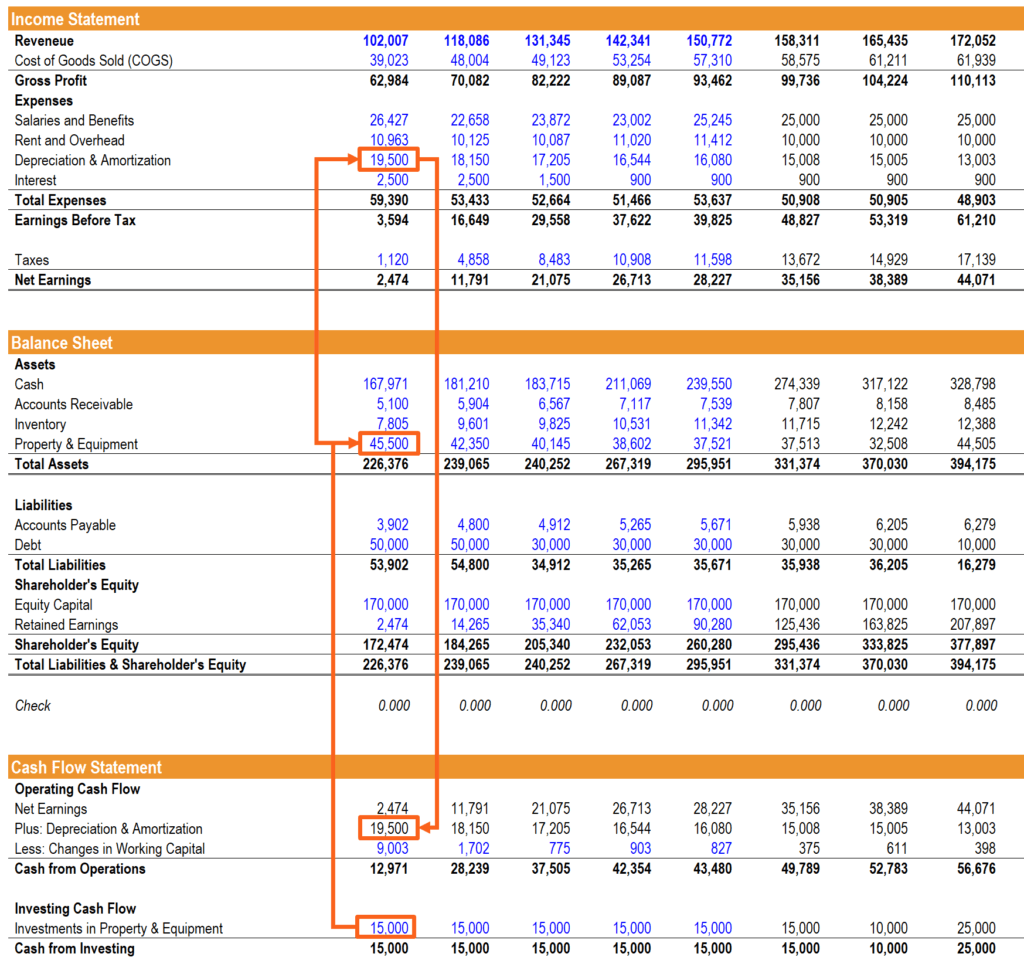
The model snapshot below highlights both ideas. Its depreciation expense of 19,500 appears on the income statement and is added back in operating cash flow. The highlighted PP&E balance is a balance-sheet amount, while the separate 15,000 investment is an asset purchase. These figures show where to look; they are not, by themselves, the effects of increasing depreciation.
Watch Depreciation on the 3 Financial Statements from Mergers & Inquisitions / Breaking Into Wall Street. It uses a 40% tax rate; our worked example will use 25%. Focus on the order of explanation—income statement, cash flow statement, then balance sheet—rather than memorizing its particular numbers.
Depreciation on the 3 Financial Statements
Watch this interview-style demonstration to see why the non-cash add-back does not simply leave cash unchanged.
Watch income statement for the effects on pretax income, taxes, and net income. Then follow operating cash flow as lower net income is reconciled with the depreciation add-back. Finish with balance sheet, checking that the changes in cash and PP&E equal the change in retained earnings.
Set the assumptions before doing the arithmetic
Suppose depreciation expense increases by 20 this year relative to an otherwise identical case. Assume a 25% tax rate, that the additional depreciation is deductible for tax purposes this year, and that the resulting reduction in tax expense also reduces cash taxes paid this year. Revenue, other expenses, interest, working capital, asset purchases, borrowing, and shareholder transactions are unchanged.
Those assumptions matter. We are comparing two versions of the same period, not saying that the company has just spent another 20 on equipment. They also let us treat the tax saving as a current-period cash benefit. If tax paid does not change yet, the cash result needs an additional tax-payable or deferred-tax analysis.
1. Income statement: expense rises; taxes cushion the fall in profit
Depreciation may sit within cost of goods sold, operating expenses, or a separate line. Regardless of its presentation here, an extra 20 of depreciation reduces operating income (EBIT) by 20. With interest unchanged, pretax income also falls by 20.
At a 25% tax rate, tax expense falls by 5. Net income therefore falls by 15, not 20:
| Income-statement change | Amount |
|---|---|
| Depreciation expense | +20 |
| EBIT | (20) |
| Pretax income | (20) |
| Tax expense | (5) |
| Net income | (15) |
The tax line’s negative change means 5 less tax expense. For a level check, imagine pretax income was 160 and tax expense was 40 before the change. After the extra depreciation, pretax income would be 140, tax expense 35, and net income would fall from 120 to 105.
2. Cash flow statement: start with net income, then reverse the non-cash expense
Under the indirect method, operating cash flow starts with net income. That starting figure is now 15 lower. But net income includes 20 of additional depreciation for which no cash was paid when the expense was recorded. Add back the extra 20:
Why is the result +5, rather than zero or +20? The 20 add-back removes the non-cash expense from the cash-flow calculation. What remains is the 5 reduction in cash taxes paid, under our assumptions.
There is no incremental change to investing cash flow: increasing depreciation is not a new equipment purchase. There is likewise no incremental change to financing cash flow. With no other changes, ending cash is therefore 5 higher than in the comparison case.
This is the crucial distinction between a level and a change. A company may still have substantial capital expenditure elsewhere in its cash flow statement. We are saying only that the stipulated increase in depreciation, on its own, adds no new investing outflow.
Finish at the balance sheet—and make it balance
Extra depreciation reduces net PP&E by 20. More precisely, the asset’s original gross cost need not change; accumulated depreciation is 20 higher, so the net carrying amount is 20 lower.
Cash is 5 higher because operating cash flow rose by 5. Total assets thus fall by 15:
On the other side, the 15 reduction in net income flows into retained earnings, assuming dividends and other equity movements are unchanged. Liabilities do not change under our stated cash-tax assumptions:
Both sides fall by 15. The balance-sheet check is not an afterthought: it catches two frequent errors. If you reduce PP&E by 20 but forget the 5 cash benefit, the sides will not balance. If you reduce retained earnings by the full 20, you have forgotten that lower taxes cushioned the fall in net income.
The general result is compact. For an additional depreciation expense of and an immediately usable cash tax rate :
Here, and , giving a 5 cash increase and a 15 decline in both net assets and retained earnings.
What to say—and what to qualify—in an interview
A concise answer can carry both the calculation and its reasoning:
“Assuming the extra depreciation is deductible and saves cash tax this period, a 20 increase at a 25% tax rate reduces EBIT and pretax income by 20. Tax expense falls by 5, so net income falls by 15. On the cash flow statement, I start 15 lower in net income and add back 20 of non-cash depreciation, increasing operating cash flow and cash by 5; investing and financing cash flow do not change. On the balance sheet, net PP&E falls by 20, cash rises by 5, and retained earnings falls by 15, so both sides fall by 15.”
Lead with the tax assumption rather than silently presuming every depreciation charge creates immediate cash. A loss-making company may not be able to use the deduction now; tax depreciation can differ from accounting depreciation; and lower tax expense need not mean lower taxes paid this period. In those cases, do not automatically put into cash without examining the tax balances. For the standard interview version, however, the stated immediate cash-tax assumption makes the three-statement answer above complete.
Key takeaways
An increase in depreciation lowers pretax income and net PP&E by the full expense increase. With an immediately usable tax deduction, net income and retained earnings fall by the after-tax amount; the operating-cash-flow add-back leaves a cash increase equal to the tax saving. No new capital expenditure or financing transaction is implied.
Next, you will trace a change in an operating working-capital account. The same discipline applies: identify what changed on the balance sheet, then distinguish its effect on reported profit from its effect on cash.