Recommended resources
The freely available resources this lesson will direct you to.
- Build a Cash Flow Statement From Scratch Using a Balance Sheet and Income Statementwww.youtube.com
- Financial Modeling Tutorial | Build a Three-Statement Model in 30 Minutes with CFI CEO Tim Vipondwww.youtube.com
- 16.3 Prepare the Statement of Cash Flows Using the ...openstax.org
- 4.3 Statement of Cash Flows (SCF) – Intermediate Financial Accounting 1ecampusontario.pressbooks.pub
Hello. In the previous lesson, you separated the cash proceeds from selling an asset from any accounting gain or loss, and recorded asset purchases and sales in cash flow from investing. We now turn to cash flow from financing (CFF): cash raised from lenders and shareholders, and cash returned to them.
The interview skill is to trace each transaction through two places at once: the financing section of the cash flow statement and the relevant debt or equity balance on the balance sheet. By the end, you should be able to calculate those effects for borrowing, repayments, share issuance, buybacks, and dividends—and check that the resulting balance sheet still balances.
Financing cash flow: follow the funding claim
Operating cash flow concerns the business’s activities; investing cash flow records transactions such as the asset purchases and disposals you just studied. Financing cash flow records cash transactions with providers of capital. Borrowing and issuing shares bring cash in. Repaying loan principal, buying back shares, and paying dividends send cash out.
The statement-of-cash-flows template below places those financing lines beneath operating and investing cash flows. Notice that the three sections together explain the change between opening and closing cash.
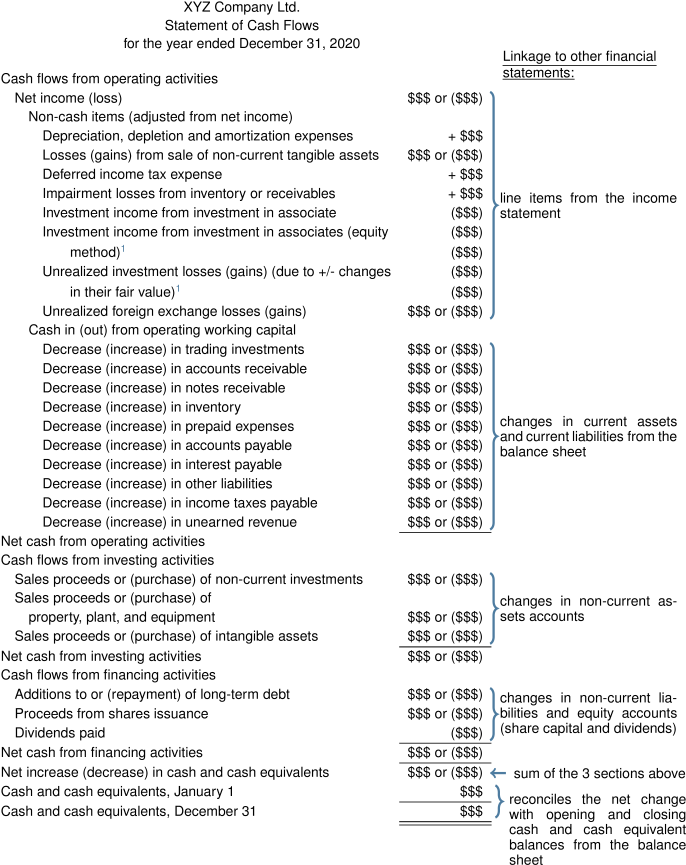
Read the OpenStax discussion of Financing Activities for the basic classification, including share buybacks and transactions that change funding accounts without moving cash.
16.3 Prepare the Statement of Cash Flows Using the ...
OpenStax distinguishes cash raised from creditors or shareholders from cash returned to them. Its examples also show why a change in a debt or equity account is not always a cash flow.
Under “Financing Activities,” read the classification. Continue through the example beginning “In the Propensity Company example, the financing section included three transactions” and ending with the discussion of increased borrowing; focus on its distinction between shares issued for cash and shares issued for employee bonuses. Under “Financing Activities Leading to a Decrease in Cash,” read the outflows. Finally, under “Noncash Investing and Financing Activities,” read the disclosure point.
For the straightforward cash transactions in this lesson, the signs are:
| Transaction | CFF | Balance-sheet funding account |
|---|---|---|
| Issue debt | Inflow | Debt increases |
| Repay debt principal | Outflow | Debt decreases |
| Issue shares | Inflow | Shareholders’ equity increases |
| Repurchase shares | Outflow | Shareholders’ equity decreases |
| Pay a cash dividend | Outflow | Shareholders’ equity decreases if declared and paid together |
Every row also changes cash on the balance sheet by the amount of the CFF entry. The distinction between a dividend declared and one paid matters; we will return to it below.
Debt: distinguish principal from interest
Suppose a company borrows 100 in cash. CFF shows +100 from debt issuance; balance-sheet cash rises by 100 and debt rises by 100. There is no immediate increase in revenue or net income merely because the company borrowed money.
If it then repays 35 of principal, CFF shows (35), while cash and debt each fall by 35. The debt schedule and financing cash flow agree:
With opening debt of 80, the two transactions produce ending debt of and debt-related CFF of .
Watch the debt roll-forward in Corporate Finance Institute’s Financial Modeling Tutorial | Build a Three-Statement Model in 30 Minutes. The relevant excerpt is short: concentrate on how opening debt, new borrowing, and repayments determine closing debt, rather than on the later interest calculation.
Financial Modeling Tutorial | Build a Three-Statement Model in 30 Minutes with CFI CEO Tim Vipond
Corporate Finance Institute’s tutorial shows the debt-balance “roll-forward” used to connect financing assumptions to the balance sheet.
In the debt-schedule portion, watch the roll-forward. Identify where the model starts with prior-period closing debt and adds or subtracts the period’s debt movement. Stop at the interest-expense discussion; interest is distinct from the principal cash flows being calculated here.
Principal is not interest. Repaying 35 of principal reduces the amount owed by 35; it is not an income-statement expense. Interest is the cost of borrowing and can affect net income and operating cash flow. In a financing question, therefore, ask whether “debt payment” means principal, interest, or both before assigning a CFF figure.
Nor can you always recover gross borrowing and repayment from the net change in debt. A company that begins with 100 of debt, borrows 70, and repays 50 ends with 120. The balance increased by 20, and net debt-related CFF is +20, but issuance of 70 and repayment of 50 are separate transactions if the question asks for each.
One further balance-sheet trap is the current portion of long-term debt. Moving an amount from “long-term debt” to “current portion” because repayment is approaching is a reclassification, not a cash payment. Include both portions when analysing total debt principal; record a CFF outflow when principal is actually repaid.
Equity: issuance, repurchases, and dividends
Issuing new shares for 50 cash produces +50 in CFF, +50 cash, and +50 book shareholders’ equity. In a simplified balance sheet, the equity increase appears in share capital and any share premium (also called additional paid-in capital). This is the amount recorded from the issuance, not an automatic revaluation of every existing share.
A company can instead use 20 cash to repurchase its own shares. CFF shows (20) and cash falls by 20. Total book equity also falls by 20. Depending on the accounting presentation, the repurchased shares may appear as treasury shares, a deduction from equity, or the relevant share-capital accounts may be reduced when shares are cancelled. Either way, do not treat the buyback as an operating expense.
In the same Corporate Finance Institute tutorial, watch the financing lines and the equity balances together. The model does not make a dividend payment in its example; we will calculate one separately.
Financial Modeling Tutorial | Build a Three-Statement Model in 30 Minutes with CFI CEO Tim Vipond
The tutorial places debt and share transactions in financing cash flow, then updates equity capital and retained earnings on the balance sheet.
Watch financing entries for the cash-flow lines. Then watch equity balances for the separate treatment of capital raised through shares and earnings retained after dividends. Treat the model’s combined positive or negative share movement as a simplification: in an interview, name an issuance and a repurchase separately when both occur.
A cash dividend is different from a buyback: it distributes cash to shareholders without buying shares from them. Assume a company declares and immediately pays a dividend of 10. CFF is (10), cash falls by 10, and retained earnings—a component of equity—falls by 10. The dividend is not an income-statement expense; net income is calculated before this distribution decision.
That gives a useful retained-earnings check when there are no other adjustments:
The last term says declared, not necessarily paid. If a company declares 12 but pays only 7 by period-end, retained earnings falls by 12, a dividend payable of 5 remains, and CFF records only the 7 paid. Paying a dividend that was declared in an earlier period reduces cash and the existing payable; it does not reduce retained earnings a second time.
For a worked balance-sheet analysis, read Step Six, “Non-current liabilities and equity changes,” in Statement of Cash Flows (SCF). It includes both the current portion of debt and a retained-earnings reconciliation. Its dividend example expressly states that the dividend was declared and paid, allowing the cash payment to be identified.
4.3 Statement of Cash Flows (SCF) – Intermediate Financial Accounting 1
This intermediate accounting example demonstrates how financing cash amounts are recovered from debt and equity account movements—not simply guessed from their closing balances.
In Step Six, “Non-current liabilities and equity changes,” begin with the “Long-term note payable” account and read through the current-portion explanation. Then locate the “Common shares” and “Retained earnings” accounts; read from their account analyses through the statement that the dividends were declared and paid. Focus on why net income and dividends have different effects on retained earnings.
Put all five transactions into one three-statement check
Consider one period with the following opening balance sheet. Amounts are illustrative:
| Assets | Opening | Liabilities and equity | Opening |
|---|---|---|---|
| Cash | 40 | Debt | 80 |
| Other assets | 310 | Share capital and premium | 200 |
| Retained earnings | 70 | ||
| Total assets | 350 | Total liabilities and equity | 350 |
During the period, the company borrows 100, repays 35 of debt principal, issues 50 of shares, repurchases 20 of shares, and declares and pays a 10 cash dividend. Assume repurchased shares are shown as a deduction from equity. Its other activity produces net income of 18, CFO of 25 (net income plus 7 of non-cash depreciation), and CFI of (30) from a cash asset purchase.
First calculate CFF from cash transactions, keeping the individual signs visible:
Cash can now be checked against all three cash-flow sections:
Next update the non-cash balance-sheet accounts. Debt closes at . Share capital and premium rises to , with (20) of treasury shares reducing total equity. Retained earnings closes at . Other assets rise from 310 to 333: the asset purchase adds 30, while depreciation reduces their carrying value by 7.
| Assets | Closing | Liabilities and equity | Closing |
|---|---|---|---|
| Cash | 120 | Debt | 145 |
| Other assets | 333 | Share capital and premium | 250 |
| Less: treasury shares | (20) | ||
| Retained earnings | 78 | ||
| Total assets | 453 | Total liabilities and equity | 453 |
This check does more than confirm arithmetic. It shows where each financing transaction went: debt transactions changed a liability, issuance and repurchases changed contributed equity, and the dividend changed retained earnings. Net income also changed retained earnings, but net income itself was not a financing cash inflow.
Finally, apply the cash test before using any balance-sheet movement as a CFF shortcut. Shares issued in exchange for an asset, or debt converted into shares, can change equity or debt without cash changing hands. The simple roll-forwards above work directly only when the stated movements are cash transactions and there are no other adjustments.
Key takeaways
For each financing transaction, identify the cash amount, give it a positive sign for funds raised or a negative sign for funds returned, and update the matching debt or equity account. Debt principal repayments are not interest expense; share buybacks are not dividends; and a dividend declared is not necessarily a dividend paid. Reconcile opening cash with CFO, CFI, and CFF, then use the balance sheet as an independent check.
Next, you will trace an increase in depreciation through all three statements, adding the tax effect to the statement-linking discipline you have practised here.