Recommended resources
The freely available resources this lesson will direct you to.
- Statement of Cash Flows: How to Account for a Disposal of Fixed Assetswww.youtube.com
- Depreciation and the Purchase of Equipment in a Three Statement Modelwww.youtube.com
- Capital Expenditure (CapEx) - Financial Edge Trainingwww.fe.training
- Cash Flow Statement: In-Depth Explanation with Exampleswww.accountingcoach.com
Hello. Last lesson, you reconciled net income to cash flow from operations (CFO) by reversing non-cash items and adjusting for operating working capital. That calculation still did not explain every change in cash. This lesson adds cash flow from investing (CFI): what happens when a company buys a long-term asset or sells one it already owns?
These are common three-statement interview questions because one transaction can affect cash, property, plant and equipment (PP&E), and—on a sale—profit. The aim is to calculate each effect without confusing the cash paid or received with the accounting gain or loss.
Buying an asset: cash leaves, but no immediate expense is required
Suppose a company pays 60 for a machine and begins using it after the reporting date. Assume no depreciation has yet been recorded. The purchase is a capital expenditure, or CapEx: the company has exchanged one asset, cash, for another, PP&E.
Watch A Simple Model’s Depreciation and the Purchase of Equipment in a Three Statement Model for the purchase itself. Stop before the separate depreciation analysis; the immediate purchase is our focus here.
Depreciation and the Purchase of Equipment in a Three Statement Model
A Simple Model traces a cash equipment purchase across the three statements. Watch it to see why paying for a machine is not the same as immediately expensing its cost.
Watch the purchase, beginning when the presenter turns to buying machinery and ending as the discussion shifts to depreciation. Focus on the unchanged income statement, the investing cash outflow, and the equal-and-opposite movements in balance-sheet cash and PP&E.
For our purchase of 60, the immediate effects are:
| Statement | Effect |
|---|---|
| Income statement | No immediate expense or change in net income |
| Cash flow statement | CapEx of (60) in CFI; no purchase-related CFO adjustment |
| Balance sheet | Cash (60); PP&E +60 |
The balance sheet remains balanced because total assets have not changed: cash fell by 60 while PP&E rose by 60. CapEx is not a depreciation add-back. The company actually paid 60, so the cash outflow must appear in CFI. If the machine is subsequently depreciated, that later expense reduces its net book value and enters the CFO reconciliation you learned last lesson.
The assumption that the company paid cash matters. A PP&E addition does not, by itself, prove that cash left during the period; an asset acquired without an immediate cash payment is not an immediate investing cash outflow.
Selling an asset: separate proceeds from profit
A disposal reverses part of the asset story, but it has an extra complication: the sale price may differ from the asset’s carrying value, also called its net book value. Carrying value is the asset’s recorded cost less the accumulated depreciation associated with it.
If a machine with a carrying value of 80 sells for 100 cash, the company removes 80 of net PP&E and records a gain of 20 on the income statement. CFI records 100, not 20: CFI reports the entire cash receipt. The gain measures how much the selling price exceeded book value; it is not a second receipt of cash.
Edspira’s Statement of Cash Flows: How to Account for a Disposal of Fixed Assets explains why the cash proceeds and the gain are treated differently.
Statement of Cash Flows: How to Account for a Disposal of Fixed Assets
Edspira separates the cash received on disposal from the gain or loss included in net income. The distinction prevents the same sale from being counted twice in cash flow.
Watch the disposal logic for the treatment of proceeds and gains in the cash flow statement. Then watch the machine example, from the stated sale price and original cost through the calculation of accumulated depreciation; stop when the presenter moves to additional company-wide balances. Focus on the difference between original cost and carrying value.
Because the gain of 20 increased net income, it also appears in the starting figure for CFO under the indirect method. To keep the sale proceeds wholly in CFI, subtract that gain in the CFO reconciliation. For a sale at a loss, add the loss back instead. These adjustments reclassify the effect embedded in net income; neither changes the cash actually received.
Here is the complete gain case. Assume the 20 book gain is taxable at 40%, the resulting tax of 8 is paid in cash this period, and there are no other effects. The supplied illustration lays out the figures across the statements.
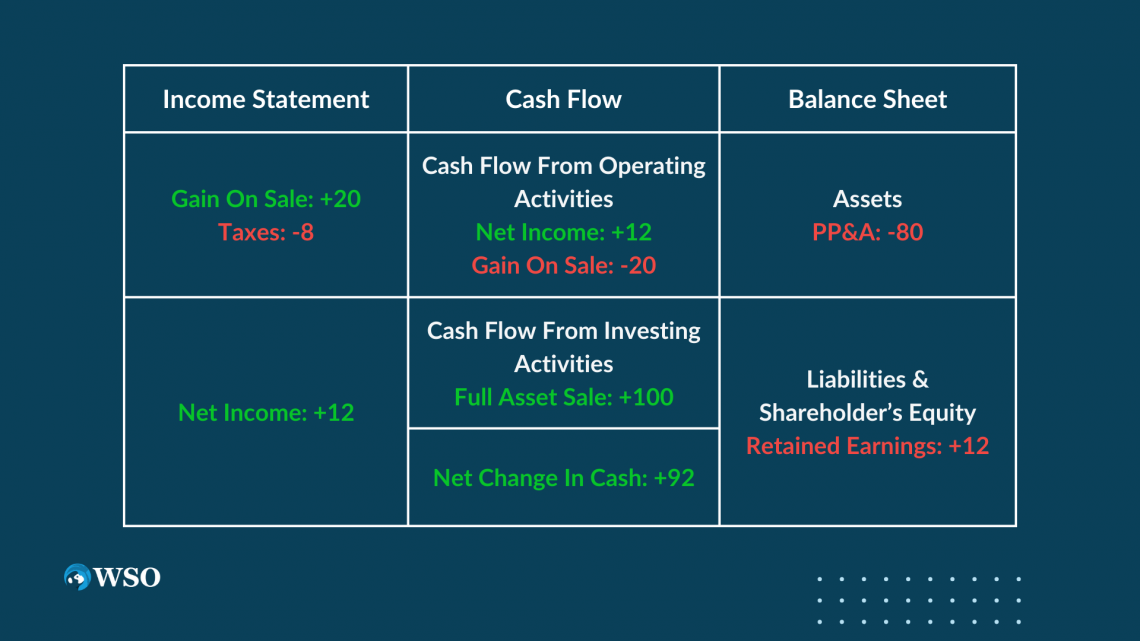
Work through the cash flow rather than memorising the diagram:
The negative 8 in CFO is the cash tax effect under these assumptions. Subtracting the gain removes the sale’s 20 accounting profit from operating cash flow; it does not erase the 100 received in investing cash flow.
The balance sheet provides a useful independent check. Cash rises by 92 and net PP&E falls by 80, so total assets rise by 12. Net income rises by 12 and, assuming it is retained, retained earnings rise by 12. Both sides agree.
If the same asset with carrying value 80 instead sold for 70, the company would record a loss of 10, remove 80 of net PP&E, and show +70 in CFI. In the indirect CFO reconciliation, it would add back the 10 loss included in net income. Whether that loss produces an immediate cash tax saving depends on the tax assumptions; do not assume a saving unless the question supplies one.
Reconcile investing cash flow with the PP&E balance
Purchases and disposals can happen in the same period. For cash transactions, keep their amounts separate before calculating net investing cash flow:
You may hear net CapEx used for cash spending on assets less disposal proceeds. But when asked for CapEx without that qualifier, identify the purchase spending rather than silently netting it against sales.
A second reconciliation explains the ending net PP&E balance:
Notice the different disposal figures: CFI uses sale proceeds; the PP&E roll-forward uses carrying value. The difference between them is the gain or loss on sale.
Read Financial Edge Training’s Capital Expenditure (CapEx) for the distinction between cash-flow CapEx and an estimate derived from changes in PP&E. Its caution about estimating CapEx from balance sheets is useful when reviewing company financials.
Capital Expenditure (CapEx) - Financial Edge Training
Financial Edge Training explains where cash CapEx appears and why changes in net PP&E do not always reveal the cash spent on assets.
Under “CapEx Formula,” read the cash-flow method, from the numbered methods through the sentence on net CapEx. Then, under “Calculating CapEx through BASE analysis,” read the balance method. Finally, after the filing example, find the “Insight” paragraph beginning “The CapEx calculated from the two methods above is significantly different.” Read the limitation; you can skip the filing screenshots. Focus on why disposals and other changes can make a simple PP&E-based estimate differ from reported cash CapEx.
Consider a compact period-end calculation. Beginning net PP&E is 200; the company buys assets for 50 cash, records 15 of depreciation, and sells an asset with a carrying value of 40 for 55 cash. Assume no other PP&E movements.
The sale produces a gain of , while the PP&E-related investing cash flow is . Depreciation belongs in the PP&E reconciliation, but it is not another CFI outflow: it is the later allocation of an asset’s cost, not a payment made this period.
If the question instead gave ending net PP&E of 195 and asked you to infer additions, rearrange the same reconciliation:
In this simplified example, additions equal cash CapEx because the purchase was paid in cash and no other transactions affected PP&E. In actual statements, acquisitions, non-cash additions, disposals, and other movements can break that equivalence. When reported cash CapEx is available in CFI, use it rather than assuming that the change in net PP&E alone reveals cash spending.
Key takeaways
For a cash purchase, record the full payment as a CFI outflow and increase PP&E by the asset’s cost; there is no immediate income-statement expense under the assumptions used here. For a sale, record the full proceeds as a CFI inflow, remove the asset’s carrying value from PP&E, and recognise any difference as a gain or loss. Under the indirect method, subtract a gain from CFO or add back a loss so the proceeds are counted only in CFI.
The most reliable interview check is to name three distinct numbers before calculating: cash paid or received, carrying value added or removed, and gain or loss. Next, you’ll apply similar three-statement discipline to debt and equity transactions in cash flow from financing.