Recommended resources
The freely available resources this lesson will direct you to.
- Prepare A Cash Flow Statement | Indirect Methodwww.youtube.com
- Financial Modeling Quick Lessons: Cash Flow Statement (Part 1) [UPDATED]www.youtube.com
- Cash Flow from Operations: Full Tutorial + Sample Excelbreakingintowallstreet.com
- Cash Flow Statement (CFS) | Formula + Calculatorwww.wallstreetprep.com
Hello. In the previous lesson, you built an income statement down to net income and saw why depreciation reduces profit without being a cash payment in that period. Earlier, you saw how the cash flow statement connects profit to the change in cash. Now you’ll make that connection numerically: start with net income, reverse relevant non-cash items, and account for cash tied up in—or released from—operating working capital.
This is a useful investment banking interview calculation because the arithmetic is short, but each sign tests whether you understand the underlying transaction.
Why net income needs reconciling
Net income measures profit under accrual accounting, not cash received minus cash paid. Revenue can be recorded before a customer pays; an expense can be recorded before a supplier is paid; and depreciation can reduce profit without requiring a payment this period.
The indirect method of calculating cash flow from operations (CFO) starts with net income and corrects for those differences. Watch Wall Street Prep’s Financial Modeling Quick Lessons: Cash Flow Statement (Part 1) for the reasoning behind the main adjustments.
Financial Modeling Quick Lessons: Cash Flow Statement (Part 1) [UPDATED]
Wall Street Prep builds an indirect operating cash-flow calculation from net income. Watch for the explanation behind each sign, rather than memorising a list of pluses and minuses.
Watch the starting point for why the calculation begins with net income and keeps investing and financing cash flows separate. Then watch depreciation, receivables, inventory, and payables. In the receivables and payables examples, identify what has already affected profit but has not yet changed cash.
The scope matters. CFO is not the total change in cash. Capital expenditures belong to investing cash flow, while borrowing and debt-principal repayment belong to financing cash flow. Those categories will receive their own treatment in the next lessons.
Reverse non-cash effects on profit
Suppose net income includes a depreciation expense of 10. The expense reduced net income by 10, but recording that expense did not itself use 10 of cash during the period. Starting from net income, you therefore add back 10 in the operating cash-flow reconciliation.
This does not mean depreciation creates cash. It means the deduction made in arriving at profit is reversed when calculating cash flow. Nor should you add back an expense merely because you dislike its effect on profit. Interest expense and tax expense remain in net income in a simplified case where the corresponding amounts were paid in cash and are classified as operating cash flows.
The same reversal principle applies to other identified non-cash expenses already included in net income, such as amortisation or stock-based compensation. An identified non-cash gain included in net income works in the opposite direction: subtract it from the operating reconciliation. For an interview question, check both whether an item affected your starting figure and whether it belongs in operating cash flow before adjusting it.
Wall Street Prep’s written explanation reinforces the distinction between an accrual profit measure and cash flow:
Cash Flow Statement (CFS) | Formula + Calculator
Read Wall Street Prep’s discussion of why a cash flow statement must reconcile accrual-based net income. It also states the working-capital sign rules you will use below.
In “How to Prepare a Cash Flow Statement,” begin with the opening paragraph introducing the three financial statements. Read the explanation through the section’s closing warning about profitable companies running short of cash. Focus on the examples of revenue timing, depreciation, and changes in working-capital assets and liabilities; you do not need to follow the linked specialist topics.
Translate working-capital movements into cash effects
For this reconciliation, operating working capital means the operating current assets and liabilities that explain timing differences between profit and cash. In a simple interview case, use accounts receivable and inventory as operating current assets, and accounts payable and accrued operating expenses as operating current liabilities. Exclude cash itself: cash is the figure the cash flow statement ultimately explains. Exclude debt principal and long-term assets from this working-capital calculation.
For each account, compare the ending balance with the beginning balance. Then ask whether that movement has held back cash or preserved it:
| Account movement | CFO adjustment | Why |
|---|---|---|
| Receivables increase | Subtract | More revenue remains uncollected. |
| Receivables decrease | Add | Cash is collected against previously recorded receivables. |
| Inventory increases | Subtract | More cash is tied up in goods, subject to related payables. |
| Inventory decreases | Add | Less cash is tied up in goods. |
| Operating payables increase | Add | Payment for goods or services is deferred. |
| Operating payables decrease | Subtract | Obligations are paid down. |
The compact rule is: increases in operating current assets reduce CFO; increases in operating current liabilities increase CFO. Decreases reverse those signs. It applies to changes, not ending balances.
Consider an inventory purchase of 10 made entirely on supplier credit. Inventory rises by 10, producing a negative 10 adjustment; accounts payable also rises by 10, producing a positive 10 adjustment. The two cancel, consistent with no cash having been paid for that purchase yet. Looking at inventory alone would give the wrong cash interpretation.
You can calculate the combined effect using a simplified definition:
Here, “change” means ending NWC less beginning NWC. An increase in operating NWC is a use of cash, so it is subtracted. Use this shortcut only when your NWC figure contains the appropriate operating accounts; otherwise, adjust each account separately.
Reconcile a complete set of figures
Return to the previous lesson’s simplified company, which earned net income of 36 and recorded depreciation of 10. Assume depreciation is its only non-cash income-statement item, interest and tax expense were paid as recorded, and the following operating balances are the only working-capital accounts. All amounts use the same units.
| Operating account | Beginning | Ending | Movement | CFO adjustment |
|---|---|---|---|---|
| Accounts receivable | 24 | 31 | Increase of 7 | (7) |
| Inventory | 30 | 26 | Decrease of 4 | 4 |
| Accounts payable | 18 | 25 | Increase of 7 | 7 |
| Accrued operating expenses | 9 | 6 | Decrease of 3 | (3) |
Receivables rose, so 7 of recognised revenue has not translated into cash collection on a net basis. Inventory fell, releasing 4. Higher payables preserve 7 of cash, while paying down accrued expenses uses 3. The reconciliation is:
Check it with the NWC shortcut. Beginning operating NWC is ; ending operating NWC is . NWC has decreased by 1, releasing 1 of cash. Thus, CFO is net income of 36, plus depreciation of 10, plus that 1 of cash released: 47.
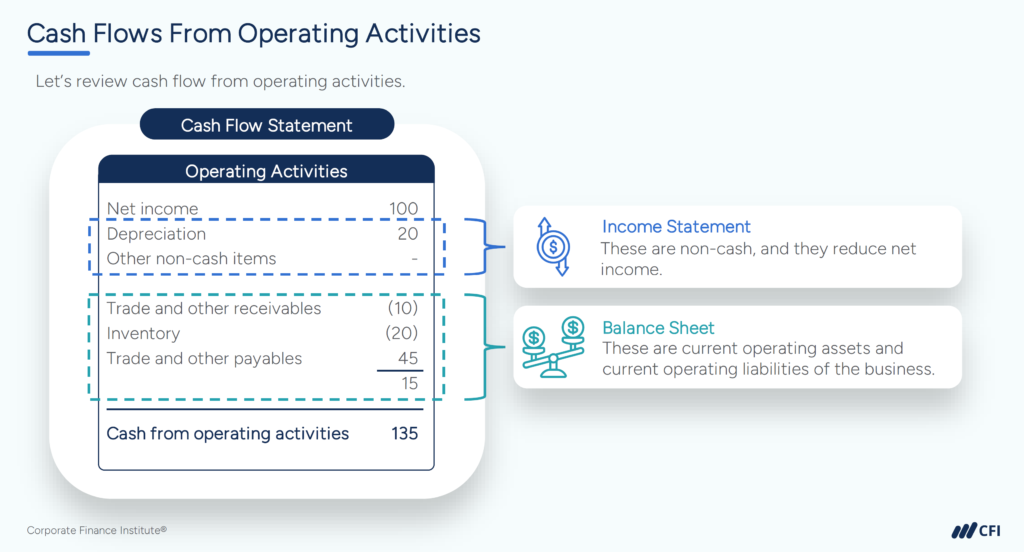
The diagram below shows the same pattern with different numbers. Its 15 is the subtotal of the three working-capital adjustments, not an additional adjustment.
Interpret the answer in an interview
A clear verbal answer is: “I start with net income, add back non-cash expenses that reduced it, and adjust for changes in operating working capital. Increases in operating assets use cash; increases in operating liabilities preserve cash. I then sum those adjustments to get cash flow from operations.”
Three checks make that answer more reliable:
- Do not add back depreciation twice. Add it back once if it reduced the net income you started with.
- Do not confuse a balance with a change. An ending receivables balance of 31 is not a 31 cash outflow; in the example, its increase of 7 is the adjustment.
- Do not call CFO free cash flow or the total change in cash. CFO stops before the separate investing and financing sections.
Key takeaways
The indirect method turns accrual profit into operating cash flow by reversing relevant non-cash effects and correcting for operating working-capital movements. For asset balances, an increase generally means less operating cash; for operating liability balances, an increase generally means more. The signs should follow the cash story, not just a memorised rule.
Next, you’ll move beyond CFO and calculate how capital expenditures and asset disposals affect investing cash flow and the balance sheet.