Recommended resources
The freely available resources this lesson will direct you to.
- Accounts Receivable on the 3 Financial Statementswww.youtube.com
- Most Asked Finance Interview Question | Master 3-Statement Linkage for ER & IB Interviewswww.youtube.com
- How are the Three Financial Statements Linked? - Wall Street Prepwww.wallstreetprep.com
- Accounts Receivable on the 3 Financial Statements (11:19) - BIWSbreakingintowallstreet.com
Hello. In the previous lesson, you traced an increase in depreciation: profit fell, but operating cash flow rose because the expense was non-cash and, under the stated assumptions, reduced cash taxes. A change in accounts receivable tests a different distinction. A company can report a sale before it receives the customer’s money.
This lesson follows accounts receivable through all three statements. The interview skill is not just knowing that “receivables up means cash down”; it is identifying why receivables rose before deciding whether revenue and net income changed.
Start with the balance-sheet account, then ask what caused the change
Accounts receivable (A/R) is an operating current asset: it represents amounts customers owe for sales already recorded. An increase means more cash is tied up in unpaid customer balances. In the indirect cash flow statement, an increase in A/R is therefore subtracted from net income when calculating cash flow from operations.
For this lesson, define operating net working capital as operating current assets, such as A/R and inventory, less operating current liabilities, such as accounts payable. Cash and financing debt are excluded. Using ending balance less beginning balance as the change:
and, holding other operating-cash-flow adjustments constant,
The sign is worth understanding rather than memorizing. If a customer owes an additional 100 at period-end, that 100 is included in the company’s operating assets but has not arrived as cash. The negative cash-flow adjustment removes the unpaid amount from a profit measure that uses accrual accounting. It describes cash not yet collected, not necessarily a payment the company made.
How are the Three Financial Statements Linked? - Wall Street Prep
Read Wall Street Prep’s explanation to connect net income, working-capital adjustments, and balance-sheet movements before working through one account in detail.
In “How are the Income Statement and Cash Flow Statements Linked?”, read the profit-to-cash bridge and the immediately following discussion of increases and decreases in working capital. Then, in “How are the Cash Flow Statement and Balance Sheet Linked?”, find the paragraph beginning “The cash flow statement is linked to the balance sheet” and read the four sign rules, through the bullet on a decrease in an operating current liability. Focus on the difference between an operating asset and an operating liability; you can stop before the discussion of capital expenditures.
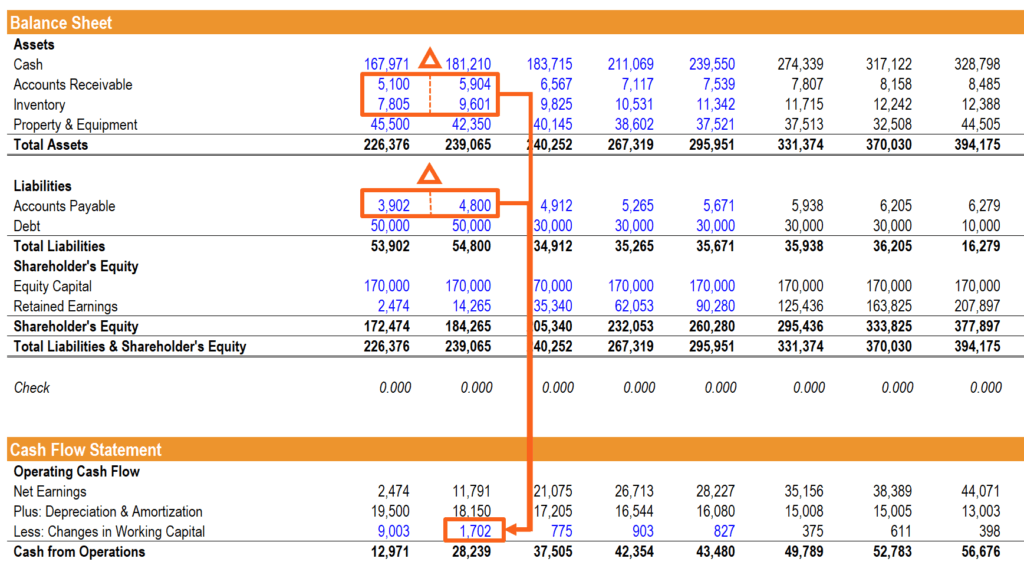
The highlighted model shows why you must isolate the account named in a question. A/R rises from 5,100 to 5,904, an increase of 804. Inventory and accounts payable also change, so the highlighted 1,702 working-capital deduction reflects all three movements, not A/R alone.
Case 1: A/R rises because the company makes an additional credit sale
Suppose the company provides a service worth 100 and records an additional sale, but the customer has not paid by period-end. Assume there are no incremental costs, the 100 is taxable at 25%, and the additional 25 of tax is paid in cash this period. Compare this with a case in which the additional sale did not occur.
Watch the selected portions of Accounts Receivable on the 3 Financial Statements from Mergers & Inquisitions / Breaking Into Wall Street. The video uses a 40% tax rate; we will use 25% to keep the assumptions consistent with the previous lesson. Crucially, its increase in A/R comes from an additional sale, not merely a slower collection of sales that were already recorded.
Accounts Receivable on the 3 Financial Statements
Watch the explanation of what A/R represents, followed by the three-statement trace of an additional credit sale. Notice both the revenue recorded and the cash still missing.
Start with what A/R means, where the speaker locates the unpaid customer balance on the balance sheet. Then watch the credit-sale trace, following the income statement, operating cash flow, and balance-sheet check. Pay particular attention to the assumption that the tax on the additional profit is paid before the customer pays.
Income statement. Revenue and pretax income each rise by 100. Tax expense rises by 25, so net income rises by 75. Revenue is recognized because the service was provided, not because cash arrived.
Cash flow statement. Under the indirect method, start with the additional 75 of net income. A/R rose by 100, so subtract 100 for the sale not yet collected:
Investing and financing cash flow are unchanged. Ending cash is therefore 25 lower than in the comparison case. That is the cash tax payment: the company has not collected the 100 sale proceeds but, under our assumption, has paid 25 of tax on the resulting profit.
Balance sheet. A/R is 100 higher and cash is 25 lower, so total assets are 75 higher. The additional 75 of net income increases retained earnings by 75. Liabilities are unchanged under the assumption that the extra tax has already been paid. Both sides rise by 75:
The cash decline is not a universal consequence of a credit sale. It depends here on paying the additional tax before collecting from the customer. If that tax were accrued but not yet paid, cash would not fall by 25 in this example; a 25 tax payable would instead appear, with the associated operating-cash-flow adjustment.
Case 2: A/R rises because existing customers pay later
Now change only the collection timing. Assume sales, expenses, tax expense, and net income are identical in two comparison cases. In one case, customers pay 100 less by period-end, leaving A/R 100 higher. No additional sale has been made.
This time, the income statement does not change: revenue was already recorded in both cases. The cash flow statement starts with the same net income but subtracts the additional 100 in A/R, so operating cash flow and ending cash are 100 lower. Investing and financing cash flow do not change.
On the balance sheet, A/R is 100 higher and cash is 100 lower. Total assets do not change; neither liabilities nor retained earnings change. The balance sheet balances because one asset has taken the place of another.
| Incremental effect of A/R rising by 100 | Additional credit sale, tax paid | Slower collection of existing sales |
|---|---|---|
| Revenue | +100 | 0 |
| Net income | +75 | 0 |
| A/R adjustment in operating cash flow | (100) | (100) |
| Operating cash flow and cash | (25) | (100) |
| A/R on balance sheet | +100 | +100 |
| Retained earnings | +75 | 0 |
The table resolves an apparent contradiction in common interview answers. “A/R up by 100” tells you the cash-flow adjustment’s sign, but not the income-statement effect on its own. You need to know whether the question introduces a new credit sale or changes when an already-recorded sale is collected.
When a customer subsequently pays an existing 100 receivable, the collection has the opposite balance-sheet and cash-flow effects: A/R falls by 100, operating cash flow and cash rise by 100, and the income statement is unchanged. Do not record revenue or increase retained earnings again on collection; those effects belonged to the earlier sale.
Make the answer precise under interview pressure
For a question phrased simply as “What happens if accounts receivable increases by 100?”, first state the assumption that determines the answer:
“If sales and expenses are unchanged and customers simply pay later, the income statement does not change. On the cash flow statement, the 100 increase in A/R reduces operating cash flow and ending cash by 100. On the balance sheet, A/R rises by 100 and cash falls by 100, so total assets, liabilities, and equity are unchanged. If instead the increase comes from an additional credit sale, I would first account for that sale and its taxes on the income statement.”
That qualification takes only a few seconds but prevents the most important error: treating every increase in A/R as both a new sale and a pure collection-timing change. For either version, finish with the balance-sheet check and distinguish the incremental cash effect from the company’s total change in cash, which may include many other transactions.
Key takeaways
An increase in A/R is a negative operating-cash-flow adjustment because some recorded customer balance has not been collected. If it reflects slower collection of otherwise unchanged sales, there is no income-statement effect: cash falls as A/R rises. If it reflects an additional credit sale, revenue and net income also rise; the final cash effect depends on associated costs and when taxes are paid. Always specify the transaction, trace income statement then cash flow statement then balance sheet, and check that the balance sheet balances.
Next, you will trace an asset write-down. Unlike merely waiting to collect a receivable, a write-down can itself change reported profit, so the distinction between an asset’s balance and an expense will matter again.