Recommended resources
The freely available resources this lesson will direct you to.
Hello. In the previous lesson, a rise in accounts receivable could mean either an additional credit sale or slower collection; the income-statement answer depended on which transaction occurred. An asset write-down is more direct: the company reduces an asset’s recorded value and, under the assumptions we will use, recognizes a loss now.
This is the final three-statement case in the accounting module. You will trace a write-down through profit, operating cash flow, and the balance sheet using an assumed tax rate. The interview challenge is to distinguish the non-cash loss from the possible cash-tax saving—and to avoid counting the same asset reduction twice.
What is being written down?
An asset’s carrying amount is its recorded balance-sheet value. A write-down reduces that amount when the asset can no longer be supported at its previous value. For example, equipment might become less useful than expected, or inventory might become damaged or obsolete. The write-down recognizes a loss in the current period; it does not mean the company pays cash to write the asset down.
For an asset measured under the cost model, the simplified accounting entry is a debit to a write-down or impairment expense and a credit to the asset (or to an allowance that reduces its net carrying amount). That single entry explains the starting point: expense rises on the income statement, while the asset falls on the balance sheet.
Watch the selected portions of IAS 36 Impairment of Assets Explained from Silvia of CPDbox for the meaning and recognition of an impairment. The recoverable-amount test in this video concerns assets within IAS 36; do not apply that test to inventory, which follows different measurement rules. The three-statement mechanics we examine below are nevertheless similar when either type of asset is written down through profit or loss.
IAS 36 Impairment of Assets Explained (applies in 2026) + FREE Practical Checklist
Watch IAS 36 Impairment of Assets Explained from Silvia of CPDbox to connect a decline in an asset's carrying amount with an impairment loss and its accounting entry.
Watch the definition for carrying and recoverable amounts. In the section beginning at 03:30, watch the comparison to see how the impairment amount is determined. Then watch the entry for an asset held under the cost approach. Focus on the debit to a loss and the credit that lowers the asset's net carrying value; the video's subsequent revaluation-model treatment is outside our simplified case.
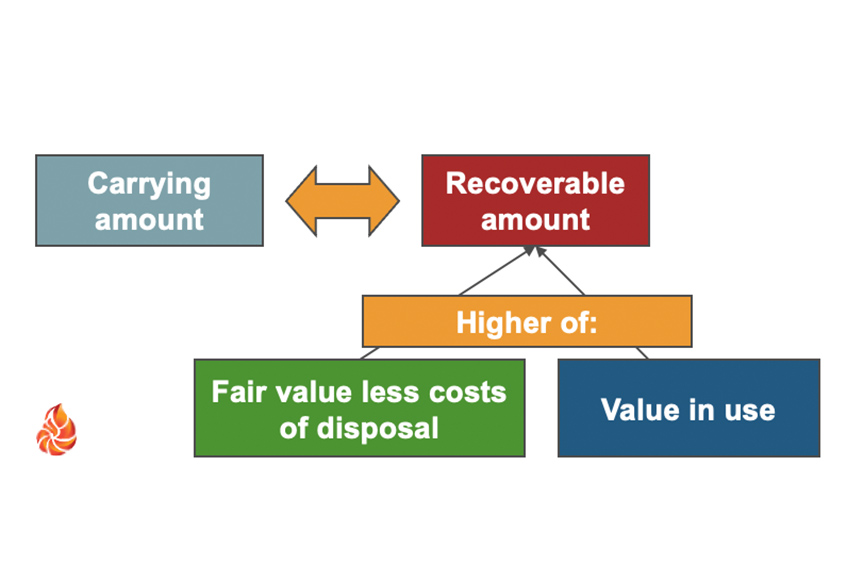
In an interview question that already gives you the write-down amount, you need not calculate recoverable amount. Your task is to follow the stated loss through the statements. Also distinguish a write-down, which leaves the asset with some recorded value, from a complete write-off, which eliminates that value. Either can create a non-cash loss.
Trace a 100 write-down at a 25% tax rate
Assume a company records a 100 write-down of equipment through its income statement. To make the tax and cash effects definite, assume:
- The 100 loss is fully deductible for current tax purposes, and the company has enough taxable profit to use the deduction now.
- The tax rate is 25%, and the reduction in taxes is reflected in cash taxes paid this period.
- There are no other changes, no dividends, and no effects on future depreciation included in this current-period comparison.
Compare the statements with the write-down against the same statements without it. “Cash rises by 25” below means cash is 25 higher than it would otherwise have been, because the company pays 25 less tax. It does not receive 25 for writing down the equipment.
Income statement. The impairment expense rises by 100, so pretax income falls by 100. Tax expense falls by . The after-tax effect on net income is therefore:
Cash flow statement. Under the indirect method, begin with net income, which is 75 lower. Add back the 100 non-cash impairment expense: it reduced profit but was not itself a cash payment. Operating cash flow is 25 higher, reflecting the assumed cash-tax saving.
There is no investing cash outflow from recording the write-down. Buying the equipment would have affected investing cash flow when it was purchased; changing its recorded value today is not another purchase or a disposal. Financing cash flow is also unchanged. Ending cash is thus 25 higher relative to the comparison case.
Balance sheet. The equipment’s net carrying amount is 100 lower, while cash is 25 higher. Total assets are 75 lower. Net income is 75 lower, so retained earnings—and therefore total equity—are 75 lower. Liabilities are unchanged under our paid-tax assumption:
The balance sheet balances. This is the same non-cash-charge logic you used for depreciation, but the expense here arises from a write-down, not from the routine allocation of an asset’s cost over its useful life.
Read the short three-statement discussion and numerical illustration in Inventory Write-Off from Wall Street Prep. It uses 100 at a 30% tax rate, rather than our 25%, so concentrate on the pattern of entries and translate the numbers yourself. Its example assumes the tax saving affects current cash; that result is conditional, as the next section explains.
Inventory Write-Off | Journal Entry + Example
Read Wall Street Prep's Inventory Write-Off for a compact illustration of how a non-cash asset loss affects all three statements.
In “How Does an Inventory Write-Off Affect the Financial Statements?”, read the explanation, beginning with the effect on the inventory balance and ending with the operating-cash-flow add-back. Immediately below the sentence introducing the 100k example, read the three-statement illustration. Focus on reconciling the loss, tax saving, non-cash add-back, and retained earnings. Treat its stated placement of the expense in “non-operating items” as an example, not a universal rule: presentation depends on the asset and circumstances.
Why the tax assumption changes the answer
The write-down itself does not generate cash. Only a current reduction in cash taxes makes cash higher in our example. If the question does not tell you whether the loss is deductible or when taxes are paid, state your assumption rather than presenting the 25 cash increase as inevitable.
Suppose instead that the 100 loss reduces current tax expense by 25, but the tax bill has not yet been paid. Net income is still 75 lower. Relative to the comparison case, the company owes 25 less in tax, so taxes payable is 25 lower. There is no current cash difference: in the indirect cash flow statement, the 100 impairment add-back is offset by the 25 decrease in taxes payable as well as the 75 decline in net income.
The balance-sheet check now reads: the asset is down 100; liabilities are down 25; retained earnings are down 75. Both sides fall by 100. Tax expense falling is not automatically the same as cash taxes falling this period.
A second possibility is that the write-down provides no tax deduction, with no tax benefit recognized in this simplified case. Tax expense is unchanged, so net income and retained earnings each fall by the full 100. Add back the 100 non-cash loss in operating cash flow: cash is unchanged. The asset and equity each fall by 100.
These are not three competing rules. They are answers to different tax assumptions. For a standard interview calculation, it is reasonable to start with an immediately usable deduction and current cash-tax saving if you say so explicitly.
An inventory-specific trap: do not add back the loss twice
The equipment example kept the balance-sheet asset outside operating working capital. Inventory sits inside operating working capital, which creates a common modeling error. If an inventory write-down reduces the reported inventory balance by 100, that decline is not 100 of cash released from selling inventory. It is a non-cash reduction in its recorded value.
For a 100 inventory write-down with our immediately realized 25 tax saving, the clean indirect presentation is the same as before: net income falls 75, the non-cash loss is added back by 100, and operating cash flow rises 25. In a detailed cash-flow reconciliation, the working-capital movement must exclude the 100 non-cash inventory reduction if you show the separate impairment add-back. Alternatively, if a simplified model treats the entire reported 100 inventory decline as a positive inventory adjustment, that adjustment already reverses the non-cash expense; do not also add back 100 as impairment.
The distinction is between a change in an account’s reported balance and a change caused by cash operating activity. The previous lesson’s slower collection left more money tied up in receivables. An inventory write-down can lower an asset balance without freeing any cash at all.
Expense presentation also requires care. An inventory loss may appear in cost of goods sold or as a separate charge; an equipment impairment may appear on a different income-statement line. Do not assert that every write-down is necessarily “non-operating,” or that it affects every profit metric in the same way. For this lesson, the essential fact is that the assumed loss passes through pretax income and reduces net income.
A concise interview response
For a question such as “Walk me through a 100 asset write-down at a 25% tax rate,” a clear answer is:
“Assuming the loss goes through the income statement, is deductible now, and reduces cash taxes this period: pretax income falls by 100, tax expense falls by 25, and net income falls by 75. On the cash flow statement, I add back the 100 non-cash charge to the 75 reduction in net income, so operating cash flow and cash are 25 higher. On the balance sheet, the asset falls by 100 and cash rises by 25, leaving assets down 75; retained earnings fall by 75, so it balances. If the tax saving is not realized in cash now, I would adjust the cash and tax-payable effects.”
This gives the conclusion, states the decisive assumption, and finishes with a balance-sheet check. If the question specifies inventory, also be ready to explain why its non-cash decline must not be counted as both a working-capital cash inflow and a separate add-back.
Key takeaways
A write-down through profit or loss reduces pretax income and the asset’s carrying amount. Under an immediately usable 25% deduction, a 100 write-down lowers net income and retained earnings by 75; the 100 non-cash add-back leaves operating cash flow and cash 25 higher only because cash taxes fall by 25. Check the tax timing, avoid treating the write-down as investing expenditure, and never double-count an inventory reduction in the cash-flow reconciliation.
This completes the three-statement mechanics module. Next, the course turns to equity value and enterprise value, where identifying what belongs to shareholders versus other claimholders becomes the central discipline.