Recommended resources
The freely available resources this lesson will direct you to.
- CRITICAL THINKING - Cognitive Biases: Anchoring [HD]www.youtube.com
- Derren Brown’s Covert Hypnosis Explained (NLP Anchoring)www.youtube.com
- How a Corporate Mentalist Can Help You Instantly Improve Your Negotiation Skillswww.christophergracelive.com
- NLP anchors or NLP anchoring how and why do they work? Neuroquotientneuroquotient.com
Introduction
In our last session, we examined the foundational techniques of influence: building rapport through pacing and leading. You learned how mentalists and persuaders synchronize with a subject's reality to lower resistance before guiding their thoughts and behaviors. This process establishes the groundwork for more targeted psychological maneuvers.
This lesson builds directly on that foundation by dissecting two powerful Neuro-Linguistic Programming (NLP) techniques: anchoring and reframing. We will explore the neurological and psychological mechanisms that make these techniques effective, focusing on how they exploit cognitive vulnerabilities such as attentional narrowing and cognitive biases. Understanding these specific "loopholes" is crucial for developing the mental defenses you seek to build.
Anchoring: Forging a Link Between Stimulus and State
At its core, NLP anchoring is a process of creating a conditioned response. It involves associating a specific internal state—usually a strong emotion—with a unique external trigger. This trigger, or "anchor," can be a touch, a word, a sound, or a gesture. Once the association is formed, firing the anchor automatically brings back the emotional state.
The neurological basis for this phenomenon lies in the brain's capacity for associative learning and neuroplasticity. When a peak emotional state occurs simultaneously with a unique sensory stimulus, the neurons representing that emotion and that stimulus fire together. According to Hebbian theory, "neurons that fire together, wire together," strengthening the synaptic connection between them.
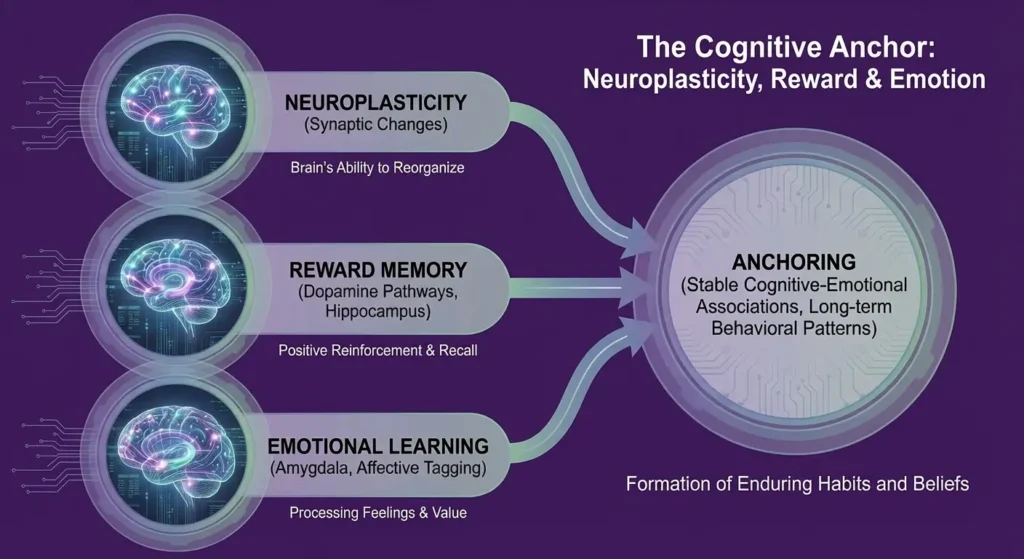
This process involves several key brain systems:
- Neuroplasticity: The brain's ability to reorganize itself by forming new neural connections.
- Reward Memory: The dopamine pathways and hippocampus are crucial for linking experiences with positive reinforcement, making the memory more salient.
- Emotional Learning: The amygdala assigns emotional significance, or "affective tagging," to stimuli, creating powerful and lasting associations.
The diagram below illustrates how these components converge to form a stable cognitive-emotional association, or what NLP calls an anchor.
To understand the mechanics from a neuro-behavioral perspective, the following article provides an excellent breakdown.
NLP anchors or NLP anchoring how and why do they work? Neuroquotient
This article from NeuroQuotient explains the neurological underpinnings of NLP anchoring, which it calls "neuro behaviour."
Please read the full article. Pay close attention to the sections on brain function, which explain the roles of the senses, memory, and limbic systems, and the example provided of overcoming public speaking anxiety. Finally, focus on the conclusion drawn from the cited study about what makes an effective anchor—its proximity to the moment of maximum emotional intensity.
Anchoring in Action: A Mentalist's Tool
Mentalists use anchoring covertly to influence a subject's state or recall specific information. The process is often rapid, built upon a foundation of confusion and rapport. The following video analyzes a classic clip of mentalist Derren Brown using an anchor to induce temporary amnesia.
Derren Brown’s Covert Hypnosis Explained (NLP Anchoring)
This analysis breaks down how Derren Brown combines a pattern interrupt with a specific gesture and phrase to create a powerful anchor.
Watch the video's introduction and the clip of the first subject from the beginning. Then, focus on the detailed breakdown of the anchoring technique from the explanation. Notice how Brown associates the command "gone from your mind" with a specific hand gesture. This is a multi-modal anchor (auditory and visual) designed to create a powerful, instantaneous effect.
Exploiting Cognitive Vulnerabilities
Anchoring is effective because it leverages inherent features of our cognitive architecture.
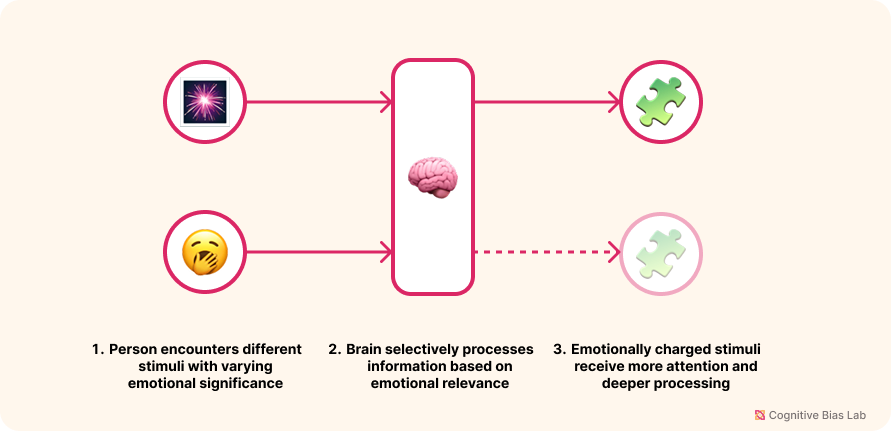
1. Attentional Narrowing and Emotional Salience
Our brains do not process all sensory information equally. Emotionally significant stimuli automatically capture our attention and receive deeper processing. When an anchor is linked to a strong emotion, firing that anchor makes the associated thought or feeling highly salient, causing other competing thoughts to fade into the background. This is a form of attentional narrowing.
2. The Anchoring Bias
It is important to distinguish NLP anchoring (state-trigger association) from the anchoring bias, a well-documented cognitive bias. The anchoring bias is our tendency to rely too heavily on the first piece of information offered (the "anchor") when making decisions. An initial number, for example, sets a mental benchmark that influences all subsequent negotiation, even if that number is arbitrary.
This video provides a clear and concise explanation of this cognitive vulnerability.
CRITICAL THINKING - Cognitive Biases: Anchoring [HD]
This video from Wireless Philosophy uses simple experiments to illustrate the power of the anchoring bias.
Watch from the beginning to understand the core concept through the math problem example. Then, continue watching the section from arbitrary anchors, which shows how even completely unrelated numbers (like social security digits) can influence financial decisions.
An adept influencer can use both types of anchoring simultaneously. For instance, they might state a high price for a product (setting a cognitive anchor) while firing a pre-established NLP anchor linked to a feeling of confidence or decisiveness in the subject, making them more likely to accept the inflated frame of reference.
Reframing: Changing Perception by Changing the Frame
The second major NLP technique is reframing. It doesn’t change the facts of a situation, but rather changes the meaning associated with it by altering its context or "frame." Since our emotional response is tied to meaning, a change in frame leads to a change in response.
This technique exploits the cognitive vulnerability that our perception is not objective. We interpret events through mental filters. By offering an alternative, and often more compelling, frame, an influencer can steer a subject's interpretation and bypass their initial resistance. This is often leveraged alongside authority bias, our tendency to give more weight to the suggestions of someone we perceive as an authority—a status the influencer establishes through rapport and confident communication.
The following article offers a crisp explanation of both reframing and how to create and use NLP anchors in a practical context.
How a Corporate Mentalist Can Help You Instantly Improve Your Negotiation Skills
This article frames NLP techniques in the context of negotiation, which is a form of influence.
Read the sections titled "Control the Frame" for a clear definition and example of reframing. Also, read the section "The Confidence Anchor", which details the process of creating a personal, positive anchor.
As the article illustrates, when someone says, "That’s too expensive," arguing the price is ineffective. Reframing the conversation to be about "quality and long-term results" sidesteps the objection by changing what is being evaluated.
Conclusion
In this lesson, we have moved beyond general influence and into the mechanics of specific NLP techniques that exploit cognitive loopholes.
The key takeaways are:
- NLP Anchoring creates a conditioned response by linking a unique trigger to a peak emotional state. It relies on the brain's neuroplasticity and emotional memory systems.
- Reframing alters the emotional and cognitive response to a situation by changing its contextual meaning, not its facts.
- These techniques are effective because they exploit vulnerabilities like attentional narrowing (emotions capturing focus), the anchoring bias (over-reliance on initial information), and the authority bias (accepting a frame from a trusted source).
You can now explain how these methods work from both a procedural and a psychological perspective. In our next lesson, we will shift from analysis to application and defense. We will focus on developing the metacognitive awareness needed to recognize these patterns in real-time and deploy strategies to resist involuntary influence.