Recommended resources
The freely available resources this lesson will direct you to.
- Conversational Hypnosis - Pacing and Leading: The Components of Rapportwww.youtube.com
- This is how an illusionist targets your unconscious mind | Derren Brown | Big Thinkwww.youtube.com
- Covert hypnosis — Grokipediagrokipedia.com
- Pacing And Leading: Sneaky Tactics To Persuade People - Max Trancemaxtrance.com
Introduction
In our previous lesson, we distinguished between voluntary hypnosis, which enhances self-control, and involuntary hypnosis, which leverages psychological states to influence behavior without explicit consent. We established that building rapport is a foundational step in creating the state of susceptibility required for involuntary influence.
This lesson delves into the precise mechanics of how that influence is established. We will dissect the techniques mentalists and other persuaders use to build rapport with near-instantaneous effect. You will learn to describe "pacing" and "leading"—the core components used to synchronize with a subject's reality and then guide their responses. Understanding this process is the first practical step toward recognizing and defending against unwanted influence.
Rapport: The Bridge of Influence
At its heart, influence begins with rapport. In the context of hypnosis and NLP, rapport is more than just a pleasant conversation; it is a state of deep unconscious connection and trust. When rapport exists, the subject perceives the influencer as being "like them," which lowers conscious resistance and makes them more receptive to suggestion.
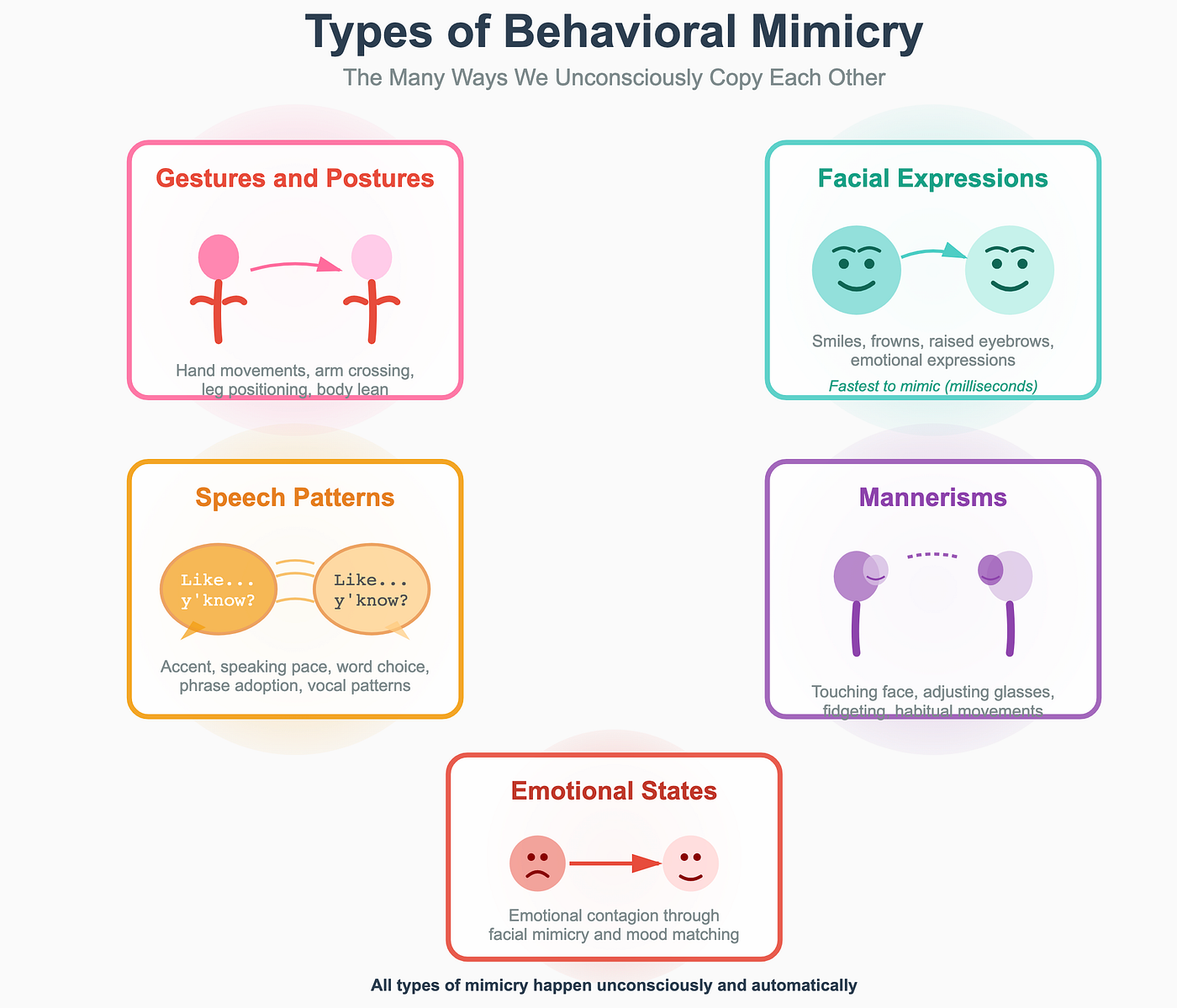
This feeling of similarity is often built on a foundation of behavioral mimicry, an automatic and unconscious process where individuals in sync with one another begin to mirror each other's behaviors. Skilled influencers simply execute this process consciously and with a specific intent.
Pacing and Leading: The Art and Science of Influence
The primary method for establishing rapport and directing a subject's experience is a two-step process derived from the work of Milton H. Erickson and codified in Neuro-Linguistic Programming (NLP): pacing and leading.
- Pacing: Meeting the person in their current reality by matching their observable experience.
- Leading: Guiding the person toward a new experience or state after rapport has been established through pacing.
To get a practical feel for how these concepts work in a conversational context, the following video from Mike Mandel Hypnosis provides an excellent overview.
Conversational Hypnosis - Pacing and Leading: The Components of Rapport
This video, "Conversational Hypnosis - Pacing and Leading," breaks down the components of rapport. It uses simple analogies and clear examples to demonstrate how to match and mirror behavior and language.
Watch the segments that explain how to match body language, posture, and speech patterns subtly. Pay attention to the distinction between matching and mocking. Then, focus on the section explaining how to reflect back words to build connection. Finally, observe the detailed breakdown of the linguistic structure of pacing and leading, including the "three paces and a lead" rule of thumb and how to lead someone from one emotional state to another.
As the video illustrates, pacing involves calibrating to multiple aspects of a person's experience. This creates what is known as an agreement frame—a state where the subject's unconscious mind is consistently agreeing with the influencer because their reality is being accurately described and reflected back to them.
The following reading explains the psychological principles behind this process in more detail.
Pacing And Leading: Sneaky Tactics To Persuade People - Max Trance
This article from Max Trance delves into the mechanics of pacing and leading, grounding them in the principle of state-dependent learning.
Please read the sections titled State Dependent Learning, Agreement Frames, and Matching and Mirroring. Focus on how pacing leverages the mind's preference for familiarity to bypass the "critical faculty" and how mirroring physiology creates an unconscious agreement frame.
To synthesize these ideas, pacing can be summarized as matching:
- Physiology: Posture, gestures, breathing rate (mirroring).
- Tonality: Volume, tempo, and pitch of speech.
- Language: Using the subject's key words and predicates (e.g., if they say "I see what you mean," you might respond with "Let's look at this differently").
- Verifiable Experience: Stating truths about their immediate reality. For example: "As you sit there (pace), listening to my voice (pace), and reading these words (pace)..."
Once this "yes-set" is established through several pacing statements, the subject is primed to accept the next statement, which is the lead. The lead is a suggestion for a new behavior, feeling, or thought. For example: "...you can begin to feel a sense of deep curiosity (lead)." Because the lead follows a string of undeniable truths, the unconscious mind is more likely to accept it without question.
Application: How Mentalists Establish Influence
Your interest in how mentalists hypnotize people brings us to the direct application of these techniques. Mentalists are masters of what is sometimes called "rapid hypnosis." They don't have time for a lengthy, formal induction. Instead, they use a potent combination of pacing, leading, and other psychological principles to create a state of heightened suggestibility in moments.
The article "Covert Hypnosis" from Grokipedia provides a clear description of the pacing and leading strategy and gives examples of its portrayal in popular culture, which often features mentalist characters.
This resource offers a concise summary of covert hypnotic strategies, including pacing and leading, and their depiction in fiction.
First, read the section Specific Strategies and Examples. This will reinforce the pacing/leading sequence with clear examples of embedded commands and metaphors. Then, review the section on film and television for examples of how fictional mentalists, such as Patrick Jane in The Mentalist, apply these techniques.
While pacing and leading create a smooth ramp into a suggestible state, some mentalists use a more jarring approach. They intentionally create a moment of confusion or disorientation to overload the conscious mind, making it instantly receptive to a command. This is a form of leading by shock. The renowned mentalist Derren Brown is an expert at this.
In this video, he explains how he uses bafflement and pattern interruption to create a window of hyper-suggestibility.
This is how an illusionist targets your unconscious mind | Derren Brown | Big Think
In this clip from Big Think, illusionist Derren Brown discusses how he targets the unconscious mind. He explains that creating bewilderment is a key tool for influence.
Watch the segment from his explanation of the toolkit. He describes how states of bafflement and disorientation make a person hyper-suggestible because they are looking for a clear direction. Notice his example of the interrupted handshake—a classic NLP technique that creates a momentary cognitive vacuum, which can then be filled with a suggestion. This directly relates to the concept of overloading the conscious mind we discussed in the previous lesson.
By combining subtle pacing to build an initial bridge of rapport with moments of calculated confusion to bypass critical thought, a mentalist can rapidly gain compliance and guide a subject's responses, making it appear as though they have uncanny powers of mind reading or control.
Conclusion
In this lesson, we have moved from the "what" of hypnotic influence to the "how." You can now describe the foundational techniques mentalists and influencers use to establish control over an interaction.
The key takeaways are:
- Rapport is a state of unconscious alignment, built by making a subject feel understood and "in sync."
- Pacing is the technique of consciously matching a subject's physiology, language, and observable reality to build rapport and create an "agreement frame."
- Leading is the subsequent step of introducing a new idea, behavior, or feeling, which the subject is primed to follow due to the established rapport.
- Mentalists use these techniques, often combined with pattern interruption and induced confusion, to rapidly create states of heightened suggestibility.
Now that you understand how influence is initiated through rapport, our next lesson will explore more specific NLP techniques that exploit cognitive vulnerabilities. We will examine how "anchoring" is used to link a stimulus to a response and how "reframing" is used to change a person's perception of an experience.