Recommended resources
The freely available resources this lesson will direct you to.
- The Surprising Neuroscience of Hypnosis: Myths, Truths & Use Cases w/ Dr. David Spiegel MDwww.youtube.com
- Stanford Professor | The Powerful Neuroscience of Transformation and Hypnosiswww.youtube.com
- [PDF] Self-Hypnosis - University of Wisconsin–Madisonwww.fammed.wisc.edu
- Autosuggestion: a cognitive process that empowers your brain?pmc.ncbi.nlm.nih.gov
Introduction
In our last session, we focused on building your metacognitive defenses against involuntary influence. We established that influence works by creating a temporary gap in your self-monitoring capabilities. Today, we shift from defense to proactive application. You will learn how to intentionally harness the same neurological mechanisms for your own therapeutic benefit.
This lesson addresses your goal of understanding and using voluntary hypnosis for healing. We will describe the core process of self-hypnosis, breaking it down into distinct, actionable phases. We will also define and explore autosuggestion, the practice of giving yourself targeted mental instructions to achieve specific outcomes. By the end of this lesson, you will understand the complete structure of a self-hypnosis session, from inducing the state to applying therapeutic suggestions and returning to full awareness.
The Foundation: All Hypnosis is Self-Hypnosis
A fundamental concept in modern clinical hypnosis is that the practitioner acts as a guide or coach, teaching the client how to enter and utilize a hypnotic state. The control always remains with the individual. This directly counters the popular misconception of hypnosis as a loss of control. As Dr. David Spiegel, a leading researcher in the field, states, hypnosis is not about losing control but about enhancing your control over your brain and your experience.
Let's begin by grounding ourselves in the principles of this practice. The following document from the University of Wisconsin's School of Medicine and Public Health provides a concise overview.
[PDF] Self-Hypnosis - University of Wisconsin–Madison
Please read the "Overview" section.
Focus on the assertion that all hypnosis is self-hypnosis. Also, note the three factors involved in a session—absorption, dissociation, and suggestibility—and the five main principles that structure the process. We will use these principles as a framework for our lesson.
This framework confirms that you are the agent of your own change. The key difference between this and the "involuntary" influence we've discussed is agency. In self-hypnosis, there is a preserved and active sense of control, whereas in other forms of suggestion, there can be a diminished sense of intention or volition.
The Five Phases of a Self-Hypnosis Session
A typical hypnosis session, whether guided by a therapist or performed by yourself, follows a structured process. This process can be broken down into five distinct phases, as illustrated below.
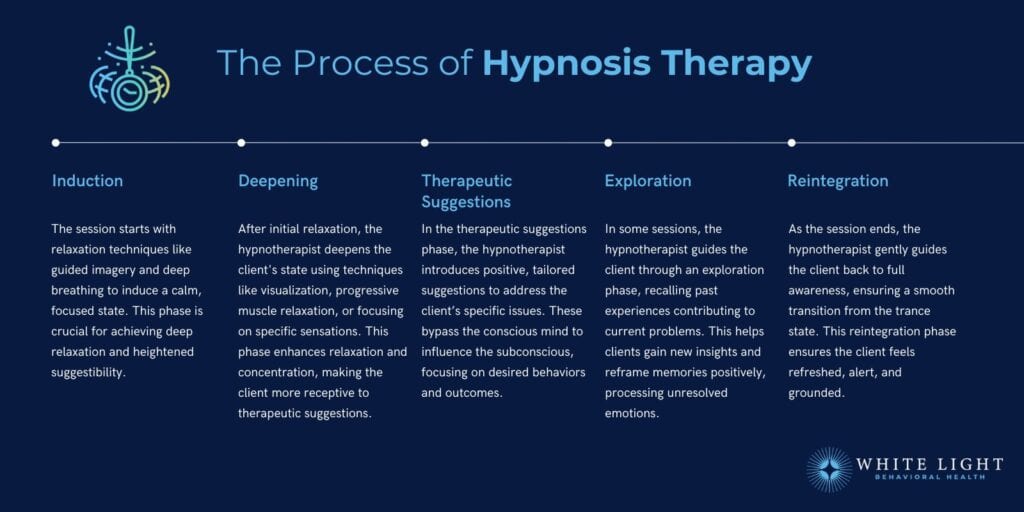
We will now examine each of these phases, focusing on the practical "how-to" of inducing the state and applying it for therapeutic purposes.
Phases 1 & 2: Induction and Deepening
The first goal is to guide your mind into a state of highly focused attention, also known as trance. This involves two steps: Induction, which initiates the process, and Deepening, which intensifies the state of relaxation and focus.
As we've learned, the hypnotic state is characterized by three key components:
- Absorption: Intense focus on a single point of attention, like a telephoto lens.
- Dissociation: The filtering out of peripheral awareness and distractions.
- Cognitive Flexibility: An increased willingness to consider new perspectives, which we previously called suggestibility.
A powerful and direct way to trigger this state is through conscious control of your breath. Breathing is unique because it sits at the threshold of voluntary and involuntary control. By consciously slowing your exhalation, you can activate the parasympathetic nervous system, which induces a state of calm and relaxation, making you more receptive to the hypnotic process.
The Surprising Neuroscience of Hypnosis: Myths, Truths & Use Cases w/ Dr. David Spiegel MD
In this clip from his interview with Rich Roll, Dr. Spiegel explains the neurophysiology of breathwork.
Watch the segment from his explanation of why breath is a unique pathway into the mind-body connection. Pay particular attention to how different breathing patterns influence the sympathetic (fight-or-flight) and parasympathetic (rest-and-digest) nervous systems.
Building on this principle, practitioners use specific structured techniques for induction and deepening. The "Self-Hypnosis" handout you read earlier provides two classic and effective examples.
[PDF] Self-Hypnosis - University of Wisconsin–Madison
Now, please read the section titled "Trance Induction."
Focus on the two techniques presented: the finger technique, which acts as a simple trigger, and the staircase technique, which is a classic method for progressive relaxation and deepening the trance.
These techniques guide you from a normal waking state into one of deep physical relaxation and heightened mental focus, preparing you for the next, most crucial phase.
Phase 3: Utilization via Autosuggestion
Once you are in a state of focused attention, your mind is highly receptive to new ideas. This is where autosuggestion—the process of providing yourself with targeted, therapeutic suggestions—comes in. The goal is to introduce ideas that actively bias your perceptions, physiological states, or behaviors toward a desired outcome.
An academic review provides a precise neurocognitive definition and practical guidelines for formulating these suggestions.
Autosuggestion: a cognitive process that empowers your brain?
Please read the highlighted sections from this paper on the neuroscience of autosuggestion.
First, read the formal definition of autosuggestion in the text box under the heading "Defining autosuggestion." Note the key elements: instantiation and reiteration, active self-bias, and its verbal/linguistic form. Next, jump to the "Discussion and future directions" section. Read the paragraph detailing the linguistic guidelines for crafting effective autosuggestions. These four rules are critical for practical application.
To summarize the key rules for formulating autosuggestions:
- Use "I" statements: The suggestion should be personal (e.g., "I am calm").
- Use the present tense: State the desired outcome as if it is already true ("My body is comfortable," not "My body will be comfortable").
- Be positive: Frame the suggestion in terms of what you want, not what you want to avoid ("I am a non-smoker" or "I protect my lungs" is more effective than "I will not smoke").
- Be short and concise: Simple statements are more easily absorbed by the subconscious mind.
For example, the "Cool breeze technique" for headache relief, described in the "Utilization" section of the University of Wisconsin handout, is a perfect application of these principles. It combines imagery (a cool breeze) with direct suggestion ("Your hands are warm and comfortable," "Your head feel[s] cooler, soothing and relaxing").
Practical Demonstrations: Two Guided Sessions
Theory is best understood through practice. The following videos contain complete, guided self-hypnosis sessions led by two renowned experts. As you follow along, notice how they integrate all the phases we have discussed: induction, deepening, suggestion, and re-alerting.
First, Dr. David Spiegel demonstrates a structured, clinical approach focused on creating a "growth mindset" to deal with a stressor.
Stanford Professor | The Powerful Neuroscience of Transformation and Hypnosis
In this video, Dr. Spiegel leads a guided self-hypnosis exercise.
I encourage you to follow along with the exercise, which begins at this timestamp. Observe his rapid induction, the use of hand levitation for deepening, the way he structures the suggestion (dissociating the body's feeling of comfort from the mental problem), and the clear countdown for re-alerting.
Next, therapist Marisa Peer demonstrates a more emotionally-focused session aimed at reframing deep-seated beliefs about self-worth. This is a powerful example of using hypnosis for what the framework calls "Exploration" and reframing.
Stanford Professor | The Powerful Neuroscience of Transformation and Hypnosis
In this segment, Marisa Peer conducts a session focused on overcoming the fear of rejection and feelings of not being "enough."
Follow her guided session starting at this point. Note her use of the staircase method for deepening, the regression to a past scene for exploration, and the powerful, repeated use of positive autosuggestions like "I am enough."
Phases 4 & 5: Exploration and Reintegration
As you saw in Marisa Peer's session, the utilization phase can sometimes involve Exploration, where the hypnotist guides the client to recall past experiences that may contribute to current problems. The goal is to gain new insights and positively reframe memories.
Finally, every session concludes with Reintegration (or Re-alerting). This is the crucial step of gently guiding the mind back to full waking awareness, ensuring you feel refreshed, alert, and grounded.
[PDF] Self-Hypnosis - University of Wisconsin–Madison
Please read the final two sections of the main text, "Re-alerting" and "Summary of the hypnotic process."
Focus on how re-alerting reverses the induction (e.g., counting up the staircase) and the importance of empowering yourself to use the technique again in the future.
Conclusion
In this lesson, you have learned that voluntary self-hypnosis is a structured, controllable skill for personal development. It is not about losing control, but about gaining deliberate influence over your own mind and body.
Here are the key takeaways:
- The Process is Structured: Self-hypnosis follows a clear five-phase model: Induction, Deepening, Therapeutic Suggestions (Utilization), Exploration, and Reintegration.
- Induction Creates Focus: Techniques like controlled breathing and progressive relaxation are used to induce a state of deep absorption and dissociation from distractions.
- Autosuggestion Directs Change: The core of the therapy lies in autosuggestion—providing your mind with concise, positive, present-tense "I" statements to guide it toward a desired outcome.
- You Are in Control: Throughout the process, you retain full agency. Self-hypnosis is a tool you learn to wield for yourself.
In our next lesson, we will connect these concepts directly to your expertise in Jain philosophy. We will analyze the fascinating parallels between the mechanisms of hypnotic trance and autosuggestion and the Preksha Dhyaan practices of kayotsarga (cessation of the body) and anupreksha (contemplation/auto-suggestion).