Recommended resources
The freely available resources this lesson will direct you to.
Introduction
In our previous lesson, we detailed the process of voluntary self-hypnosis, establishing it as a structured method for inducing a state of focused attention and implanting therapeutic autosuggestions. We saw that the core components are achieving a state of absorption and dissociation (trance) and then utilizing that state to introduce new ideas to the mind.
This lesson brings us to a central part of your goal: bridging this modern psychological framework with the ancient wisdom of Jain philosophy. We will analyze the profound parallels between the hypnotic mechanisms we've discussed and the Preksha Dhyaan practices of kayotsarga (cessation of the body) and anupreksha (contemplation). Given your deep familiarity with Preksha Dhyaan, we will focus not on introducing the practices themselves, but on re-examining them through the lens of neuroscience and psychology to reveal their shared operational principles with hypnosis.
The Two Pillars of Preksha Dhyaan: Perception and Contemplation
Preksha Dhyaan is a system of meditation that, at its core, aims to purify consciousness and bring about behavioral transformation. It is fundamentally a practice of seeing the self and reality clearly, without distortion.
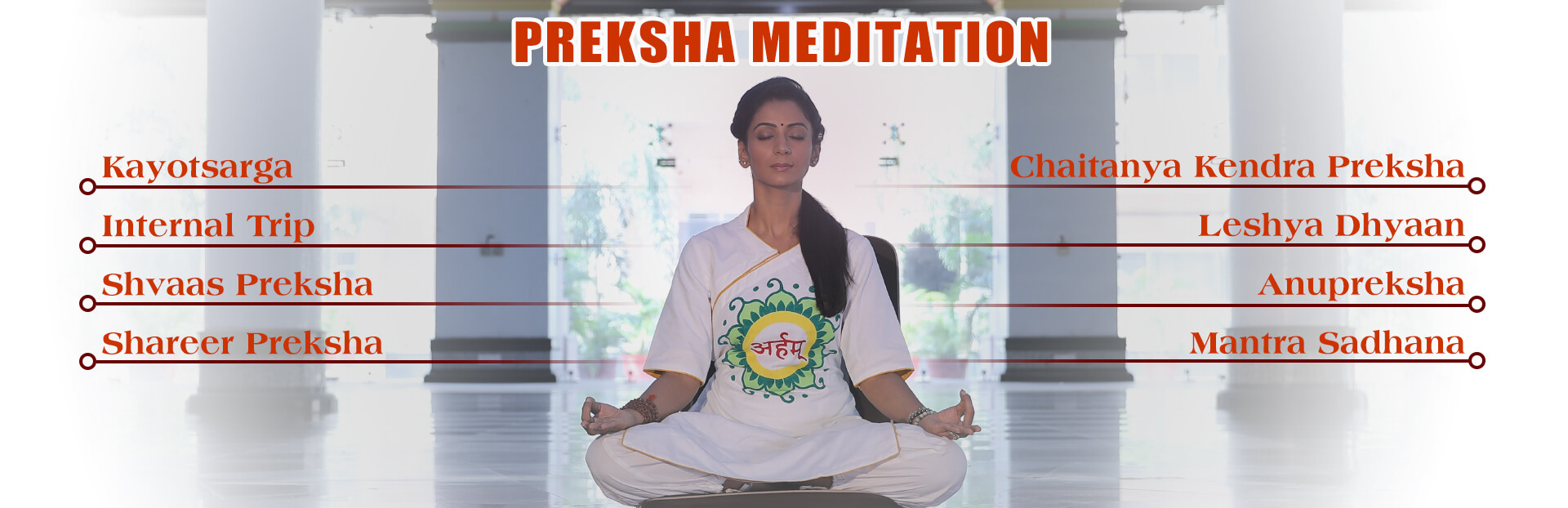
To establish a common framework for our analysis, let's turn to a text that breaks down the practice into two key functions.
Preksha Dhyana Contemplation and Auto Suggestion - Jain Quantum
This resource from Jain Quantum provides a precise philosophical breakdown of Preksha Dhyaan. We will use it to define the two main activities that we will compare to hypnosis.
Please read the introductory section, which bifurcates the system into Preksha (perception) and Anupreksha (contemplation/auto-suggestion). Then, move to the section titled "Philosophical Version." Focus on the paragraphs that define Preksha as profound perception and Anupreksha as the objective reflection that follows perception. This distinction is the key to our analysis.
As the text clarifies, Preksha is about pure, non-conceptual awareness—perceiving things as they are. Anupreksha is about concentrated, objective thinking or contemplation, often used to internalize truths or effect attitudinal change. Now, let's see how these map onto the hypnotic process.
Kayotsarga as a Method of Hypnotic Induction
The first phase of a Preksha Dhyaan session is typically kayotsarga, which you know as the "cessation of the body." It is a practice of complete physical relaxation coupled with sustained awareness. From a psychological perspective, kayotsarga functions as a highly effective form of hypnotic induction and deepening.
Recall the three components of a hypnotic state: absorption, dissociation, and suggestibility. Kayotsarga systematically cultivates the first two.
- Absorption: The practitioner focuses attention sequentially on different parts of the body.
- Dissociation: By relaxing the body to the point of immobility and viewing it as a separate object, the practitioner cultivates a powerful sense of dissociation—a separation of the conscious observer from physical sensation and the external environment.
This process has a direct and measurable neurophysiological effect. It involves a conscious down-regulation of the sympathetic nervous system ("fight or flight") and activation of the parasympathetic nervous system ("rest and digest").
The following video from the Preksha Meditation channel provides a detailed scientific explanation of how kayotsarga achieves deep relaxation by modulating the electrical energy sent from the nervous system to the muscles.
Kayotsarg: Scientific Perspective 28.06.20
This video offers a scientific perspective on Kayotsarga, explaining its impact on the nervous system and muscle tension, which directly parallels the physiological state of deep hypnotic trance.
Watch the section from the beginning of the explanation of muscle function to the conclusion of the scientific discussion. The speaker uses the analogy of an electromagnet to explain how electrical impulses from nerves cause muscle contraction. She explains that stress leads to excessive, prolonged contraction, and that kayotsarga intentionally reduces this electrical flow, inducing a state of profound relaxation and energy conservation.
This intentional reduction of neuro-muscular activity is precisely what hypnotic induction techniques like progressive muscle relaxation aim to achieve. The goal is to quiet the body to focus the mind.
This next resource from the International Journal of Indian Psychology explicitly connects kayotsarga to the subconscious mind, reinforcing its function as a gateway to the inner workings of consciousness, much like hypnosis.
Therapeutic Approaches Involving Modification of the ...
This academic paper reviews therapeutic techniques that influence the unconscious mind, including Preksha Meditation.
In the section on "Preksha Meditation," please read the paragraph describing how the practice works. Pay close attention to the statement that in the state of Kayotsarg, direct contact with the subconscious and unconscious mind occurs. This is the critical link between the practice and the psychological state necessary for suggestion.
Thus, kayotsarga is not merely "relaxation." It is a systematic, self-directed process for inducing a psycho-physiological state identical to a deep hypnotic trance, characterized by parasympathetic dominance, physical stillness, focused attention, and dissociation.
Anupreksha as a Form of Autosuggestion
Once the receptive state of kayotsarga is established, Preksha Dhyaan proceeds to its utilization phase: anupreksha. As you know, this involves contemplating or reflecting on a specific theme. When used for personal transformation, this practice is functionally identical to autosuggestion.
The goal of anupreksha is to internalize a concept so deeply that it changes one's attitudes and automatic behaviors. This is achieved through the focused and repeated introduction of an idea.
Let's return to the "Preksha Dhyana: Contemplation and Auto Suggestion" text, which makes this connection explicit.
Preksha Dhyana Contemplation and Auto Suggestion - Jain Quantum
This text explicitly frames Anupreksha as a form of autosuggestion, providing clear examples.
First, read the section titled "Auto-Suggestion (Bhavana)". The text states that bhavana (which it equates with this form of contemplation) is the "frequent and prolonged repetition of an idea" and that "repeated willing by auto suggestion by a practitioner of anupreksha enables him to achieve a desired objective." Next, jump to the section "TECHNIQUE OF CONTEMPLATIVE MEDITATION" and review the instructions under Category (II). Notice the specific phrasing used for the "Contemplation of Fearlessness": "The virtue of fearlessness is becoming stronger; I am Becoming free from fear." This is a perfect example of a positive, present-tense suggestion, exactly as prescribed in clinical hypnosis.
The process described is a direct parallel to the "Utilization" phase of self-hypnosis we covered in the last lesson.
- A receptive trance state is induced (kayotsarga).
- A carefully formulated suggestion is introduced and repeated (anupreksha).
- The suggestion, entering a mind with reduced critical analysis, begins to reprogram subconscious patterns.
To see this in practice, let's observe a guided kayotsarg session. Notice how the guide's words function as suggestions to facilitate the state.
This guided session demonstrates how verbal cues, essentially suggestions, are used to induce the state of Kayotsarg and deepen the experience of dissociation.
Watch the main relaxation sequence from the focus on the right big toe to the relaxation of the brain. The guide repeatedly uses the command "relax" and the suggestion "experience it is relaxing." This is a form of guided induction. Then, notice the shift in focus from "this is the moment" where the practitioner is told, "You are differ from your body, you are the consciousness." This is a direct suggestion to deepen the state of dissociation and experience the observer self, a key philosophical goal of the practice.
Synthesis: Shared Mechanisms, Different Scopes
The parallels are striking and direct:
- Kayotsarga is a sophisticated induction technique that creates a state of hypnotic trance by combining focused attention (absorption) and the perception of the body as a separate object (dissociation).
- Anupreksha is the Jain equivalent of autosuggestion, using the focused, receptive state created by kayotsarga to introduce transformative ideas and reprogram the subconscious mind.
The primary difference lies not in the mechanism, but in the scope and ultimate purpose. Modern hypnosis is typically a therapeutic tool focused on resolving specific issues like pain, anxiety, or habits. Preksha Dhyaan, while having immense therapeutic benefits, embeds these mechanisms within a broader spiritual framework. Its ultimate aim is the purification of karma and the realization of the soul's true nature, leading to liberation (moksha). The contemplation of "body-soul separateness" is not just a dissociation technique; it is a profound philosophical exercise aimed at transcending material identification entirely.
Conclusion
This lesson has drawn a direct line between modern psychological techniques and ancient Jain practices. We have seen that Preksha Dhyaan is not based on esoteric or mystical principles, but on a sophisticated, practical understanding of the human mind that predates Western psychology by centuries.
Here are the key takeaways:
- Kayotsarga as Hypnotic Induction: The practice of kayotsarga systematically induces a state of deep trance by activating the parasympathetic nervous system and fostering absorption and dissociation.
- Anupreksha as Autosuggestion: The practice of anupreksha functions as a powerful form of autosuggestion, using the receptive trance state to introduce and internalize transformative ideas for attitudinal and behavioral change.
- Shared Process: Together, kayotsarga and anupreksha form a complete process that mirrors the induction-utilization sequence of a formal hypnosis session. The core mechanism—creating a receptive state and introducing suggestion—is identical.
In our final lesson, we will synthesize everything we have learned. We will evaluate how strengthening your mind through these practices—developing metacognitive defense and an ability for potent self-suggestion—directly maps onto the Jain philosophical goal of resisting the compulsions of Mohaniya Karma.