Recommended resources
The freely available resources this lesson will direct you to.
Welcome back! In our previous lesson, we dove deep into distortion, learning how to add harmonic richness and aggression to our lead sounds. We saw how different distortion algorithms can warm up a sound for a Liquid track or add gritty texture for Neurofunk.
A common result of adding so much harmonic content is that the sound can become dynamically messy and difficult to sit properly in a dense DnB mix. The quiet parts get lost, and the loud parts might be too harsh. This lesson tackles that exact problem. We will focus on using multiband compression—specifically the famous "Over The Top" (OTT) style—to clamp down on dynamics and dramatically enhance your lead's presence. By the end of this session, you'll understand why this effect is a secret weapon for modern electronic producers and how to apply it within Serum to make your leads sound polished, powerful, and upfront.
1. The Theory of "Over The Top" Compression
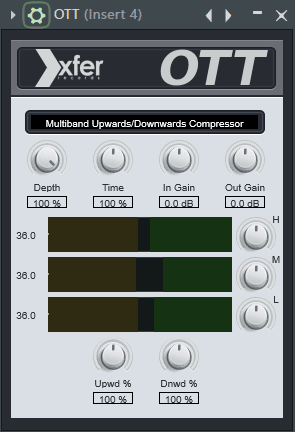
Before we touch any knobs in Serum, it's crucial to understand what "OTT" actually is and why it's so effective. It's not just a standard compressor; it's a specific and extreme application of multiband upward and downward compression.
The following video provides an excellent deep dive into the mechanics and psychoacoustics that make OTT work. It's one of the best explanations available and perfectly aligns with your goal of understanding the "why."
This video, "Why Does OTT Sound So Good?" by sseb, breaks down the core principles of OTT compression.
Please watch these three key sections: The core compression: This part explains the concept of simultaneous upward compression (making quiet sounds louder) and downward compression (making loud sounds quieter). Pay attention to how this extreme dynamic squashing brings out hidden details in a sound. Mid-range treatment: Here, the video explains why the mid-range frequencies are compressed less than the highs and lows, and how this relates to human hearing and preserving musical clarity. The "Disco Smile": This final section reveals how OTT boosts the output gain of the high and low bands, compensating for our ears' frequency sensitivity and creating the powerful, bright sound signature common in dance music.
Let's summarize the two foundational concepts from the video:
A. Extreme Dynamic Squeezing
At its heart, OTT drastically reduces the dynamic range of a sound.
- Downward Compression: Tames the peaks. Anything that gets too loud is pushed down.
- Upward Compression: Boosts the floor. Anything that's too quiet (like the tail of a note, subtle harmonics from distortion, or faint reverb) is pulled up.
The result is a sound that is extremely consistent in volume. Every subtle detail is now audible, creating a dense, "hyper-detailed" texture. This is why OTT is so good at making a lead feel present and upfront—there are no quiet moments for it to fade into the background.
B. Perceptual EQ Shaping (The "Disco Smile")
OTT isn't just about dynamics; it's also a powerful tonal shaper. As the video explained, it applies a kind of EQ curve that's sculpted to match how we hear.
- Our ears are most sensitive to mid-range frequencies. This is where melodies and the core identity of most instruments live. OTT wisely compresses this range less, preserving its clarity.
- Our ears are less sensitive to very low and very high frequencies. To compensate, OTT boosts the output gain of the low and high bands.
This creates a "U"-shaped or "smile" EQ curve, making the sound feel powerful in the bass and crisp and airy in the highs, all while keeping the mids clear. This is a classic trick for making sounds cut through a mix on any sound system.
2. Applying Multiband Compression in Serum
Now that we have the theory, let's apply it in practice. Serum's built-in compressor includes a powerful multiband mode that functions as its own OTT.
The next video provides a quick and direct demonstration of using this exact module for modern DnB sound design.
10 Serum 2 Tricks for Modern DnB Bass Sound Design
This clip from STRANJAH's "10 Serum 2 Tricks" tutorial focuses on the multiband compressor.
Watch from the demonstration. Notice how he activates the multiband compressor and adjusts the individual band gains to bring out character in the sound. He also points out the new crossover controls in Serum 2.
As shown in the video, the key controls in Serum's multiband compressor are:
- MULTIB. button: Toggles the multiband mode on.
- Threshold: Sets the level at which the compressor starts working. For an OTT effect, you'll typically set this very low to ensure the entire signal is being processed.
- Attack / Release: Controls how quickly the compressor reacts. Slower times can sound smoother, while faster times can create an audible "pumping" effect.
- Gain: This is the makeup gain. Since compression reduces the overall level, you use this to bring the volume back up.
- HI / MID / LO knobs: These are the individual output gain controls for each band. This is where you create the "disco smile" by turning up the HI and LO bands.
- Crossover Frequencies (Low <> Mid, Mid <> High): These sliders, a newer addition to Serum, let you define the exact frequencies where the bands are split. This gives you precise control over what content is processed by which band. For example, you can ensure the "LO" band is only affecting the sub-bass, or the "HI" band is only affecting the very top-end air.
3. Practical Application: Enhancing a Supersaw Lead
Let's build a lead and use OTT to give it that modern, polished presence. Please open an instance of Serum.
Step 1: Create the Source Sound
- Initialize the patch (
Menu > Init Preset). - In OSC A, select a basic Saw wave.
- Turn on Unison and set it to 7 voices.
- Increase the Detune knob to about 0.15. You now have a classic, wide supersaw.
- Go to the FX rack and add a Distortion module. Select the
Tubetype and set theDriveto around 50%. This adds the harmonic richness we discussed in the last lesson.
Play a few notes. The sound is big and has some character, but it might feel a bit "fluffy" or uncontrolled.
Step 2: Apply OTT
- Add a Compressor module after the Distortion. Effect order is key here; we want to control the dynamics of the final, distorted sound.
- Click the MULTIB. button to activate multiband mode. The interface will change to show the three band controls.
- Dial in the settings for an aggressive OTT effect:
- Set the Threshold to approximately -30dB. You should see the gain reduction meters for all three bands reacting strongly.
- Increase the main Gain knob to bring the volume back to a comfortable level. Use your ears and DAW's meters to match the volume to when the effect is bypassed. This is crucial for fair A/B comparison.
- Now, shape the tone. Boost the HI band knob to around +8dB.
- Boost the LO band knob to around +4dB.
- Leave the MID band at 0dB or even cut it slightly to -2dB.
Step 3: Analyze the Result
Toggle the Compressor on and off. You should hear a dramatic difference. With the compressor on, the lead should sound:
- Brighter and Crisper: The high-end boost makes the "fizz" of the supersaw cut through.
- Denser and Fuller: The upward compression brings up the "inside" of the sound, making it feel solid and consistent.
- More "In-Your-Face": The squashed dynamics mean the lead has a constant, high average volume that commands attention.
This is the sound of modern dancefloor DnB leads. It's not subtle, but it's incredibly effective at making a lead the undeniable focus of a track.
For a more subtle approach, you can use the Mix knob on the compressor module to blend the compressed signal with the original dry signal. This is known as parallel compression and is a great way to get the tonal benefits of OTT without completely destroying the sound's original dynamics. Try setting the Mix to 40% for a powerful but slightly more natural result.
Conclusion
In this lesson, you've learned how to wield one of the most powerful tools in modern sound design: multiband compression. You now understand not just how to use it in Serum, but why it works so well for creating present and powerful leads.
Key Takeaways:
- OTT is an extreme form of multiband compression that combines both upward and downward compression to drastically reduce dynamic range.
- It enhances presence by making quiet details (harmonics, tails) as loud as the main body of the sound.
- Its signature bright and powerful tone comes from boosting the high and low frequency bands, creating a "disco smile" EQ curve that complements human hearing.
- In Serum, this is achieved using the Compressor effect in MULTIB. mode, by setting a low threshold and adjusting the individual band gain knobs.
- The trade-off is a loss of natural dynamics. Using the effect's
Mixknob for parallel compression is a key technique for finding a balance.
We have now generated a core timbre, added harmonic character with distortion, and controlled its dynamics and presence with multiband compression. The final step in this module is to place our sound in a virtual space. In our next lesson, we will explore how to use delay and reverb to create depth and atmosphere without sacrificing the clarity and power we've worked hard to build.