Recommended resources
The freely available resources this lesson will direct you to.
In our previous lesson, we established the critical importance of signal flow, understanding that the order of effects in Serum's FX rack is a primary creative decision. You learned how placing distortion before or after effects like reverb and EQ can fundamentally change your sound's character and clarity.
Now, we'll zoom in on the distortion module itself. This lesson focuses on selecting and applying specific distortion types to achieve your sonic goals. We'll move beyond simply adding "distortion" and learn to choose the right algorithm—whether it's for adding subtle warmth to a liquid lead, bright presence to a dancefloor anthem, or outright aggression to a neurofunk bass. By the end of this lesson, you'll understand how different distortion types generate harmonic richness and be able to use them as a precise tool for shaping your lead's identity.
1. The Theory of Harmonic Generation
At its core, distortion is a form of waveshaping. It alters the shape of an audio waveform, and in doing so, it adds new harmonic content that wasn't present in the original signal. The specific way it reshapes the wave determines the character of the distortion.
To build a solid mental model, let's explore the theory of waveshaping and saturation.
08. Waveshaper & Saturation - Woochia
This article by Woochia provides a clear, foundational explanation of how distortion works, using the concept of a transfer function curve.
Read from the beginning down to the end of the section on wavefolding. Focus on these key ideas: The relationship between a waveform and its harmonic content. How a transfer function (the x/y graph) defines the waveshaping. The difference between hard-edged clipping (aggressive) and smooth-curved saturation (subtle). The concept of asymmetrical distortion and how it creates a different tonal color. What wavefolding is and how it creates complex, metallic tones by folding the waveform back on itself instead of clipping.
The article introduces two crucial dichotomies that define most distortion types:
A. Hard Clipping vs. Soft Clipping (Saturation)
This is about the "sharpness" of the transfer curve's corners.
- Hard Clipping: The waveform is abruptly chopped off when it exceeds a threshold. This creates a squared-off shape, adding many aggressive, high-frequency harmonics. Think of it as a brutal, instantaneous limit.
- Soft Clipping/Saturation: The waveform is gently rounded as it approaches the threshold. This adds fewer, generally lower-order harmonics, resulting in a warmer, fuller sound often described as "analog warmth."
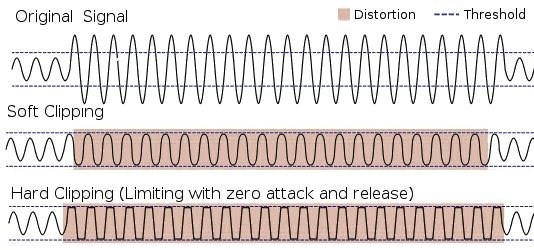
B. Symmetric vs. Asymmetric Distortion
This is about whether the top and bottom halves of the waveform are treated equally. This choice has a profound impact on the type of harmonics generated.
How do you pick the right kind of distortion/saturation? - Reddit
This community post provides a concise, technical breakdown of why the symmetry of a distortion curve matters.
Read section 1, "Symmetry." The key takeaway is the relationship between symmetry and the types of harmonics produced.
As the post explains:
- Symmetric Distortion: Shapes the positive and negative parts of the wave identically. This primarily adds odd harmonics (3rd, 5th, 7th, etc.). The resulting sound is often cleaner and more focused, as the harmonic structure is simpler.

- Asymmetric Distortion: Shapes the positive and negative parts differently. This adds both even and odd harmonics. This creates a richer, denser, and more complex harmonic texture. The even harmonics (2nd, 4th, 6th...) reinforce the fundamental frequency's octave, which can make the sound feel more "grounded" or "solid," but it can also lead to a busier sound that might clash with other elements in a mix.
Understanding these two pairs—hard/soft and symmetric/asymmetric—gives you a framework for predicting how any distortion algorithm will behave.
2. A Tour of Serum's Distortion Algorithms
Now let's apply this theory to the tools available in Serum's FX rack. The following video gives an excellent visual and auditory tour of the most common distortion types.
Xfer Records Serum Tutorial 08 - FX Distortion
This tutorial from SadowickProduction systematically explores Serum's distortion module, using an oscilloscope and spectrum analyzer to show exactly what each algorithm does to a sine wave.
Watch from the sine wave demonstration to see how classic clipping and diode models add harmonics. Then, watch from the algorithm overview which covers more exotic types like Sinefold and X-Shapers. Finally, watch the section on pre vs. post filtering, which reinforces what we learned in the last lesson. Focus on the visual feedback in the spectrum analyzer as he switches between types.
Let's categorize these algorithms based on our theoretical framework to guide your selection:
| Category | Serum Algorithms | Typical Use Case & Character | DnB Genre Fit |
|---|---|---|---|
| Soft & Warm Saturation | Tube, Soft Clip, Tape Sat, Soft Sat |
Adds warmth, presence, and cohesion. Gently rounds peaks, adding pleasant, lower-order harmonics. Good for "glue." | Dancefloor, Liquid |
| Hard & Aggressive Clipping | Hardclip, Diode 1, Diode 2, Zero Sq. |
Adds brightness, grit, and aggression. Squares off the waveform, creating a rich spectrum of odd harmonics. | Neurofunk, Jump-Up, Heavy Dancefloor |
| Complex & Creative | Sinefold, Asymm, Rectify, X-Shaper |
Creates complex, metallic, or strange textures. Uses wavefolding or heavy asymmetry to generate dense, often inharmonic content. | Neurofunk, Experimental |
| Digital & Lo-Fi | Downsample |
Adds digital "aliasing" artifacts for a crunchy, lo-fi character. Simulates a lower sample rate. | Neurofunk, Lo-fi DnB |
3. Advanced Distortion Strategies in Serum
Beyond the main FX rack, Serum offers other places to introduce saturation. For intentional sound design, knowing these options is crucial.
Strategy 1: Distortion at the Source (Oscillator Warp)
You can apply distortion directly to the wavetable itself using the oscillator's Warp Mode. This bakes harmonic richness into the sound before it ever hits the main filter or effects, leading to a more organic and complex interaction with subsequent processing.
10 Serum 2 Tricks for Modern DnB Bass Sound Design
This video by STRANJAH showcases several modern tricks for DnB sound design, including source-level distortion.
Watch the section on using distortion warp modes. Notice how this instantly adds grit to the oscillator. The video also highlights the new Soft Saturation algorithm in the main FX rack (FX rack distortion), which Steve Duda is particularly proud of for its analog modeling.
Why do this? Distorting at the source means the filter has a more harmonically rich signal to work with. Sweeping the filter will now reveal different parts of this newly generated harmonic content, creating more interesting movement.
Strategy 2: Distortion at the Filter (Filter Drive)
Most of Serum's filters include a Drive parameter. This is essentially a dedicated saturation stage built into the filter circuit. Increasing the drive saturates the signal as it enters the filter. This is particularly powerful when combined with high resonance.
Why do this? Filter drive allows you to add aggression that is directly tied to the filter's character. For formant or comb filters, increasing the drive can accentuate their vocal or metallic qualities, creating the "talking" or nasal sounds common in neurofunk. It's a way to make the filter itself a source of tonal character, not just a subtractive tool.
4. Practical Application
Let's put this into practice. Initialize Serum (Menu > Init Preset).
Exercise 1: Warmth vs. Aggression
- Set OSC A to a basic saw wave.
- In the FX rack, add the Distortion module.
- Set the type to
Tubeand increase theDriveto around 60%. Play some notes. Listen to how it adds body and presence without being harsh. This is your Dancefloor/Liquid approach. - Now, switch the type to
Hardclip. Keep theDriveat 60%. The sound is now much brighter, fizzier, and more aggressive. This is your Neurofunk/Jump-Up starting point. - Justify your choice: In your head, articulate why you would choose
Tubefor a Fred V style lead (to make it stand out warmly) versusHardclipfor a Noisia-style lead (to give it a raw, angry edge).
Exercise 2: Creative Neuro Texture
- Keep the
Hardclipdistortion, but set theDriveto 100%. - Change the distortion type to
Sinefold(a wavefolder). The sound becomes extremely complex and metallic. - Add a Filter module after the distortion. Set it to
LP 24. - Now, automate the filter's
Cutoffwith LFO 1. Set the LFO rate to 1/8. - Analysis: You are creating a massive amount of harmonic content with the wavefolder and then rhythmically carving it away with the filter. This is a fundamental technique for creating complex, moving neuro basses and leads. The aggression comes from the distortion; the movement comes from the filter.
Exercise 3: Expressive Filter Drive
- Disable the FX rack for now.
- Enable the main Filter and route OSC A to it.
- Choose the
Formant IIfilter type. - Increase the
Resonanceto ~70% and theDriveto ~80%. - Play notes while sweeping the
Cutoffknob manually. Listen for the "vowel" or "talking" quality. The Drive is pushing the filter's resonant peaks into saturation, creating that expressive vocal character. This is perfect for Fox Stevenson-style leads.
Conclusion
In this lesson, you moved from treating distortion as a single effect to understanding it as a diverse toolkit for harmonic generation. You now have a mental model for choosing the right type of saturation or clipping based on your creative intent.
Key Takeaways:
- Distortion reshapes a waveform to add new harmonics. The character of these harmonics is defined by the distortion's algorithm.
- Soft/Symmetric types (
Tube,Soft Clip) are ideal for adding warmth and presence, perfect for Dancefloor and Liquid leads. - Hard/Asymmetric/Complex types (
Hardclip,Sinefold) are tools for aggression and creating complex textures, essential for Neurofunk. - Distortion is not limited to the FX rack. Using it as an oscillator warp mode or with filter drive are advanced techniques for creating integrated, organic sounds.
- Your choice of distortion is a trade-off between harmonic richness and mix clarity. Asymmetric types add more density but carry a higher risk of sounding muddy.
In the next lesson, we will address a common consequence of adding so much harmonic content: unruly dynamics. We'll explore how to use multiband compression (OTT) to control the dynamics of your now harmonically-rich lead, making it feel dense, powerful, and present in the mix.