Recommended resources
The freely available resources this lesson will direct you to.
- Markets, Efficiency, and Price Signals: Crash Course Economics #19www.youtube.com
- Friedrich Hayek Part 1: what intellectual history tells us about market signalswww.youtube.com
- Prices Are Signals (and Politicians Keep Shooting the Messenger)truthonthemarket.com
- A Price Is a Signal Wrapped Up in an Incentivemru.org
In our last lesson, we established the fundamental mechanics of a market, seeing how the forces of supply and demand push a price towards an equilibrium point where buyers and sellers can agree. We saw how a market arrives at this price. Now, we will explore the deeper significance of that price. This is where the economic argument for free markets, a cornerstone of libertarian thought, truly comes alive.
This lesson focuses on a concept that is central to understanding how a complex, modern society can function without a central planner: the role of prices as signals. You will learn how these seemingly simple numbers contain a wealth of information, coordinating the actions of billions of people in a way that no single person or government could ever hope to replicate. This idea, particularly as developed by the economist Friedrich Hayek, is one of the most powerful arguments for the free market system.
A Price Is More Than a Number
In our daily lives, we think of prices as hurdles to overcome or amounts to be paid. But in economics, a price is much more: it is a piece of information, a signal, that is broadcast across the entire economy. As one economist put it, a price is a signal wrapped in an incentive.
To get a feel for this idea, let's start with a quick, dynamic explanation.
Markets, Efficiency, and Price Signals: Crash Course Economics #19
This clip from Crash Course Economics introduces the concept of price signals using simple, relatable examples.
Please watch the section from the beginning of the segment. Notice how the prices of skinny jeans and tablets act as messages from consumers to producers, telling them what to make.
The video illustrates the core idea: high prices for iPads told Samsung and Microsoft, "Society wants more of these! There's an opportunity here." Conversely, if a product's price is falling and it isn't selling, the signal is, "Stop making this; people don't value it anymore."
This communication network doesn't require a government agency or a central command center. It works automatically, using the price itself as the messenger. This is why some economists describe the price system as the "nervous system of the economy"—it transmits vital information to every part of the economic body, allowing it to adapt and respond.
The Miracle of Coordination and Spontaneous Order
This brings us to a fundamental question that intrigued the economist and philosopher Friedrich Hayek: How does a complex economy work at all? Think of a simple pencil. No single person on Earth knows how to make one from scratch. One person mines the graphite, another fells the tree for the wood, another extracts the rubber for the eraser, and yet another operates the machinery that assembles it all. These people don't know each other and may live on different continents. So how do their actions all coordinate to produce that pencil?
Hayek's answer was that the economy is a spontaneous order—a system that is the result of human action, but not of human design. Like language, it evolved organically. The key mechanism that allows this spontaneous order to function is the price system.
The following video explores Hayek's profound insight into how prices solve the problem of coordinating the actions of millions of people, each of whom only has a tiny fragment of knowledge.
Friedrich Hayek Part 1: what intellectual history tells us about market signals
This video from the Fraser Institute features economist Donald Boudreaux explaining Friedrich Hayek's ideas on spontaneous order and the role of prices.
Please watch two segments: First, from the discussion of complexity, focus on the idea that society is a 'spontaneous order' and the 'fatal conceit' of thinking a central planner can grasp all its details. Then, watch from the explanation of coordination, which uses the "I, Pencil" and tin market examples to show how prices transmit knowledge and coordinate decisions.
As the video explains, the marvel of the price system is that it economizes on knowledge. The car manufacturer using tin doesn't need to know why the price of tin went up—whether a mine collapsed or a new technology increased demand for it elsewhere. All they need to know is the price itself. That single number contains all the necessary information to signal that tin is now scarcer, providing an immediate incentive to find a substitute.
This decentralized coordination is what so astonished the future Russian president Boris Yeltsin when he made an unscheduled visit to a Texas supermarket in 1989. He couldn't believe the sheer variety of goods available to ordinary people, a stark contrast to the chronic shortages in the centrally planned Soviet Union. That abundance was not designed by a "Global Food Czar"; it was the result of the price system coordinating the actions of millions of farmers, truckers, and grocers.
The Three Functions of the Price Mechanism
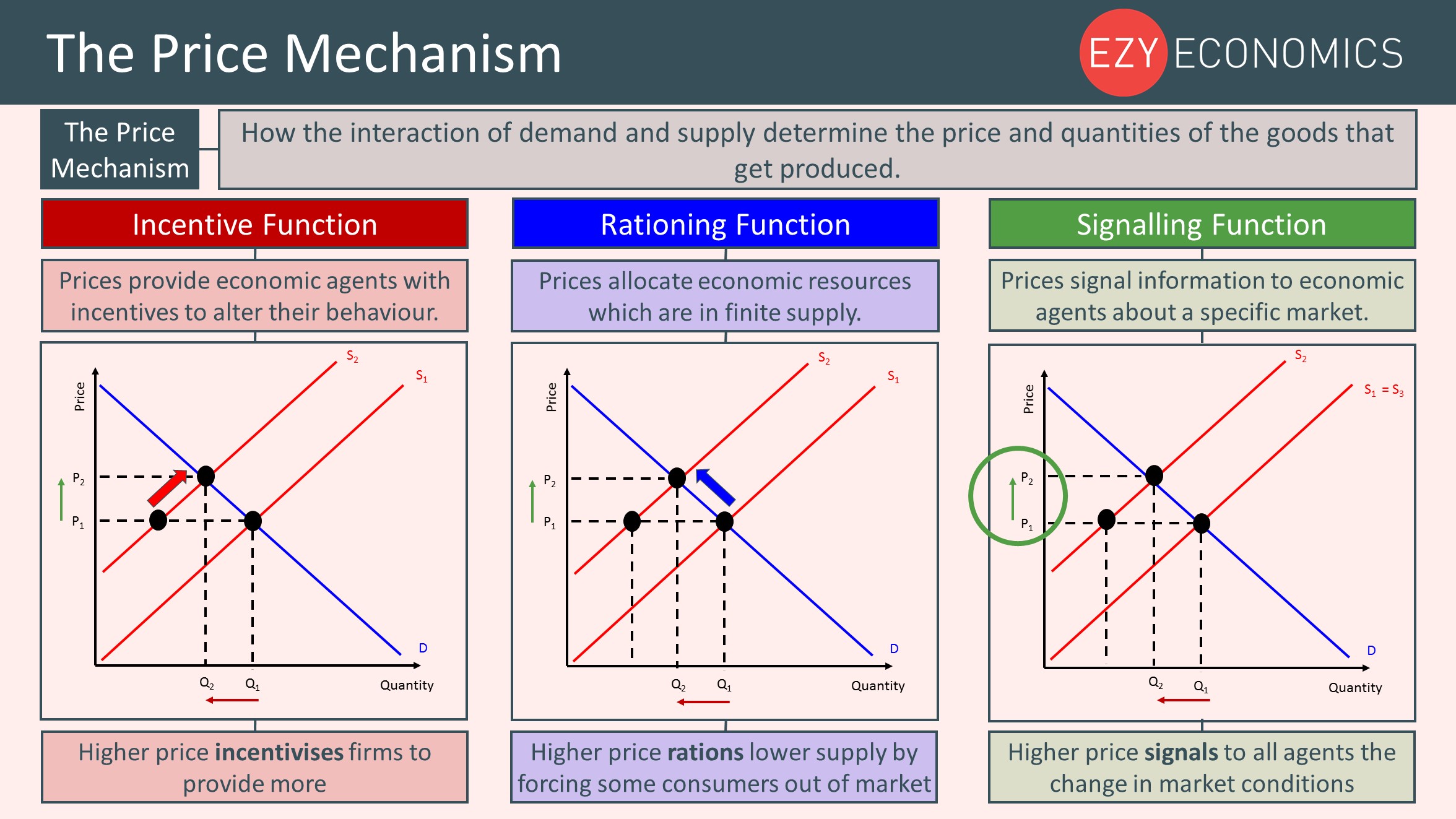
We can break down the work of the price mechanism into three distinct but interconnected functions: signalling, incentive, and rationing.
-
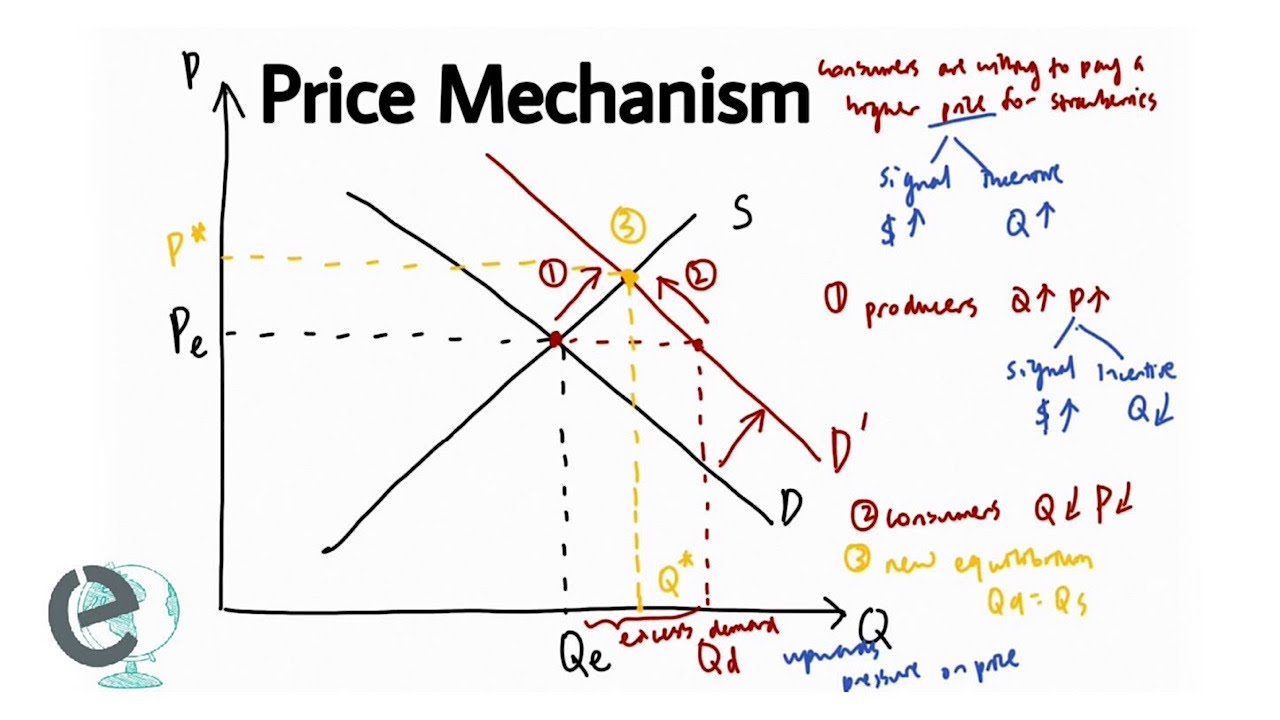
The Signalling Function: As we've discussed, prices are messengers. A rising price signals to producers that a good is in high demand or that its supply is limited, suggesting a profitable opportunity. A falling price signals the opposite. This directs resources toward where they are most valued by society.
-
The Incentive Function: The signal would be useless if no one had a reason to act on it. Prices provide that reason. The prospect of higher profits incentivizes producers to increase supply when prices rise. For consumers, a higher price provides an incentive to economize or find substitutes. A powerful example of this occurred during the early COVID-19 pandemic.
Prices Are Signals (and Politicians Keep Shooting the Messenger)
This section of an article by the economists Josh Hendrickson and Brian Albrecht provides a vivid example of the incentive function of prices.
Please read the part under the heading "Profit-Seeking Entrepreneurs: Making Price Signals Count". Focus on the story of distilleries pivoting to produce hand sanitizer and the discussion of how both profits and losses provide crucial incentives.
The distilleries didn't need a government directive. The high price of hand sanitizer was both a signal of extreme scarcity and a powerful incentive to retool their factories to meet that need.
- The Rationing Function: When a good is scarce, who gets it? In a system without prices, it might be the person who gets in line first, or who has political connections. The price system provides a different answer: the good goes to whoever values it most, demonstrated by their willingness to pay the market price. A high price rations the limited supply by ensuring that only those who have the most urgent use for the good (or derive the most value from it) will buy it, while others are discouraged. This ensures resources are allocated efficiently.
When We Shoot the Messenger: Price Controls
Given the vital role of prices in communicating information, what happens when the government tries to block the signal? This is what occurs with price controls—laws that mandate a price other than the market equilibrium. The government is essentially "shooting the messenger" because it doesn't like the message (e.g., "gasoline is scarce").
The most famous example in modern U.S. history is the gasoline crisis of the 1970s.
Prices Are Signals (and Politicians Keep Shooting the Messenger)
This section of the same article details the consequences of ignoring price signals during the 1970s oil crisis.
Please read the first part of the section "Price Controls, or When We Ignore Price Signals." Read from the beginning of the section down to the end of the part about the gasoline crisis.
When the government capped the price of gasoline, it did two things:
- It destroyed the rationing function. Because the price was artificially low, people had no reason to conserve gas.
- It destroyed the incentive function. Oil companies had less incentive to produce and ship more gasoline to areas that needed it most.
The result was not affordable gas, but no gas. The price cap created massive shortages, leading to long lines and wasted time. The underlying scarcity didn't go away just because the government made it illegal for the price to report on it. Instead of the price rationing the scarce gas, people's time spent waiting in line did.
Conclusion
In this lesson, we have moved beyond the simple mechanics of supply and demand to see the profound role that prices play in organizing an entire economy. This is a crucial piece of the intellectual puzzle for understanding the libertarian case for free markets.
Here are the key takeaways:
- Prices as Information: Prices are not just arbitrary numbers; they are signals that convey complex information about supply, demand, and scarcity across the globe.
- Spontaneous Order: The price system allows for a complex "spontaneous order" to emerge, coordinating the economic activities of millions without needing a central planner.
- Three Functions: Prices work through three functions: signalling information, providing incentives for producers and consumers to act on that information, and rationing scarce resources to their most valued uses.
- Distortion: When governments interfere with prices through controls, they distort the signals, leading to inefficiencies like shortages and surpluses, and preventing the economy from adapting to reality.
We have now seen how prices coordinate what gets produced and in what quantities. But what drives producers to make those things better, faster, and cheaper over time? The answer lies in our next topic: competition. We will explore how competition acts as a powerful discovery process, driving the innovation and efficiency that lead to economic progress.