Recommended resources
The freely available resources this lesson will direct you to.
Welcome to our new module. In our previous discussions, we explored the philosophical heart of libertarianism—principles like self-ownership and non-aggression—and saw how they lead to a deep skepticism of state power. We concluded by noting that the libertarian case for a free society doesn't just rest on philosophy; it also makes a bold practical claim: that free markets are the most effective way to organize society and create prosperity.
To properly evaluate this claim, we need to add some economic tools to our intellectual toolkit. This lesson is the first step in that process. We will tackle one of the most fundamental questions in all of economics: How are prices determined? You've heard phrases like "the law of supply and demand" before, but what do they actually mean? This lesson will demystify these concepts. We will define what supply and demand are, see how their interaction creates a stable "equilibrium" price in a market, and understand the powerful, automatic forces that correct prices when they are too high or too low.
The Two Sides of a Market: Demand and Supply
Every market, whether it's for a cup of coffee, a smartphone, or a share of stock, has two sides: buyers and sellers. Economics models the behavior of these two groups using the concepts of demand and supply.
Demand: The Buyer's Perspective
Demand refers to the relationship between the price of a good and the quantity of it that consumers are both willing and able to buy. Think about your own purchasing decisions. The price is almost always a key factor. This common-sense observation is formalized in the Law of Demand: all other things being equal, as the price of a good falls, the quantity that people demand rises. Conversely, as the price rises, the quantity demanded falls.
For a clear and engaging introduction to this idea, let's watch a short video that uses the simple example of pizza slices to explain demand.
This video from the channel Professor Dave Explains provides an excellent introduction to the concept of demand.
Please watch the segment on demand, from the beginning. Pay close attention to: The formal definition of demand. The Law of Demand and the reasons behind it (substitution and income effects). How a "demand schedule" (a table) is turned into a "demand curve" (a graph).
As the video shows, the demand curve is a graphical representation of this relationship. It slopes downwards, illustrating that people are willing to buy more of something at lower prices.
It's important to be precise with our language here. Economists distinguish between "demand" and "quantity demanded."
- Demand refers to the entire curve—the whole relationship between various prices and the quantities people would buy at those prices.
- Quantity demanded refers to a specific point on that curve—the amount people would buy at one particular price.
A change in the price of the good causes a change in the quantity demanded (a movement along the curve). A change in some other factor (like consumer income or tastes) would cause a change in demand itself (a shift of the entire curve), a topic we will explore later.
Supply: The Seller's Perspective
Now let's switch to the other side of the market. Supply refers to the relationship between the price of a good and the quantity of it that producers are willing and able to sell.
If you were the owner of a pizza shop, a higher price for pizza would be an incentive to produce more. You could hire more staff, stay open longer, or even open a new location. This logic leads to the Law of Supply: all other things being equal, as the price of a good rises, the quantity that producers supply also rises. A higher price generally means higher potential profits, motivating sellers to increase their output.
Let's return to the same video to see how this works.
This part of the video explains the concept of supply, continuing with the pizza shop example.
Please watch the segment on supply, from this section. Focus on the Law of Supply and how a "supply schedule" is visualized as an upward-sloping "supply curve."
Just as with demand, the supply curve is the graphical representation of this relationship. It slopes upwards, showing that producers are willing to sell more of a good at higher prices. And like with demand, we distinguish between "supply" (the entire curve) and "quantity supplied" (a specific point on the curve).
Market Equilibrium: Where Buyers and Sellers Agree
We have now defined the two opposing forces in a market: buyers who want low prices, and sellers who want high prices. How does the market resolve this tension?
It does so by finding an equilibrium. The equilibrium is the point where the demand curve and the supply curve intersect. At this intersection, we find the equilibrium price and the equilibrium quantity. This is the one price where the quantity of a good that buyers want to buy is exactly equal to the quantity that sellers want to sell. Because the amounts supplied and demanded are equal, this is also known as the "market-clearing price."
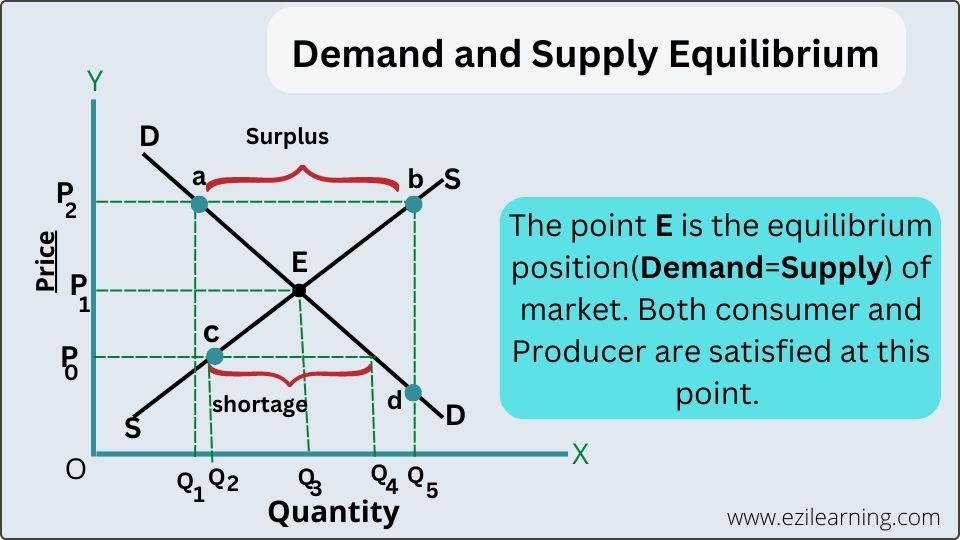
At this point, the market is stable or "in balance." Every buyer who is willing to pay the equilibrium price can find a seller, and every seller who is willing to accept the equilibrium price can find a buyer. There is no automatic tendency for the price to change.
To better understand this concept, let's explore the historical background and the formal model.
8. Supply and demand: Price-taking and competitive markets
This section from the CORE Econ textbook introduces Alfred Marshall's model of supply and demand and formally explains the concept of equilibrium.
Please read the introduction and first part of Section 8.2, from the beginning. Focus on Marshall's idea that the market price tends to settle at an equilibrium level where demand and supply are balanced.
Disequilibrium: What Happens When Prices are "Wrong"?
The concept of equilibrium is powerful because it also explains what happens when a market is not in equilibrium. The market has a built-in, self-correcting mechanism that constantly pushes prices toward the equilibrium level. There are two states of disequilibrium: surplus and shortage.
Surplus: When Price is Too High
Imagine the price is set above the equilibrium price (like in the graph above).
- Sellers' reaction: At this high price, sellers are thrilled and offer a large quantity for sale ().
- Buyers' reaction: Buyers are discouraged by the high price and are only willing to buy a small quantity ().
The result is a surplus (or excess supply): the quantity supplied () is greater than the quantity demanded (). The market is flooded with unsold goods. What happens next? Sellers with unsold inventory get nervous. They will start cutting prices to attract buyers. This creates a downward pressure on the price, pushing it back down toward the equilibrium level ().
Shortage: When Price is Too Low
Now imagine the price is set below the equilibrium price (like in the graph above).
- Buyers' reaction: At this low price, buyers are excited and want to buy a large quantity ().
- Sellers' reaction: Sellers are disappointed by the low price and are only willing to offer a small quantity for sale ().
The result is a shortage (or excess demand): the quantity demanded () is greater than the quantity supplied (). Goods fly off the shelves, and many potential buyers leave empty-handed. What happens next? Eager buyers might start offering to pay more. Sellers quickly realize they can raise their prices without losing sales. This creates an upward pressure on the price, pushing it back up toward the equilibrium level ().
The following video explains these adjustment processes very clearly.
This video by economics professor Dirk Mateer explains how markets react to surpluses and shortages to return to equilibrium.
Please watch the following segments: First, watch the explanation of a surplus, from this section. Notice how sellers' actions push the price down. Next, watch the explanation of a shortage, from this section. Notice how buyers' and sellers' actions push the price up. Finally, watch the summary from "prices and surpluses and shortages", which explains that shortages and surpluses are not "wrong" but are crucial information signals.
This dynamic is the "magic" of the market. No central authority needs to set the price. The independent actions of millions of individual buyers and sellers, each pursuing their own interests, automatically guide the price toward the one level that balances everyone's desires.
Conclusion
In this lesson, we have laid the first and most important stone in our foundation of economic principles. You now have a working model of how markets operate to determine prices.
Here are the key takeaways:
- The Law of Demand: As price goes up, the quantity people want to buy goes down (a downward-sloping curve).
- The Law of Supply: As price goes up, the quantity producers want to sell goes up (an upward-sloping curve).
- Equilibrium: The market price and quantity are determined by the intersection of the supply and demand curves. At this point, the market "clears"—the quantity demanded equals the quantity supplied.
- Self-Correction: Markets are dynamic. If the price is too high, a surplus will emerge, pushing the price down. If the price is too low, a shortage will emerge, pushing the price up. These pressures constantly guide the market back to equilibrium.
We have seen how a market arrives at an equilibrium price. But what does that price mean? As the last video hinted, the equilibrium price is more than just a number; it's a powerful piece of information. In our next lesson, we will explore this idea further, examining how prices act as signals that coordinate the decisions of countless individuals across the entire economy—a concept that is absolutely central to the libertarian argument for free markets.