Recommended resources
The freely available resources this lesson will direct you to.

Introduction
In our last lesson, we explored the "what" of Raga Chikitsa, creating a kind of musical pharmacopoeia by identifying specific ragas prescribed for various ailments. We established a foundational chain of influence: Raga → Elements → Chakras → Nadis → Organs.
Today, we transition from the "what" to the "how." Our objective is to analyze the traditional theory of how ragas affect the body's nadis and chakras. We will delve into the esoteric anatomy of the subtle body, a concept central to yogic and tantric thought, to understand the mechanics behind this vibrational healing. Think of our last session as studying a function library's API documentation; today, we're looking at the underlying architecture and data structures that make those functions work. This exploration will build the bridge between the metaphysics of the aatma and the physics of sound that is at the heart of your inquiry.
The Subtle Body: An Energetic Blueprint
The entire theory of raga's influence rests on the concept of a subtle body (sukshma sharira) that coexists with our physical body (sthula sharira). This subtle body is conceived as a complex network of energy channels and centers. To understand this blueprint, we'll turn to a clear explanation in Hindi, a language you're comfortable with.
72,000 Nadis & 7 Chakras Explained | Secret Yogic Blueprint
This video, "72,000 Nadis & 7 Chakras Explained," provides an excellent and culturally-rooted overview of the subtle body, which it aptly calls the "invisible software" of our existence.
Please watch the following segments to build a strong foundation: The Core Concept (from "क्या हो अगर" to "चैतन्य तक जोड़े हुए"): This part introduces the idea of the subtle energy body, composed of nadis (energy channels) and chakras (energy centers), as the fundamental blueprint controlling our physical, mental, and spiritual states. The Three Main Nadis (from "हमें केवल तीन महानाड़ियों" to "जागरण का मार्ग है"): Focus on the description of the three principal channels: Ida (left, lunar, feminine energy) Pingala (right, solar, masculine energy) Sushumna (central, the spiritual highway) The Seven Chakras (from "हम अपनी यात्रा" to "शिव से मिल जाती है"): This is a detailed walkthrough of the seven primary chakras, from Muladhara (root) to Sahasrara (crown). Pay attention to the location, element, and psychological function associated with each one.
This yogic model describes an intricate energetic network. The sheer scale is vast; traditional texts assert there are 72,000 nadis, forming a complex web of life-force (prana) distribution throughout the body.

Nada Yoga: The Universe as Vibration
Now that we have a map of the subtle body, how does sound interact with it? The philosophical basis for this connection is Nada Yoga—the yoga of sound. This school of thought posits that the entire universe, including ourselves, is a manifestation of vibration, or nada.
Sadhguru provides a concise and powerful explanation of this principle and its direct link to the system of chakras and Indian classical music.
Can Chakras Be Activated With Music?
In this video, "Can Chakras Be Activated With Music?", Sadhguru connects the dots between modern physics, yogic science, and music.
Please watch these key parts: Existence as Vibration (from "the whole existence is a reverberation" to "we experience them as sounds"): This section frames the ancient yogic insight that "the whole existence is sound" in a way that resonates with a modern, scientific worldview. The Energetic System (from "Pranamaya kosha is made up" to "chakras in the body"): Here he mentions the 72,000 nadis and establishes that there are 108 active energy centers, or chakras. Music as a Spiritual Tool (from "So, the Indian classical music" to "compulsive cycles of life"): This is the crucial link. He explains that Indian classical music evolved as a method to activate these 108 points in the body, not merely for entertainment, but as a path for spiritual evolution.
The recurring number of 72,000 is significant. Just as there are said to be 72,000 nadis, the Carnatic music system, through its mathematical permutation of swaras, also generates 72 parent scales, or melakartas. While this may be symbolic, it points to a deep, perceived correspondence between the structure of the human energetic system and the structure of music itself.
The Mechanism: How Ragas Influence Chakras
With the foundational concepts of the subtle body and Nada Yoga in place, we can now analyze the specific mechanism through which a raga is believed to work. The core idea is that the vibrations of specific musical notes (swaras) resonate with specific energy centers (chakras).
A modern research paper provides an excellent summary of this theory, bridging the traditional yogic model with physiological correlates.
Raga: The connecting link between psyche and soma
This article clearly lays out the traditional theory, correlating the subtle body with the physical nervous system, and explains how ragas are thought to activate this system.
Please read the following sections to understand the detailed mechanism: Introduction: Read the first paragraph, which introduces Nada Yoga and the concept that raga is an integrative therapy aimed at activating designated chakras. The Chakra-Plexus Correlation: Review the section on the subtle body. Pay close attention to Figure 2, which you can see below. It proposes a near-perfect alignment of the seven chakras with the major nerve plexuses of the autonomic nervous system. This is a key attempt to map the esoteric anatomy onto physical anatomy. The Swara-Chakra Link: Read the section "Association of Swaras with Chakras". This explains the primary mechanism: Each of the seven swaras is mapped to one of the seven primary chakras. The vadi (king) note of a raga, being the most emphasized, is thought to be the primary activator of its corresponding chakra. The Raga-Chakra Link: Continue with the next section, "Association of Ragas with Chakras". This adds another layer, stating that entire ragas, not just individual notes, are also associated with specific chakras. The Master Table: Carefully study Table 1, which is the centerpiece of this article. It provides a comprehensive map linking each chakra to its qualities, associated ragas, and vadi swaras. For example, it shows that the Manipura (Solar Plexus) chakra, associated with power and self-esteem, can be influenced by Raga Malkauns, or by ragas where 'Ga' is the vadi swara, like Raga Yaman.
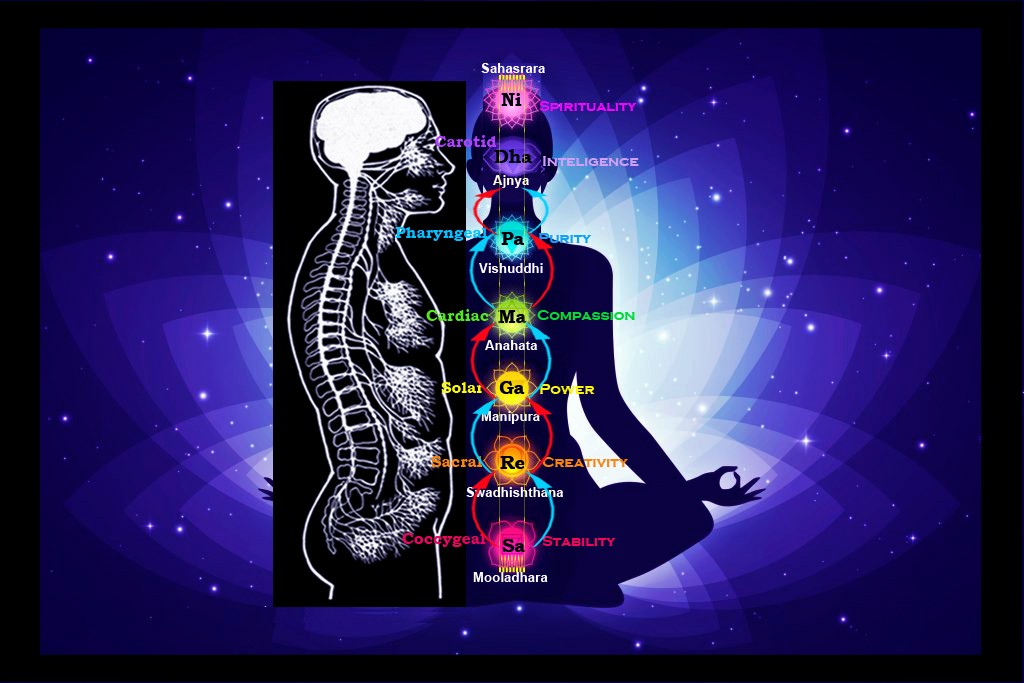
This theory presents a clear, hierarchical process:
- A musician performs a raga, emphasizing its vadi swara.
- The specific frequency and vibrational quality of the vadi swara resonates with its corresponding chakra, much like one tuning fork can cause another of the same frequency to vibrate.
- This resonance activates the chakra, clearing blockages and restoring its optimal "spin" or energy level.
- The awakened energy (prana) then flows from the activated chakra through the thousands of associated nadis to the connected organs, glands, and nerve plexuses.
- This restored flow of energy brings the psycho-physiological system back into a state of harmony and health.
This process is a form of entrainment, where the powerful, coherent rhythm of the raga influences the less coherent, imbalanced rhythms of the body's subtle energy system, bringing them into synchrony.
Conclusion
In this lesson, we have moved deep into the theoretical heart of Raga Chikitsa. We've constructed the traditional model that explains how musical vibrations are thought to induce healing and elevated states of being.
Key Takeaways:
- The traditional theory is built upon the concept of a subtle body, an energetic grid composed of 72,000 nadis (channels) and key chakras (centers).
- Nada Yoga provides the philosophical framework, positing that all existence is vibration and can therefore be influenced by sound.
- The core mechanism involves resonance: specific musical notes (swaras), particularly the dominant vadi swara of a raga, are believed to activate their corresponding chakras.
- This activation stimulates the flow of prana through the nadi network, which in turn influences the physical body's nerve plexuses, organs, and glands, thereby restoring balance and well-being.
We have now explored both the "what" (the prescriptions of Raga Chikitsa) and the "how" (the traditional theory of nadis and chakras). We are now prepared to shift our lens from ancient wisdom to modern science. In our next lesson, we will begin the module on Psychoacoustics, examining how the auditory cortex and limbic system collaborate to process music and generate emotion. This will allow us to compare the yogic model of subtle energy with the neurological model of brain function, seeking points of convergence and divergence.