Recommended resources
The freely available resources this lesson will direct you to.
- Music Therapy and its Impact on the Brain | Elizabeth Stegemöller | TEDxIowaStateUniversitywww.youtube.com
- Indian Music Therapy Science: Ancient Nada Healing for Modern Diseases | Ruma Chakravartywww.youtube.com
- [PDF] Modern Music Therapy and its Applications - Walsh Medical Mediawww.walshmedicalmedia.com
- Biological principles for music and mental health - PMCpmc.ncbi.nlm.nih.gov
Introduction
In our previous explorations of Raga Chikitsa, we delved into the traditional, esoteric framework connecting ragas to the subtle body's nadis and chakras. We mapped out an ancient system built on resonance and energetic flow. Today, we pivot from this ancient model to its modern counterpart. Our objective is to describe the core principles of modern, evidence-based Music Therapy.
This shift is crucial for your goal of bridging spiritual wisdom with scientific understanding. While Raga Chikitsa offers a profound metaphysical perspective, modern Music Therapy provides a framework grounded in psychology, neuroscience, and clinical practice. We will define what it is, explore how it's practiced, and—most importantly for your interests—investigate the neurological mechanisms that explain why it works. This lesson will establish the scientific foundation we need before we can compare and synthesize these two powerful, yet distinct, approaches to healing with sound.
What is Modern Music Therapy?
First, it is essential to distinguish modern Music Therapy from simply listening to music for relaxation or from the traditional practices we've discussed. Modern Music Therapy is a clinical health profession with rigorous standards.
The American Music Therapy Association (AMTA) provides the most widely accepted definition.
[PDF] Modern Music Therapy and its Applications - Walsh Medical Media
This short document provides a concise definition that is central to the field.
Please read the paragraph under the heading "Definition of music therapy" to understand the official definition. Focus on the keywords in this sentence: the definition.
Let's unpack the key components of that definition, as they represent the foundational principles of the practice:
- Clinical and Evidence-Based: Interventions are not arbitrary; they are chosen based on scientific evidence of their effectiveness for specific conditions.
- Individualized Goals: The therapy is not a one-size-fits-all approach. Its purpose is to achieve specific, non-musical goals (e.g., reducing anxiety, improving motor function, enhancing communication).
- Therapeutic Relationship: The process occurs within a professional relationship between a client and a therapist, who guides the process.
- Credentialed Professional: A music therapist is a trained and certified professional with expertise in both music and therapeutic principles.
This structured approach is often visualized as a clear, cyclical process.
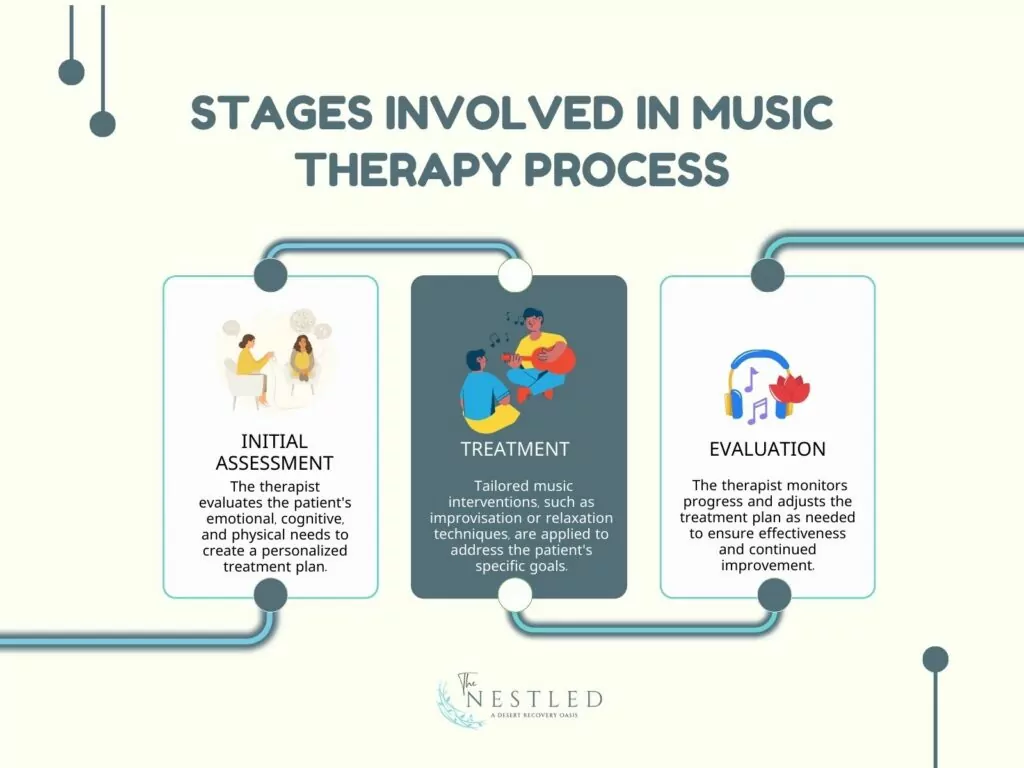
As you can see, the process mirrors systematic methodologies you might be familiar with in other scientific or technical fields:
- Initial Assessment: The therapist evaluates the client's needs—emotional, cognitive, physical, and social—to design a personalized treatment plan.
- Treatment: The therapist applies specific music interventions tailored to the client's goals.
- Evaluation: The therapist continually monitors progress and adjusts the treatment plan to ensure its effectiveness.
The Therapeutic Toolbox: Active vs. Receptive Methods
What does a music therapy "treatment" actually look like? The interventions fall into two broad categories: active and passive (or receptive).

-
Passive / Receptive Music Therapy: This is what most people first imagine. It involves listening to music. This could be pre-recorded or live music performed by the therapist. The goal is often to evoke emotional responses, facilitate relaxation, or stimulate memories (musical reminiscence). A specific technique called Guided Imagery and Music (GIM) uses classical music to facilitate journeys into the subconscious.
-
Active Music Therapy: This involves the client participating in music-making. This doesn't require any prior musical skill.
- Recreative Therapy: The client sings or plays a pre-composed piece of music. This can help with motor skills, breathing, and emotional expression.
- Improvisational Therapy: The client creates music spontaneously, using their voice or simple instruments. This is a powerful tool for non-verbal expression, communication, and exploring emotions in a safe context.
The Neurological Foundations: Why It Works
This brings us to the core of your inquiry: the "science" behind the therapy. Why does a structured musical interaction have a therapeutic effect? The answer lies in the brain's response to music, a phenomenon called neuroplasticity—the brain's ability to reorganize itself by forming new neural connections.
A short, engaging TEDx talk by Dr. Elizabeth Stegemöller provides an excellent overview of how music therapy promotes neuroplasticity.
Music Therapy and its Impact on the Brain | Elizabeth Stegemöller | TEDxIowaStateUniversity
This talk, "Music Therapy and its Impact on the Brain," clearly explains the neurological basis of music therapy.
Please watch the following segments, which outline four key ways music drives brain change: Introduction to Neuroplasticity (from "I do have a theory" to "to promote neuroplasticity"): Understand the concept of neuroplasticity as the creation of new neural connections. Principle 1: Dopamine Regulation (from "The first is that music" to "are going to be formed"): Note how preferred music increases dopamine, a neurotransmitter essential for reward-based learning. Principle 2: Clear Signal (from "The second characteristic" to "what I asked to do"): Grasp why the structured, periodic nature of music makes it an easier signal for the brain to process compared to noise or even speech. Principle 3: Neural Synchronization (from "One of the major principles" to "new connections in that brain"): This section explains the Hebbian principle ("neurons that fire together wire together") and how rhythm synchronizes neural firing. Principle 4: Whole-Brain Activation (from "music can activate the entire brain" to "they can manipulate the music"): See how music engages multiple brain regions simultaneously, giving therapists a wide array of targets.
To build on this foundation with greater depth, let's turn to a comprehensive review from the field of biomusicology. This article proposes a framework that organizes music's effects around four core biological elements. This level of detail will be valuable for your scientific curiosity.
Biological principles for music and mental health - PMC
This article provides a rigorous, evidence-based framework for understanding how specific elements of music map onto biological systems and therapeutic applications.
Please read the following sections: Introduction: Read the full Introduction section to understand the scientific motivation for creating a biological framework for music therapy. Tonality: Read the subsections "Musical terms and definitions," "Conserved aspects of tonality," "Biological foundations of tonality," and "Applications of tonality in mental health." This directly addresses your question about how specific musical qualities (pitch, harmony, timbre) trigger emotional responses by linking them to the bioacoustics of the human voice. Rhythm: Read the subsections "Musical terms and definitions," "Conserved aspects of rhythm," "Biological foundations of rhythm," and "Applications of rhythm in mental health." This explains how temporal patterns in music entrain neural oscillations, affecting movement, mood, and focus. Reward: Read the subsections "Music and brain reward circuitry" and "Applications of musical reward in mental health." This details music's powerful ability to activate the brain's dopamine and opioid systems, which is crucial for motivation and pleasure. Sociality: Read the subsections "Synchrony," "Oxytocin and social reward," and "Applications of sociality in mental health." This explores how musical interaction stimulates hormones like oxytocin, fostering social connection and reducing stress.
These two resources give you a powerful, multi-layered view. The TEDx talk provides the high-level "why" (neuroplasticity), while the scientific paper provides the detailed "how" by deconstructing music into its functional components—Tonality, Rhythm, Reward, and Sociality—and mapping them to specific neural systems.
The Principle of Personalization
A final core principle that you've now seen referenced in all our resources is personalization. Unlike a pharmaceutical drug, a musical intervention is not a fixed compound. It must be tailored to the individual.
In her talk on Indian Music Therapy, Ruma Chakravarty highlights this very point.
Indian Music Therapy Science: Ancient Nada Healing for Modern Diseases | Ruma Chakravarty
The speaker emphasizes that music therapy is not a one-size-fits-all solution, but a highly customized process.
Watch the segment from "Then, I am not going" to "subjective requirement, all right?". Note the many parameters a therapist considers when designing an intervention: the condition, age, cultural background, state of mind, and even food habits and color choices.
This principle is critical. It moves us away from a simplistic "Raga X for Ailment Y" model to a more sophisticated understanding. The therapist's role is to act as a kind of bio-feedback engineer, selecting and modifying the tonal, rhythmic, and structural elements of the music to meet the specific neurological and emotional needs of the client.
The scientific review article (LINK) adds a further layer of sophistication: what a person prefers may not always align with their therapeutic goals. For instance, individuals with depression may gravitate towards sad music that reinforces their current state. A skilled therapist navigates this, balancing the motivational power of preferred music with the need to introduce new stimuli that can shift the client's neuro-emotional state towards health.
Conclusion
In this lesson, we have defined the landscape of modern, evidence-based music therapy. We've seen that it is far more than just playing calming tunes; it is a structured, scientific, and highly personalized clinical discipline.
Key Takeaways:
- Definition: Music Therapy is a clinical, evidence-based profession that uses music interventions within a therapeutic relationship to achieve individualized, non-musical goals.
- Process: It follows a systematic process of assessment, treatment, and evaluation.
- Methods: Therapists use a toolbox of both receptive (listening) and active (music-making) techniques.
- Mechanism: Its effectiveness is rooted in neuroplasticity. Music drives brain change through its unique ability to regulate neurotransmitters, provide a clear processing signal, synchronize neural activity, and engage the entire brain.
- Framework: We can understand its effects by analyzing the biological impact of its core elements: Tonality (affect), Rhythm (entrainment), Reward (motivation), and Sociality (connection).
- Personalization: Effective therapy is highly customized to the individual's condition, background, and specific neurological needs.
Now that we have a solid understanding of both the traditional theory of Raga Chikitsa and the core principles of modern Music Therapy, we are perfectly positioned for our next lesson. We will critically evaluate the areas of convergence and divergence between these two approaches, helping us to synthesize ancient wisdom with modern science.