Recommended resources
The freely available resources this lesson will direct you to.

Introduction
In our last lesson, we established a clear picture of modern, evidence-based Music Therapy. We defined it as a clinical profession grounded in psychology and neuroscience, using a systematic process of assessment and personalized intervention to achieve non-musical goals. We saw that its power lies in leveraging neuroplasticity—the brain's ability to change—through mechanisms like dopamine regulation, neural entrainment, and whole-brain activation.
Now, we will perform the synthesis you have been working towards. This lesson directly addresses the learning outcome: to critically evaluate the areas of convergence and divergence between traditional Raga Chikitsa and modern Music Therapy. We will place these two powerful systems side-by-side, examining their foundational philosophies, methods, and mechanisms. This comparative analysis is essential for your goal of building a bridge between ancient spiritual wisdom and contemporary scientific understanding, allowing you to appreciate each system not just for what it claims, but for how it works.
Foundational Frameworks: A Tale of Two Paradigms
To compare these systems, we must first clearly articulate their distinct worldviews.
-
Modern Music Therapy: As we've learned, this is a product of 20th-century Western science. Its framework is psychological and neurological. Its goal is to address specific, measurable health outcomes—reducing anxiety, improving motor function, facilitating emotional expression. The mechanism is understood through the observable, material changes in the brain's structure and chemistry. Its evidence base is empirical, relying on controlled studies and clinical data.
-
Raga Chikitsa (Healing with Ragas): This system, by contrast, is rooted in ancient Indian metaphysics, particularly the principles of Ayurveda and Yoga. It operates on a model of a subtle or energetic body.
Raga Chikitsa and Raga Ragini Vidya - Bill Osmer
This paper provides a concise overview of the traditional framework of Raga Chikitsa.
Please read section III, "RAGA RAGANI CHIKITSA: INDIAN MODE OF MUSIC THERAPY." Focus on these core concepts: The definition of Raga Chikitsa as healing through raga. The connection to Ayurveda and the five elements (pancha bhutas). The fundamental mechanism: how the vibration of notes is believed to work through chakras and nadis. The extensive correlations, such as the charts linking ragas to chakras and planets, and the list of specific ragas and their benefits.
As you can see from the reading, the foundational model of Raga Chikitsa is profoundly different. Its goal is to restore energetic balance. The mechanism is vibrational resonance, where the frequencies of a raga are thought to correct imbalances in the body's 72,000 nadis (subtle energy channels). Its evidence base is primarily scriptural authority, lineage-based knowledge (guru-shishya parampara), and anecdote.
Points of Divergence: Different Questions, Different Answers
The most significant differences arise from these distinct foundational worldviews.
-
Philosophy: Metaphysics vs. Neuroscience
- Raga Chikitsa posits a reality that includes a subtle, energetic body with structures like chakras and nadis. Healing is the process of restoring the correct vibrational rhythm to these non-physical channels. The physical body's health is a direct reflection of this subtle energetic state.
- Modern Music Therapy operates within a materialist, neurobiological framework. Emotion, thought, and wellness are functions of the brain and nervous system—of neurons, synapses, and neurochemicals. Healing is the process of inducing neuroplastic changes in these physical structures.
-
Diagnosis: Intuition vs. Clinical Assessment
- A traditional practitioner of Raga Chikitsa might diagnose an imbalance by considering the patient's Ayurvedic constitution (dosha), astrological chart, and the elemental properties of the ailment. As the paper on Raga Ragini Vidya notes, the healer has "subtle psychological conceptions of ragas at an intuitive level."
- A modern music therapist conducts a formal clinical assessment, evaluating psychological state, cognitive function, social behaviour, and physical abilities to create a treatment plan with measurable goals, as outlined in the "Stages of the Music Therapy Process" diagram from our last lesson.
-
Evidence: Authority vs. Empiricism
This is perhaps the most critical point of divergence, especially from a scientific perspective. The article "Exploring Current Music Therapy Practices in India" highlights this tension perfectly.
View of Exploring Current Music Therapy Practices in India | Voices: A World Forum for Music Therapy
This article critically examines the state of music therapy in India, directly addressing the evidence gap.
First, read the section "Music Therapy Research and Literature." Note the critique of historical claims about Tansen lighting lamps or curing Mussolini of insomnia—they are treated as powerful anecdotes that lack scientific documentation. Then, read the section starting with <span data-type="resource_reading_textrange" data-resource-subitem-id="fc76c78d" data-range-start="Survey respondents perceive" data-range-end="music therapy practitioners is also a factor">"Survey respondents perceive..." This part highlights the split between a perceived "good" status and Dr. Kinjalk's more critical view that much of the research in India is of "poor quality" and lacks a strong evidence base.
*Raga Chikitsa* draws its authority from ancient texts and the results passed down through generations. Modern Music Therapy, on the other hand, demands validation through repeatable, controlled, evidence-based research. As the presenter in the "Indian Music Therapy Science" video passionately argues, there is a pressing need for systematic documentation and experimentation to validate the ancient wisdom.
Areas of Convergence: Finding a Common Ground
Despite these profound differences, there are fascinating areas where the two systems converge, often describing the same phenomenon in different languages.
-
Mechanism: Resonance and Entrainment
The core mechanism of Raga Chikitsa is restoring the natural rhythmic vibration of the nadis. The concept of "resonant entrainment" from modern physics and neuroscience is a direct parallel.In the paper "Raga Chikitsa and Raga Ragini Vidya," the author explains entrainment using the example of pendulum clocks or tuning forks synchronizing with each other. He then explains how Dr. Thompson uses this principle for "acoustic brainwave entrainment." This "frequency following response" is the neuroscientific explanation for the traditional belief that the vibrations of a raga can restore the body's proper rhythm. Both systems agree on the fundamental principle: external sound patterns can influence and alter internal biological patterns.
-
Neurological Correlates of Raga & Rasa
Modern neuroscience doesn't invalidate the effects of ragas; it begins to explain them. When traditional texts state that a raga evokes a specific rasa (aesthetic emotion), neuroscience can now show us the corresponding brain activity.

This image bridges the two worlds beautifully. It suggests that the traditional element of **Raga** (melodic structure) is processed by the **auditory cortex** and linked to memory and context in the **hippocampus**. The emotional connection, central to the concept of *rasa*, is mediated by the **amygdala**. This isn't a replacement of the traditional knowledge, but a scientific translation of it.

Furthermore, research using EEG shows that different ragas produce verifiably different patterns of brainwave activity.
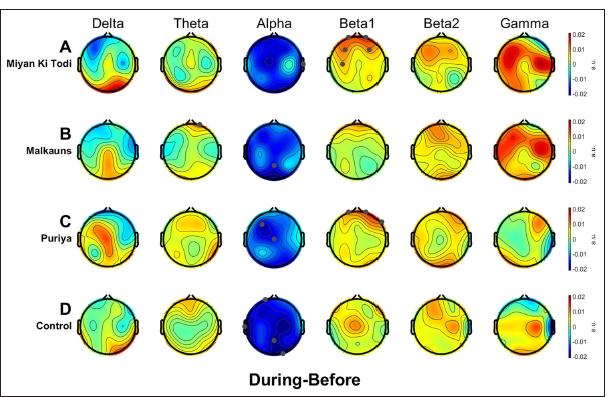
This provides empirical evidence for the long-held belief that each raga has a unique character and effect. The "feeling" of Raga Malkauns is not just subjective; it corresponds to a measurable neurological signature.
3. The Nuance of Personalization
At first glance, Raga Chikitsa can seem rigidly prescriptive, with charts listing specific ragas for specific ailments. However, a deeper look reveals a convergence with the modern principle of personalization.
Indian Music Therapy Science: Ancient Nada Healing for Modern Diseases | Ruma Chakravarty
In her talk on Indian Music Therapy, Ruma Chakravarty presents case studies that challenge a simplistic one-to-one mapping of raga to ailment.
Please watch the segment discussing the versatility of a single raga, Darbari Kanara (from "Then I'll take one raga" to "different type of symptoms").
The fact that Raga Darbari can be used to treat insomnia, bring someone out of a coma, and relieve stress shows that the traditional system is far from a simple prescription list. The effect depends on *how* the raga is rendered—its *laya* (tempo), the emphasis on certain *swaras*, the *alap* versus the *gat*. A skilled practitioner, traditional or modern, manipulates these musical parameters to meet the specific needs of the individual. This is a profound point of convergence, suggesting that the "therapeutic relationship" and "individualized goals" of modern therapy have an analogue in the intuitive, adaptive skill of the traditional musician-healer.
4. The Rise of Hybrid Models
Finally, the most exciting area of convergence is the development of modern, hybrid approaches in India. Practitioners and researchers are actively working to integrate the rich content of Indian music with the rigorous methodology of modern science.
View of Exploring Current Music Therapy Practices in India | Voices: A World Forum for Music Therapy
This article introduces a model that explicitly seeks to bridge the gap.
Read the section on Dr. Kinjalk and his KIMMA model. Notice its focus on scientifically matching music to the patient's history and ailment. Then, review the discussion of the "five internationally known models" and how KIMMA attempts to address what Dr. Kinjalk sees as a missing piece: a systematic way to select the music itself.
Models like KIMMA represent the synthesis you are interested in: they use the traditional musical forms of India but apply them within a structured, evidence-seeking framework that is compatible with modern medicine.
Conclusion: A Complementary Relationship
So, how do we critically evaluate the two systems? We can see them not as competing, but as complementary. They operate at different levels of explanation but often point to the same underlying truths.
Here is a summary of our comparison:
| Feature | Traditional Raga Chikitsa | Modern Music Therapy |
|---|---|---|
| Philosophical Basis | Metaphysical (subtle body, nadis, chakras, elements) | Scientific (neuroscience, psychology) |
| Diagnostic Approach | Intuitive, esoteric (astrology, dosha) | Clinical, systematic (psychological & physical assessment) |
| Mechanism of Action | Vibrational resonance (balancing nadis) | Neuroplasticity (dopamine, entrainment, brain connectivity) |
| Evidence Base | Scriptural authority, anecdotal, lineage-based | Empirical, evidence-based (clinical trials, peer-reviewed data) |
| Intervention | Often prescriptive (raga for ailment) but nuanced in practice | Highly personalized (active/receptive methods for client goals) |
Key Takeaways:
- Divergence: The core split is between a metaphysical/energetic worldview and a scientific/neurobiological one. This leads to different methods of diagnosis and standards of evidence.
- Convergence: Both systems acknowledge the power of sound to alter biological states (resonance/entrainment) and the importance of context and personalization.
- Synthesis: Modern science does not debunk Raga Chikitsa; it begins to provide a new language and a robust methodology to explain and validate its effects. The neurological correlates of ragas and rasas are a prime example.
- The Path Forward: The future lies in hybrid models that combine the profound musical and emotional wisdom of the raga system with the rigorous, evidence-based framework of modern therapy.
You can think of Raga Chikitsa as providing the rich, culturally potent content, while modern Music Therapy provides the method for its systematic application and validation.
In our next module, we will put this synthesized understanding into practice. We will move into case studies of specific ragas—Yaman, Bhairav, Malkauns, and Bhairavi—analyzing their musical structure and connecting it directly to the psychoacoustic and neurological effects we have now explored from both traditional and modern viewpoints. This will bring us even closer to your goal of understanding how to craft a specific bhav with music.