Recommended resources
The freely available resources this lesson will direct you to.

Introduction
In our previous lessons, we have journeyed from the metaphysical foundations of Raga Chikitsa to the empirical framework of modern Music Therapy. We critically evaluated both systems, identifying where they diverge in philosophy and where they converge in practice, particularly around concepts like resonance and entrainment. You now have a dual lens—one traditional, one scientific—through which to view the power of music.
This lesson is where we transition from analysis to application. The learning outcome is a practical one: to design a hypothetical raga listening protocol for a specific emotional goal, justifying your raga and laya choices. We will move beyond simply understanding that ragas have effects and start methodically planning how to use them to achieve a desired outcome. Think of this as designing a small, focused system where the inputs are carefully selected musical parameters and the desired output is a specific psychological state.
What is a Listening Protocol?
In a research or therapeutic context, a "protocol" is simply a detailed plan or a set of rules that ensures an experiment or treatment is conducted in a consistent and repeatable way. For our purposes, a raga listening protocol is a structured guide for a listening session, designed to produce a specific emotional or mental effect.
As a software developer, you are familiar with the importance of clear specifications and structured procedures. A listening protocol is no different. It defines the goal, the tools (raga, instrument), the process (laya, duration), and the environment. Take a look at the following diagram from a research study.
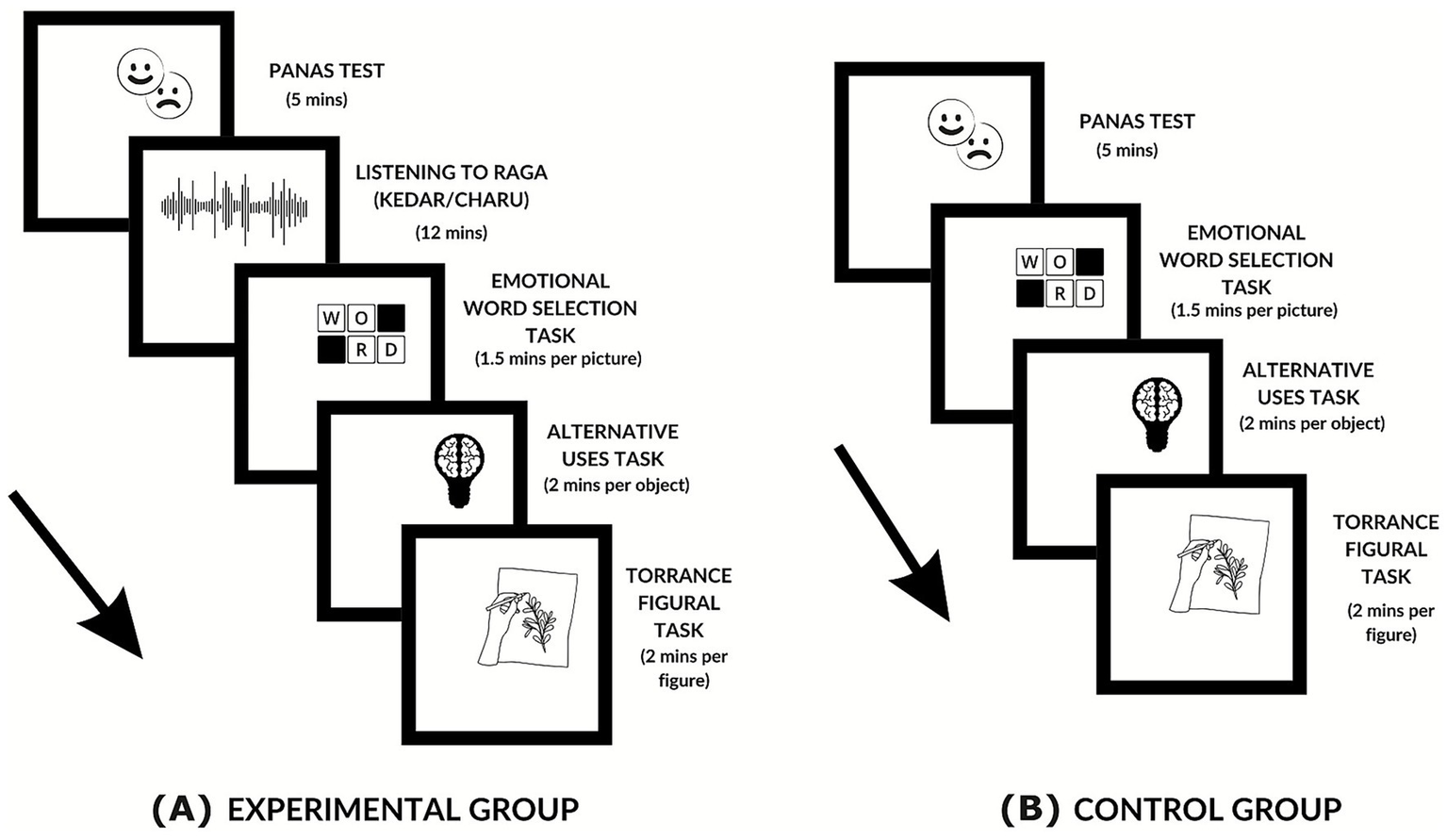
While our protocol will be for personal use rather than a formal experiment, the principle of structured intentionality is the same.
A Framework for Designing Your Protocol
Designing an effective protocol involves making a series of deliberate choices and being able to justify them. We can break this down into a four-step process.
Step 1: Define the Intention (The 'Why')
The first and most crucial step is to clearly state your objective. What is the desired emotional or psychological outcome?
- Are you trying to reduce an agitated state, like anxiety or stress? In Jain terms, this could be seen as a practice to pacify a kashaya.
- Are you aiming to enhance a specific positive state, like focus, creativity, or devotion (bhakti)?
- Are you seeking to induce a state of deep relaxation or meditative stillness (shanti)?
For this lesson, we will use anxiety reduction as our primary example, as it is a common and well-researched goal.
Step 2: Select the Tool (The 'What': Raga)
Once the goal is clear, you must select the primary tool: the raga. This choice should not be arbitrary. Your justification should draw upon both traditional knowledge and musicological understanding.
Traditional texts on Raga Chikitsa provide a wealth of information, linking specific ragas to therapeutic benefits. The document "Raga Chikitsa and Raga Ragini Vidya" contains an extensive list that can serve as an excellent starting point.
Raga Chikitsa and Raga Ragini Vidya - Bill Osmer
This document provides a valuable compendium of ragas and their traditionally attributed healing properties.
Refer to the section titled "RAGA RAGANI CHIKITSA: INDIAN MODE OF MUSIC THERAPY" and find the list that begins with "Carnatic RAGAS BENEFITS". Scan this list to see the wide range of prescribed effects. For example, note the entries for Bhairavi ("Reduces anxiety, pressures"), Sama ("Makes mind sober, tranquil, induces good sleep"), and Sivaranjani ("Powerful raga for meditation; Removes sadness").
Beyond textual prescription, you can also justify your choice by analyzing the raga's swara content. Ragas using komal (flat) notes often evoke softer, more introspective, or melancholic moods, while ragas with shuddha (natural) or teevra (sharp) notes can feel brighter or more assertive.
Step 3: Define the Method (The 'How': Laya and Structure)
A raga is not a static entity; its emotional impact is profoundly shaped by its presentation. The most important variable here is laya (tempo). Modern psychoacoustic research confirms what musicians have always known intuitively: tempo directly influences arousal.
[PDF] Study of Emotion Perception for Indian Classical Raga Music
This research paper provides empirical data on how tempo variations affect the perception of ragas, even for novice listeners.
Please read the following sections: Introduction: Pay attention to the description of a typical ICM performance structure: alap, vilambit, madhya, and drut. Results: Examine Figures 1, 2, and 3, which compare listener responses to alap (no rhythm), madhya laya (medium tempo), and drut laya (fast tempo). Note the findings, such as alap being perceived as meditative and peaceful. Conclusion: Read the summary of findings. The key takeaway is that fast tempo creates excitement, while slower tempos are associated with sad or reflective moods.
The research confirms a crucial design principle: for anxiety reduction or calmness, you should favor slower tempos. A typical structure for this goal would be:
- Alap: A slow, rhythm-free exploration of the raga to quiet the mind and establish the mood.
- Vilambit Gat: A slow-paced composition that allows for deep immersion without becoming agitating.
- Madhya Laya (Optional): A medium-paced composition might be included if the goal is gentle upliftment rather than pure sedation.
- Drut Laya (Avoid): For a goal of anxiety reduction, a fast-paced section would likely be counterproductive, as it increases arousal.
Step 4: Refine the Parameters (The 'Where' & 'With What')
Finally, consider the other variables that shape the experience:
- Instrumentation (Timbre): Different instruments have different timbral qualities. The soothing sound of a bansuri (bamboo flute) or the resonant depth of a sarod will create a different effect than a sharp-sounding instrument. Vocal music adds the complexity of language and the human voice. The constant, grounding presence of the tanpura drone is non-negotiable.
- Environment: The listening space should be quiet, comfortable, and free from distractions. Time of day can also be relevant, aligning with the traditional time theory of ragas.
- Duration: The session should be long enough to allow the mind to settle and entrain to the music, but not so long that it leads to restlessness. A 15-20 minute listening block is often a good starting point.
A Worked Example: Protocol for Anxiety Reduction
Let's apply this framework to design a protocol for reducing anxiety and promoting a sense of calm.
How To Cure Disease with Raga Chikitsa Treatment through Music for Stress, Depression | Ep 01 | AMCT
This video presents Raag Shankara and explicitly discusses its therapeutic benefits.
Please watch the first part of the video (from the beginning to the start of the performance). The presenter, speaking in Hindi, introduces the raga and lists its therapeutic benefits. Listen for the phrases related to stress (st्रेस कम होता है), calming the mind (दिमाग को शांत रखता है), and reducing anxiety (anxiety कम करता है).
Based on this, we can design the following protocol:
- 1. Emotional Goal: To reduce feelings of anxiety and mental restlessness, promoting a state of calm and balance.
- 2. Raga Selection: Raag Shankara.
- 3. Justification:
- Traditional: As stated in the video, this raga is traditionally used in music therapy to reduce stress, calm the mind, and combat anxiety and depression.
- Musicological: Shankara belongs to the Bilawal thaat, which is equivalent to the Western major scale. It generally has an uplifting, yet powerful and stable character. Its omission of Rishabh (Re) and Madhyam (Ma) in the ascent gives it a unique, direct, and heroic feel, which can counter feelings of helplessness often associated with anxiety.
- 4. Laya and Structure:
- Structure: Alap followed by a composition in Vilambit or Madhya Laya. Avoid Drut Laya.
- Justification: The session should begin with a 5-7 minute alap to allow the listener's mind to gradually settle and synchronize with the raga's mood, a principle supported by the finding that alap is perceived as "meditative and peaceful." Following this, a 10-15 minute composition in a slow-to-medium tempo maintains the calm state without introducing the agitation that a fast tempo might create.
- 5. Instrumentation: A solo vocalist or a stringed instrument like the Sitar or Sarod, supported by a clear Tanpura drone. The voice or instrument should be rendered with a calm, soothing tone (bhava).
- 6. Listening Environment: A quiet room with dim lighting, listened to in the evening (aligning with the raga's traditional performance time of the second prahar of the night).
- 7. Total Duration: Approximately 20-25 minutes (5-7 min settling/alap + 15 min composition + 5 min silence).
Practice: Design Your Own Protocol
Now it is your turn to act as the designer. Choose an emotional or spiritual goal that is meaningful to you—it could be anxiety reduction, but feel free to choose something else, such as "enhancing focus" or "cultivating devotion (bhakti)".
Use the resources and framework from this lesson to fill out the following template. The most important part is the "Justification" section, where you should explain why you are making each choice, referencing the concepts we have discussed.
My Raga Listening Protocol
-
Emotional Goal:
(e.g., To reduce anxiety, to enhance focus, to cultivate a feeling of peace, etc.)
-
Raga Selection:
(Name the raga you have chosen.)
-
Justification for Raga:
(Why this raga? Refer to its traditional benefits from the Raga Chikitsa text, and/or its musical structure - its thaat, its swaras, its associated rasa, etc.)
-
Laya and Structure:
(Describe the tempo progression: Alap, Vilambit, Madhya, Drut? What is the duration of each part? Justify your choices based on the research on tempo and emotion.)
-
Instrumentation:
(What instrument(s) would be ideal? Vocal or instrumental? Why?)
-
Listening Environment:
(Describe the ideal setting, time of day, etc.)
-
Total Duration:
(Estimate the total time for the session, including any silence before or after.)
Take your time with this exercise. It is the synthesis of everything we have learned about the practical application of music for psychological and spiritual well-being.
Conclusion
In this lesson, we have transformed theoretical knowledge into a practical skill: the ability to design a structured, intentional raga listening protocol. You've learned to define a goal and make deliberate, justified choices about raga, laya, and listening context, using both ancient tradition and modern science as your guides. This process of creating a "musical prescription" is a crucial step toward harnessing music as a tool for personal transformation.
Key Takeaways:
- A listening protocol is a structured plan for using music to achieve a specific psychological goal.
- Effective design requires clear intention (the 'Why') and justified choices for the raga (the 'What') and laya (the 'How').
- Traditional texts like Raga Chikitsa offer a rich starting point for raga selection.
- Psychoacoustic research provides empirical support for choices regarding tempo, with slower tempos promoting calmness and faster tempos inducing excitement.
In our next series of lessons, we will apply this design thinking to your ultimate goal. Having learned how to construct a musical experience, we will delve into the specific ingredients for bhakti rasa. We will analyze the musical characteristics of ragas traditionally used in devotional music, bringing you closer to understanding how to craft a soundscape for spiritual connection.