Recommended resources
The freely available resources this lesson will direct you to.
- How To Cure Disease with Raga Chikitsa Treatment through Music for Stress, Depression | Ep 01 | AMCTwww.youtube.com
- Indian Music Therapy Science: Ancient Nada Healing for Modern Diseases | Ruma Chakravartywww.youtube.com
- Raga Chikitsa and Raga Ragini Vidya - Bill Osmerswaraabhimanee.files.wordpress.com
- [PDF] मानसिक चिकित्साओं में संगीत का योगदान: एक - Impact Factor: 8.524www.ijirset.com

Introduction
Welcome to our next lesson. In our previous session, we established the foundational framework of Raga Chikitsa, exploring the thesis of the Raagoupanishad that ragas can be a form of vibrational medicine. We uncovered the traditional logic: a causal chain running from Raga → Elements → Chakras → Nadis → Organs. You can think of this as understanding the architecture of a complex system.
Today, we will move from the system's architecture to its practical application. The goal for this lesson is to identify specific ragas prescribed in traditional texts for therapeutic purposes. We will explore the "musical pharmacopoeia" that has been compiled over centuries, looking at the specific "Raag-Rog" (Raga-Disease) pairings that form the core of this healing science. This is like moving from the design documents to studying the actual function library and its specific calls.
The "Raag-Rog" Dictionary: A Pharmacopoeia of Sound
The central operational aspect of Raga Chikitsa is a prescriptive list that matches musical structures to specific ailments. These have been documented in various texts and are carried forward by oral tradition. Let's begin by consulting two resources that provide these lists, one focusing on mental and emotional states and the other on a broader range of conditions.
Since you are comfortable with Hindi, we'll start with a modern paper that summarizes prescriptions for various psychological conditions.
[PDF] मानसिक चिकित्साओं में संगीत का योगदान: एक - Impact Factor: 8.524
This research paper, "मानसिक चिकित्साओं में संगीत का योगदान" (Contribution of Music in Mental Therapies), provides a concise list of ragas used to treat mental and emotional disorders.
Please navigate to the section titled "राग चिकित्सा" (Raga Chikitsa). After the definition of raga, you will find a bulleted list under the heading "Examples of some mental diseases treated by Raga Chikitsa". As you read this list, notice the kinds of conditions addressed: Insomnia (अननिद्रा रोग): Ragas Bhairavi, Deepak, Darbari, Bageshwari Mental agitation and anger (मानसिक चंचलता व क्रोध): Ragas Malhar, Jaiaijwanti Depression (डडप्रेसन): Raga Vrindavani Sarang Anxiety (ऐंगज़ाइिी): Raga Bhimplasi This gives you a direct glimpse into the "Raag-Rog" dictionary from the Hindustani music tradition.
This list focuses primarily on mental and emotional well-being. A parallel and even more extensive system exists in the Carnatic tradition, which has been systematically documented by practitioners like Sri Ganapathi Sachchidananda Swamiji.
Raga Chikitsa and Raga Ragini Vidya - Bill Osmer
This paper provides an excellent English-language summary of Raga Chikitsa, including a detailed list of Carnatic ragas and their attributed benefits.
In the document, find the section that begins with a table correlating chakras and planets with ragas. Immediately following that table, you'll find an extensive alphabetical list under the heading Carnatic RAGAS BENEFITS. Please scan through this list of ragas and their benefits. Take note of a few examples that show the breadth of this system: Ahir Bhairav: Mitigates dust allergies and good for arthritic conditions. Amrutavarshini: Alleviates diseases related to heat. Karaharapriya: Curative for heart disease and nervous irritability. Mohana: Filters out the ill-effects of kama (desire) and krodha (anger). This one is particularly relevant to your goal of kashaya reduction. Sama: Makes the mind sober and tranquil, good for world peace.
These lists demonstrate the prescriptive nature of Raga Chikitsa. But how does a single raga accomplish this? Let's spotlight a few key examples.
Spotlight on "Medicinal" Ragas
Simply listing ragas and ailments can seem overly simplistic. The true art and science lie in understanding the character of the raga and how it is applied.
Raga Shankara: For Positive Energy and Balance
Let's watch a short, practical demonstration. The presenter here follows a clear structure: he introduces the raga's musical identity and then explicitly lists its therapeutic benefits.
How To Cure Disease with Raga Chikitsa Treatment through Music for Stress, Depression | Ep 01 | AMCT
This video provides a concise example of Raga Shankara, presented specifically in the context of its healing properties.
Watch the entire clip. First, the artist describes the raga's technical aspects (musical identity), such as its thaat (Bilawal) and performance time. Then, he directly lists its therapeutic benefits, including stress reduction, calming the mind, providing positive energy, and its use in therapy for depression.
This is a classic example of the Raga Chikitsa framework in action: a specific melodic entity prescribed for a specific set of psychological goals.
Raga Darbari Kanara: A Study in Versatility
While some prescriptions seem straightforward, the case of Raga Darbari Kanara reveals a deeper complexity. It challenges the idea of a simple one-to-one mapping between a raga and an ailment, which will appeal to your analytical perspective.
Indian Music Therapy Science: Ancient Nada Healing for Modern Diseases | Ruma Chakravarty
In this clip from her talk on Indian Music Therapy, Ruma Chakravarty discusses the multifaceted therapeutic applications of a single raga, Darbari Kanara.
Please watch the segment from "I'll take one raga". The speaker presents several documented case studies for Darbari Kanara. Notice the variety of applications: Treating insomnia. Bringing a patient out of a coma. Reducing maternity and pregnancy pain. Acting as a significant stress reliever. This demonstrates a crucial point: a raga is not a simple "pill." Its effect depends on how it is rendered and the context of its application. The same raga that can induce deep sleep can also awaken consciousness, highlighting the sophistication of this system beyond a simple lookup table.
The Mechanism: Swaras and Chakras
How can one raga have such diverse effects? The traditional explanation circles back to the framework we discussed last lesson: the connection between swaras (notes) and chakras (energy centers).
A raga is not just a collection of notes, but a specific melodic personality that emphasizes certain notes and pathways. The therapeutic effect is believed to come from the focused vibrational energy of these emphasized swaras stimulating their corresponding chakras.
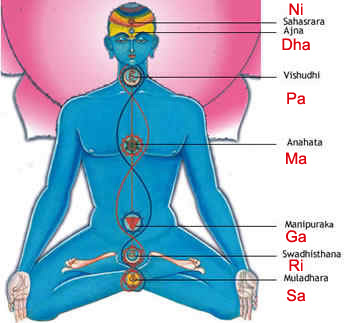
Let's use this map to theorize about a raga's effect. Consider Raga Mohana (or its Hindustani equivalent, Bhupali), which uses the notes Sa-Re-Ga-Pa-Dha. The text we read earlier noted its power to filter the effects of desire (kama) and anger (krodha).
Looking at the chart, its notes activate the lower five chakras:
- Sa: Muladhara (grounding, stability)
- Re: Swadhisthana (creativity, flow)
- Ga: Manipura (willpower, identity)
- Pa: Vishuddhi (expression, communication)
- Dha: Ajna (intuition, perception)
By omitting the turbulent emotions often associated with Ma (Anahata/heart-centric emotions in some interpretations) and the ethereal Ni (Sahasrara/transcendence), the raga's structure provides a stable, grounding, and clarifying energy. This could be seen as a musical antidote to the agitated states of kashayas like anger and greed, creating a foundation for inner peace.
Conclusion
Today, we have populated the theoretical framework of Raga Chikitsa with concrete examples, transforming it from an abstract concept into a practical, albeit complex, pharmacopoeia of sound.
Key Takeaways:
- Traditional Indian music systems contain extensive lists prescribing specific ragas for a wide range of physical, mental, and emotional ailments.
- We've seen examples like Raga Bhairavi for anxiety, Raga Malhar for anger, and Raga Shankara for stress reduction.
- The relationship is not always a simple one-to-one mapping. A single versatile raga, like Darbari Kanara, can be used for diverse purposes ranging from treating insomnia to aiding coma recovery, depending on its application.
- The underlying mechanism is thought to be the raga's specific swaras stimulating corresponding chakras, thereby restoring vibrational harmony to the psycho-physiological system.
In our previous lessons, we defined the components of music and the framework for its therapeutic use. In this lesson, we've identified the specific "medicines." In our next lesson, we will begin to analyze the "molecular structure" of these medicines. We'll start our case studies by analyzing the serene character of Raga Yaman, dissecting its musical grammar to understand how its structure generates its well-known peaceful and devotional qualities.