Recommended resources
The freely available resources this lesson will direct you to.
- Stanford CS231N | Spring 2025 | Lecture 11: Large Scale Distributed Trainingwww.youtube.com
- Ultimate Guide To Scaling ML Models - Megatron-LM | ZeRO | DeepSpeed | Mixed Precisionwww.youtube.com
- Communication Optimization for Distributed Training - arXivarxiv.org
- The New LLM Bottleneck: A Systems Perspective on Latent Attention ...arxiv.org
Introduction
Welcome to our final lesson in the "Emerging Architectures and Future Trends" module. In the previous lesson, we established that the immense size of state-of-the-art models has run up against the "memory wall." The sheer capacity required for trillion-parameter models, and the limited bandwidth to feed their compute units, makes it impossible to train them on a single device. This forces us into a massively distributed computing paradigm.
However, solving one problem introduces another. By distributing the model and data across hundreds or thousands of GPUs, we create a new, often more severe, bottleneck: communication.
Today's lesson directly addresses this consequence. Our learning outcome is to: Analyze the interconnect and communication bottlenecks that arise when training models at extreme scale. We will explore:
- The hierarchical nature of communication bandwidth in a modern GPU datacenter.
- The specific, demanding communication patterns generated by different parallelism strategies.
- Why architectures like Mixture-of-Experts (MoE) create an "all-to-all" communication bottleneck that drives the design of next-generation interconnects.
This lesson bridges the gap between the algorithmic patterns of distributed training and the physical realities of the network that connects the system, providing a full-circle view of the challenges in scaling AI.
Part 1: The Communication Hierarchy
Not all communication is created equal. In a large-scale GPU cluster, communication performance varies by orders of magnitude depending on where the data is going. This creates a distinct hierarchy of bandwidth and latency.
To understand this hierarchy, let's watch a segment from a Stanford lecture that walks through the composition of a modern GPU cluster, from a single chip to a 24,000-GPU deployment.
Stanford CS231N | Spring 2025 | Lecture 11: Large Scale Distributed Training
This video, from a Stanford CS231N lecture on Large Scale Distributed Training, provides an excellent architectural overview of a GPU cluster, quantifying the communication bandwidth at each level of the hierarchy.
Watch the segment from 02:46 to 14:13. As you watch, pay close attention to the decreasing bandwidth numbers as the system scales out: On-chip: GPU compute cores to its own HBM (High Bandwidth Memory). Intra-server: GPU to another GPU within the same server box (e.g., via NVLink). Inter-server / Intra-pod: GPU to a GPU in a different server but within the same high-performance pod. Inter-pod / Cluster-wide: GPU to a GPU in a different pod.
The video clearly illustrates a crucial systems principle: communication gets progressively slower and more expensive as data travels farther away from the local processor.
Here's a summary of the bandwidth tiers discussed for an H100-based cluster:
| Scope | Interconnect | Typical Bandwidth |
|---|---|---|
| On-Chip | Internal Bus | ~3 TB/s |
| Intra-Server | NVLink/NVSwitch | ~900 GB/s |
| Inter-Server (Intra-Pod) | High-Speed Fabric | ~50 GB/s |
| Inter-Pod (Cluster-wide) | High-Speed Fabric | <50 GB/s |
This multi-level hierarchy is a fundamental constraint. Any efficient distributed training strategy must be "topology-aware," meaning it must be designed to minimize traffic across the slower, lower-bandwidth links. The goal is to keep the most intense communication within the fastest interconnect domains (e.g., inside a single server).
Part 2: Communication Patterns of Extreme-Scale Parallelism
In earlier modules, we discussed various parallelism strategies. Now, let's analyze them through the lens of the communication bottlenecks they create. When training at an extreme scale, we don't just use one strategy; we use a hybrid approach, and each component of that hybrid strategy imposes a different type of load on the network.
The paper "Communication Optimization for Distributed Training" provides a useful framework for thinking about this. It outlines a three-layer paradigm: the Parallelization Strategy determines the communication demand, the Collective Communication Library (like NCCL) implements it, and the underlying Network executes it.
Communication Optimization for Distributed Training - arXiv
This paper provides a concise overview of how different parallelization strategies lead to different collective communication needs.
Please read Section II, 'Architecture' (Subsections A through E). This will formalize the connection between parallelism types and the communication primitives they require.
As the paper discusses, each parallelization method maps to specific communication primitives:
- Data Parallelism: Replicates the model and shards the data. This requires synchronizing gradients after each backward pass using an All-Reduce operation. The volume of data in this All-Reduce is equal to the size of the model's parameters. For a trillion-parameter model, this is terabytes of data that must be communicated every single training step.
- Tensor Parallelism: Splits individual weight matrices within a layer. This requires communication within the layer to aggregate partial results, often using an All-Reduce or All-Gather operation. While the data volume per operation might be smaller than in data parallelism, it happens very frequently (inside every split layer).
- Pipeline Parallelism: Splits the model layer-by-layer across GPUs. This primarily involves point-to-point communication, where one stage sends its output activations to the next. This is generally less bandwidth-intensive than collective operations but is highly sensitive to latency, leading to the "pipeline bubble" we've discussed previously.
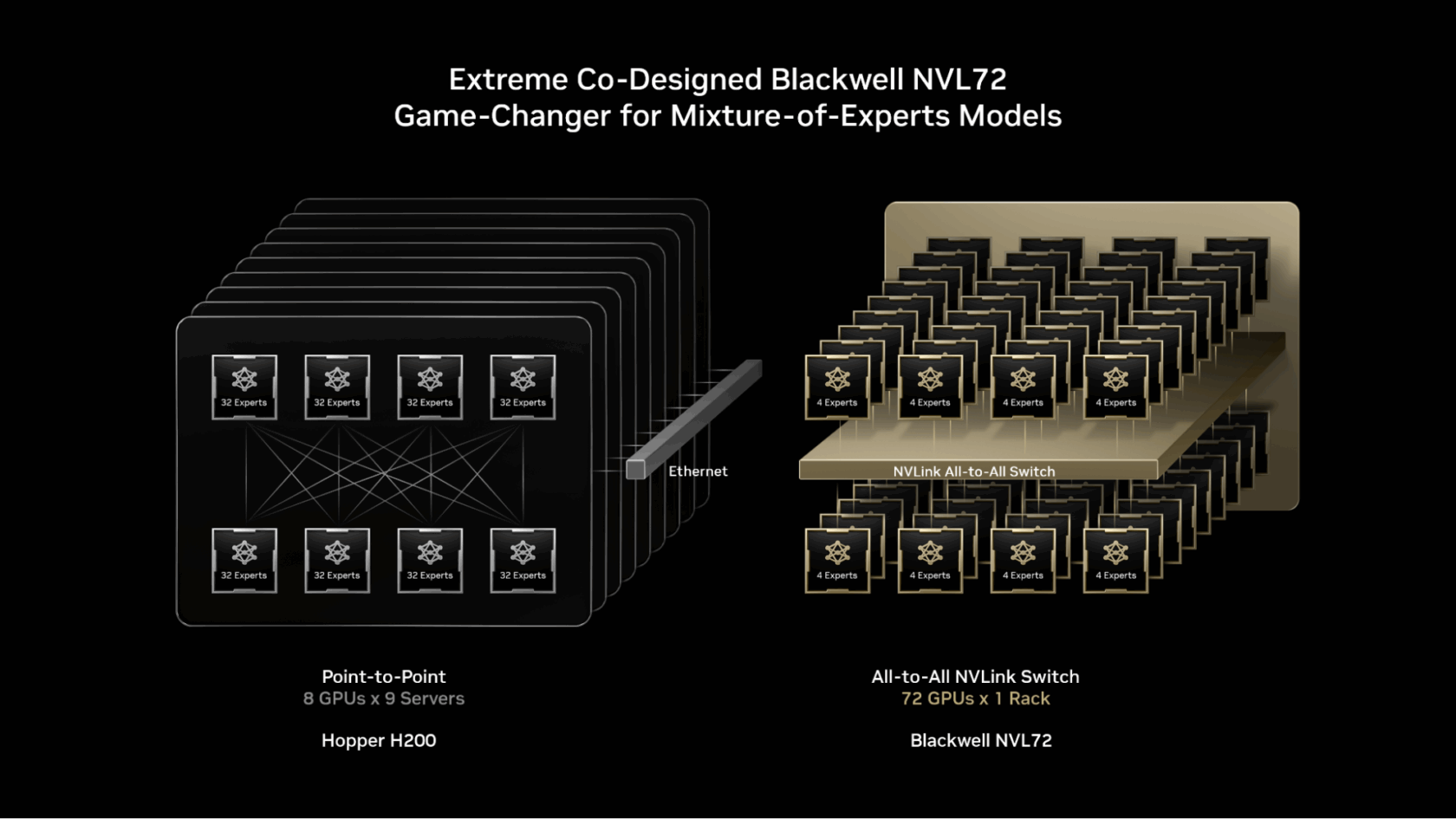
- Mixture-of-Experts (MoE) Parallelism: This is where the most significant communication bottleneck at scale appears. MoE layers use a router to send each input token to a small subset of "expert" sub-networks. When these experts are distributed across different GPUs, the system must perform a massive data shuffle. This is an All-to-All communication pattern.
The All-to-All Bottleneck of MoE
In an All-to-All operation, every GPU needs to exchange data with every other GPU participating in the operation. Imagine a room of 64 people, where each person has 64 different items and needs to give one specific item to every other person in the room. The result is a chaotic and massive data exchange that stresses the total communication capacity of the network, known as its bisection bandwidth.

Because MoE allows models to scale to trillions of parameters without a proportional increase in compute cost, it has become a standard architecture for frontier models. Consequently, solving the All-to-All communication bottleneck it creates has become a primary focus of system design.
Part 3: The Critical Role of Interconnects
The combination of a hierarchical network and demanding communication patterns like All-to-All makes the interconnect fabric the ultimate arbiter of performance at scale.
A recent paper, "The New LLM Bottleneck," provides a sharp analysis of this issue. It argues that with modern architectures, the bottleneck is no longer just about memory access within a single GPU but about the communication between GPUs, especially for MoE models.
The New LLM Bottleneck: A Systems Perspective on Latent Attention ...
This paper analyzes how architectures like MoE shift the system bottleneck toward the interconnect.
Read Section II-D, 'LLM serving systems,' and Section VII-C, 'The critical role of interconnect.' Focus on how expert parallelism creates communication overhead and why the performance of a scaled-out MoE system is highly sensitive to interconnect bandwidth.
The paper highlights a key finding: using a lower-bandwidth interconnect like InfiniBand instead of a high-bandwidth, tightly-integrated one like NVLink dramatically increases communication overhead. This overhead eats into the time budget for each token's generation (the Service Level Objective or SLO), which in turn forces the system to use smaller batch sizes, leading to underutilization of the expensive GPU compute units.
This has driven a new wave of hardware innovation aimed squarely at the All-to-All bottleneck.
Co-design: Mapping Parallelism to Topology
This brings us to a central theme of your goal: designing and optimizing AI systems. Effective design is about co-design: intelligently mapping the communication requirements of the parallelism strategy to the physical network topology.
The common practice is to:
- Apply the most communication-intensive parallelism within the highest-bandwidth domain. For example, use Tensor Parallelism (requiring frequent All-Reduce) among the 8 GPUs inside a single server connected by ultra-fast NVLink.
- Apply less intensive parallelism across slower links. For example, use Data Parallelism across different servers. The All-Reduce for gradient synchronization happens less frequently (once per step) than the All-Reduce for tensor parallelism (multiple times per layer).
This hybrid approach, which we've previously seen referred to as 3D or ND parallelism, is a direct strategy to manage the hierarchical communication bottlenecks in a large cluster. You can see this principle in action in the video "Ultimate Guide To Scaling ML Models" (resource LINK) in the segment from 00:44:14 to 00:45:51, where data parallelism is layered on top of a model-parallel group confined to a high-bandwidth server.
Conclusion
In this final lesson, we've seen how the solution to the memory wall—massive distribution—creates its own formidable challenge: the communication wall. At extreme scale, training performance is no longer just about the FLOPs of a single GPU, but about the collective ability of the network to move terabytes of data efficiently every second.
Key Takeaways:
- Communication is Hierarchical: Datacenter interconnects have tiers of performance, with bandwidth dropping dramatically as communication moves from intra-server (NVLink) to inter-server (InfiniBand/Ethernet).
- Parallelism Dictates Communication: Each parallelism strategy (Data, Tensor, Pipeline, MoE) imposes a unique communication pattern and overhead on the network.
- MoE and the All-to-All Bottleneck: Mixture-of-Experts, a key architecture for scaling to trillions of parameters, relies on an All-to-All communication pattern that heavily stresses the network's bisection bandwidth.
- Interconnects are a First-Class Citizen: The performance of extreme-scale systems is critically sensitive to interconnect bandwidth. Hardware is evolving rapidly (e.g., NVLink Switch) specifically to address the All-to-All bottleneck.
- Co-design is Essential: Optimizing performance requires a deep understanding of both the software (parallelism strategy) and the hardware (network topology) to map communication-intensive tasks to the fastest network links.
With this lesson, you have completed the foundational and core courses of your curriculum. You now possess a comprehensive understanding of the key system-level challenges in scaling AI—from the architecture of a single GPU and its memory system to the complex interplay of compute, memory, and communication in a full-fledged datacenter. You are now well-equipped to tackle the advanced courses on GPU architecture, distributed training, and system design.