Recommended resources
The freely available resources this lesson will direct you to.
Welcome back. In our previous lesson, we mastered the recording of straightforward settlements: receiving payments from customers and making payments to suppliers. These transactions form the backbone of a company's cash flow management.
However, business transactions are often more nuanced. To encourage large orders or prompt payments, companies offer discounts. This lesson addresses the learning outcome: Apply accounting rules for sales and purchase discounts. We will dissect the different types of discounts you'll encounter in a Moroccan SME, learn how to calculate them correctly on an invoice, and record them according to professional standards.
This is a crucial skill. Properly accounting for discounts not only ensures accuracy but also directly impacts the calculation of revenue, expenses, and VAT.
1. The Two Families of Discounts
In accounting, not all discounts are treated equally. They fall into two distinct categories based on their purpose: commercial discounts and financial discounts.
To understand their definitions and accounting implications, we'll start with a foundational reading.
The following resource, 'LA COMPTABILITE GENERALE', provides clear and concise definitions for the different types of discounts you will encounter.
Please read the sections titled '2-1 les réductions à caractères commercial' and '2-2 les réductions à caractère financier'. Focus on understanding the definitions of Rabais, Remise, Ristourne, and Escompte.
Based on your reading, let's summarize the key distinctions:
a) Commercial Discounts (Réductions Commerciales)
These are granted for sales-related reasons. They include:
- Rabais: A reduction for a specific issue, like a product defect or a delivery that doesn't conform to the order.
- Remise: A standard reduction based on the quantity purchased or as part of a promotional offer. This is the most common commercial discount.
- Ristourne: A reduction granted based on the total volume of business conducted with a client over a period (e.g., quarterly or annually).
The Golden Rule of Commercial Discounts: These discounts are not recorded in a separate account. They are deducted directly from the gross sales price on the invoice, and the accounting entry is made for the resulting net amount, known as the Net Commercial.
b) Financial Discounts (Réductions Financières)
This category primarily consists of the Escompte de règlement (settlement discount).
- Escompte: A reduction offered to a customer to incentivize them to pay their invoice before the official due date (e.g., payment within 10 days instead of 30).
The Golden Rule of Financial Discounts: Unlike commercial discounts, financial discounts are recorded in separate, specific accounts, as they represent a financial cost for the seller and a financial gain for the buyer.
2. Calculating Discounts on an Invoice
The order in which discounts are applied on an invoice is standardized. Getting this sequence right is critical for calculating the final amount payable and the correct VAT.
The calculation flow is as follows:
- Montant Brut (HT): Gross Amount before taxes.
- (-) Réductions Commerciales (Remises, Rabais): Deduct commercial discounts.
- = Net Commercial (HT): This is the net sales amount.
- (-) Escompte de règlement: Deduct the financial discount from the Net Commercial.
- = Net Financier (HT): This is the final taxable base.
- (+) TVA: Calculate VAT on the Net Financier.
- = Net à Payer (TTC): The final amount the customer has to pay.
The following image illustrates this calculation sequence clearly.

3. Accounting for Discounts
Now, let's translate these calculations into journal entries.
a) Recording Commercial Discounts
As stated before, you don't use a special account. The sale or purchase is simply recorded at the Net Commercial value.
- For the Seller: The
Ventesaccount (e.g., 7111 - Ventes de marchandises) is credited with the Net Commercial amount. - For the Buyer: The
Achatsaccount (e.g., 6111 - Achats de marchandises) is debited with the Net Commercial amount.
b) Recording Financial Discounts (Escompte)
This is where specific accounts come into play.
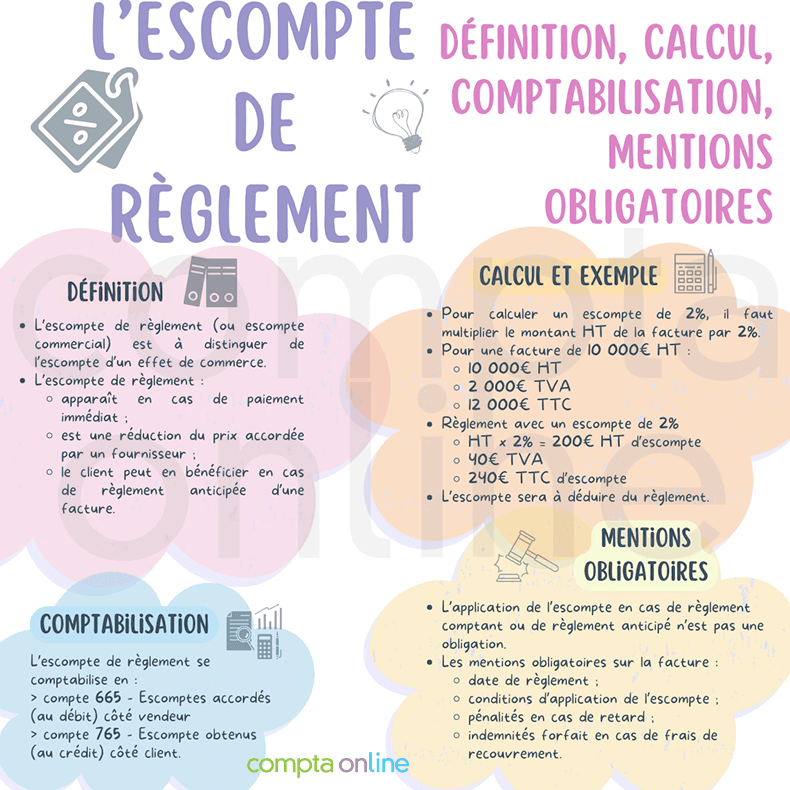
From the Seller's Perspective (Discount Granted):
The discount is a financial expense.
- Account: 6386 - Escomptes accordés (Financial charges)
- Journal Entry: You debit this account, reducing your net income.
From the Buyer's Perspective (Discount Received):
The discount is a financial revenue.
- Account: 7386 - Escomptes obtenus (Financial revenues)
- Journal Entry: You credit this account, increasing your net income.
The infographic below provides a great visual summary of the Escompte. Important Note: The infographic uses French account numbers (665/765). In the Moroccan Chart of Accounts, we use 6386 and 7386.
4. Practical Application: From Invoice to Journal
Let's put theory into practice with a typical Moroccan business scenario. We'll use a practical exercise that combines everything we've learned.
OPERATIONS-COURANTES-MTP-TSFC.pdf
The following document contains a series of highly practical exercises. We will focus on one of them to build an invoice and record the necessary journal entries from scratch.
Please review 'Enoncé du TP n° III' on page 16. Pay close attention to the conditions for commercial reductions ('Remises') and financial reductions ('Escompte') set by the company 'AIDI'. We will be working with the first transaction: the sale to 'Confection AMITEX'.
Scenario:
Company AIDI sells goods to client AMITEX on 02/10.
- Gross Amount (MB HT): 68,000 MAD
- Payment: By cheque on 04/10 (within 8 days)
Based on AIDI's discount policy from the document:
- Commercial Discount: The gross amount (68,000) is > 60,000, so AMITEX gets two successive
remisesof 10% and 5%. - Financial Discount: Payment is made within 8 days, so AMITEX gets an
escompteof 3%.
Let's prepare the journal entries for both AIDI (the seller) and AMITEX (the buyer).
Test your understanding!
First, calculate the key amounts for the invoice from AIDI to AMITEX. Then, prepare the journal entries for both companies. Use the standard VAT rate of 20%.
Show answer
1. Invoice Calculation
- Montant Brut (HT): 68,000.00
- Remise 10%: (6,800.00)
- Sous-total: 61,200.00
- Remise 5%: (3,060.00)
- Net Commercial (HT): 58,140.00
- Escompte 3%: (1,744.20)
- Net Financier (HT): 56,395.80
- TVA 20% (on Net Financier): 11,279.16 (Note: The provided solution in the resource LINK seems to have rounded the tax base or the final tax amount, leading to slightly different figures. We'll follow the exact calculation here for precision.)
- Net à Payer (TTC): 67,674.96
Self-Correction Note: The solution provided in resource LINK (page 25) shows TVA of 11,338. It also includes a Transport fee that was not part of the initial data for AMITEX. For learning purposes, we will ignore the transport fee and focus on the discounts. The logic of the entries remains the same.
2. Journal Entries
At AIDI (the Seller) on 02/10:
| N° Compte | Intitulé du Compte | Débit | Crédit |
|---|---|---|---|
| 5141 | Banque | 67,674.96 | |
| 6386 | Escomptes accordés | 1,744.20 | |
| 7121 | Ventes de biens produits | 58,140.00 | |
| 4455 | Etat, TVA facturée | 11,279.16 | |
| Facture F-3150, règlement par chèque |
Explanation:
- AIDI receives the net amount in its bank.
- The
Escompte accordéis recorded as a financial charge. - The
Ventesaccount is credited for the Net Commercial amount. - The VAT is calculated on the Net Financier and recorded as a liability.
At AMITEX (the Buyer) on 02/10:
| N° Compte | Intitulé du Compte | Débit | Crédit |
|---|---|---|---|
| 6121 | Achats de matières premières | 58,140.00 | |
| 34552 | Etat, TVA récupérable / charges | 11,279.16 | |
| 5141 | Banque | 67,674.96 | |
| 7386 | Escomptes obtenus | 1,744.20 | |
| Facture F-3150, règlement par chèque |
Explanation:
- AMITEX records the purchase at the Net Commercial value.
- The recoverable VAT is debited.
- The bank is credited for the actual amount paid.
- The
Escompte obtenuis recorded as a financial revenue.
5. Discounts Granted After the Initial Sale
Sometimes, a discount (especially a ristourne) is granted after the initial invoice has already been issued. In this case, the seller sends a credit note, or facture d'avoir.
For these post-invoice reductions, we use different accounts to keep them separate from the original sales figure:
- For the seller: 7119 - Rabais, remises et ristournes accordés par l'entreprise.
- For the buyer: 6119 - Rabais, remises et ristournes obtenus sur achats.
We will explore factures d'avoir in more detail in a future lesson, but it is useful to know that these dedicated accounts exist for reductions granted "off-invoice".
Conclusion
You have now learned to navigate one of the most common complexities in day-to-day transaction recording. Understanding the distinction between commercial and financial discounts is fundamental for any professional accountant.
Key Takeaways:
- Commercial Discounts (RRR): Reduce the invoice base amount (Net Commercial) but are not recorded in a separate account.
- Financial Discounts (Escompte): Are recorded as a financial charge for the seller (6386 - Escomptes accordés) and a financial revenue for the buyer (7386 - Escomptes obtenus).
- The invoice calculation follows a strict order: Gross -> Commercial Discount -> Net Commercial -> Financial Discount -> Net Financier -> VAT.
- The taxable base for VAT is the Net Financier.
Preview of the Next Lesson:
We have now created a variety of journal entries for sales, purchases, settlements, and discounts. But where do these entries go? How does an accounting system organize this information to be useful? In the next lesson, we will learn how to post journal entries to the general ledger and maintain running balances, taking the first step in transforming raw transaction data into structured financial information.