Recommended resources
The freely available resources this lesson will direct you to.
Welcome back. In our previous lesson, we learned how to apply accounting rules for sales and purchase discounts, creating detailed journal entries for even complex invoices. This was a critical step in accurately capturing the financial substance of a transaction.
But what happens to those journal entries after they are created? A business might have hundreds or thousands of transactions a month. Simply listing them chronologically in a journal isn't enough to understand the company's financial position.
This lesson addresses the next logical step in the accounting cycle: Post journal entries to the general ledger and maintain running balances. We will move from a chronological record (the journal) to an analytical one (the ledger), which is the central database for all financial information. Mastering this process is essential for organizing accounting data and is the foundation for preparing financial statements.
1. From Journal to General Ledger: Organizing Financial Data
So far, we have recorded transactions in the General Journal (Journal Général). Think of the journal as a diary that records every financial event in the order it happened.
Now, we introduce the General Ledger (Grand-Livre). If the journal is the diary, the General Ledger is the set of organized files. There is one "file" for every single account in the business (e.g., Cash, Accounts Receivable, Sales, Rent Expense).
The process of transferring information from the journal to the ledger is called posting (imputation or report).
- The Journal is the "book of original entry." It provides a chronological history of all transactions.
- The General Ledger is the "book of final entry." It groups all transactions by account, allowing us to see the activity and final balance of each one.
The following short video provides a good overview of the relationship between the journal, the general ledger, and the trial balance, explained in Moroccan Darija.
Comptabilité générale : Le compte, le journal, le Grand livre et la balance ( Darija )
Watch this segment from Sayih Academy to understand how accounting information flows from initial transactions through the journal and into the general ledger.
Watch from timestamp 13:31 to 14:34. The diagram shows how operations are recorded in the journal, then 'reported' to the grand livre (general ledger), which provides the final balances for each account.
2. The Structure of a Ledger Account
A ledger account simply collects all the debits and credits that affect that specific account. In its simplest form, it can be visualized as a T-account, which you've seen before.
However, in practice and in accounting software, a ledger account is usually presented in a columnar format that maintains a running balance.

A formal ledger account includes:
- Account Name and Number: (e.g., 5141 - Banque)
- Date: The date of the transaction.
- Description/Libellé: A brief explanation of the transaction.
- Posting Reference (Post. Ref.): A reference to the journal page (e.g., JNL-1), linking the ledger entry back to its source.
- Debit and Credit Columns: To record the amounts.
- Balance Column: To show the account's balance after each transaction.
The following resource clearly lays out the columnar format for both the journal and the ledger.
This reading from BC Bookkeeping Tutorials provides clear, labeled examples of a General Journal page and a General Ledger account.
Review the sections 'General Ledger' and 'General Journal' to familiarize yourself with the structure and the information contained in each. Pay special attention to the 'Sample of a General Ledger Page' and its columns, especially 'Post Ref' and 'Balance'.
3. The Posting Process and Maintaining a Running Balance
Posting is a systematic process of transferring each debit and credit from your journal entries to the correct ledger accounts. As you post each transaction, you immediately update the account's running balance.
The steps are as follows:
- Locate the ledger account for the first line item in your journal entry (e.g., the 'Cash' account).
- In the ledger account, enter the date and a description of the transaction.
- Enter the journal page number in the 'Post. Ref.' column of the ledger. This creates an audit trail.
- Enter the debit or credit amount from the journal into the corresponding column in the ledger.
- Calculate the new running balance of the account.
- For Asset & Expense accounts (normal debit balance):
New Balance = Previous Balance + Debits - Credits. - For Liability, Equity, & Revenue accounts (normal credit balance):
New Balance = Previous Balance - Debits + Credits. In many systems, credit balances are shown in parentheses or as negative numbers.
- For Asset & Expense accounts (normal debit balance):
- Go back to the journal and write the ledger account number (e.g., 101 for Cash) in the 'Post. Ref.' column. This marks the line item as "posted" and prevents errors.
- Repeat this process for the other line item(s) in the journal entry until all parts of the entry are posted.
The following video provides an excellent visual demonstration of this process.
GENERAL LEDGER: Visual Guide to Posting Journals
The video 'GENERAL LEDGER: Visual Guide to Posting Journals' from Accounting Stuff walks through the posting process for two example transactions.
Watch the first example, 'Manual Journal Entries' (02:36 - 05:46). Notice how the journal entry for an electricity expense is created and then how the debit and credit amounts are posted to the 'Overhead Expenses' and 'Accrued Expenses' T-accounts, updating their balances.
4. Comprehensive Example: From Transactions to a Posted Ledger
Let's now walk through a complete example. We will use the scenario from the DWMBeanCounter resource, which provides a set of initial balances and new transactions for a fictional company.
This exercise will solidify your understanding of how a month's worth of activity is recorded and organized.
We will now use the provided example to see the full cycle from transaction analysis to a fully posted general ledger. First, familiarize yourself with the company's starting position and its activities for the month.
Review the 'ABC's Beginning Account Balances' table to understand the financial state at the start of the month. Read through the 10 'ABC Transactions for December'. Carefully study 'ABC's General Journal', which shows the correct double-entry recording for each of those 10 transactions.
Now that you have the journal entries, the next step is to post them.
Test your understanding!
Before looking at the solution, take the first two journal entries (GJ-1-1 and GJ-1-2) from the reading and try to post them yourself.
GJ-1-1:
- Debit Cash (Acct 100) for $50
- Credit Mowing Revenue (Acct 400) for $50
GJ-1-2:
- Debit Inventory-Office Supplies (Acct 115) for $100
- Credit Accounts Payable (Acct 200) for $100
What would be the new balance in the Cash, Mowing Revenue, Inventory, and Accounts Payable accounts after posting these two entries? Use the beginning balances from the resource.
Show answer
- Cash (Acct 100): Beginning Balance $5,500 (debit) + $50 debit = $5,550 (debit).
- Mowing Revenue (Acct 400): Beginning Balance ($1,000) (credit) + $50 credit = ($1,050) (credit).
- Inventory-Office Supplies (Acct 115): Beginning Balance $0 + $100 debit = $100 (debit).
- Accounts Payable (Acct 200): Beginning Balance ($2,000) (credit) + $100 credit = ($2,100) (credit).
Now, let's see the fully posted General Ledger for the entire month.
This final part of the resource shows the result of posting all 10 journal entries to their respective ledger accounts.
Carefully review 'ABC's General Ledger'. For each account (Cash, Accounts Receivable, etc.), trace the transactions from the journal to the ledger. Verify how the 'Balance' column is updated with each entry. For example, in the Cash account, see how the balance starts at $5,500, increases to $5,550 after GJ-1-1, and then decreases to $5,525 after GJ-1-3.
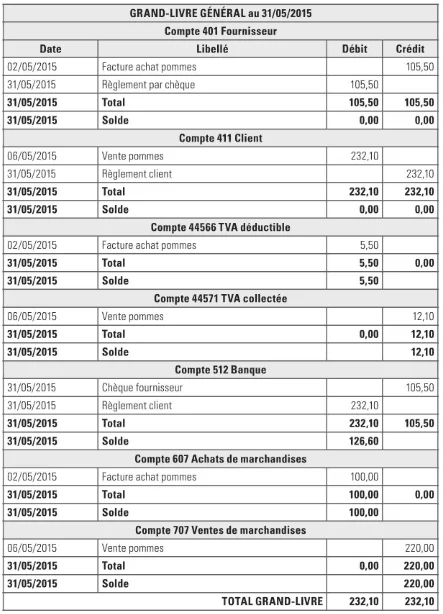
To see what a final Grand-Livre looks like in a Moroccan context, examine the image below. It uses Moroccan account numbers and French terminology. You can see how each account aggregates the transactions affecting it and concludes with a final Solde.
Conclusion
You have successfully bridged the gap between recording daily transactions and organizing them for analysis. The General Ledger is the accountant's central tool, providing a detailed history and current balance for every element of the business.
Key Takeaways:
- The General Journal is a chronological list of all transactions.
- The General Ledger (Grand-Livre) is a collection of all accounts, grouping transactions by type.
- Posting is the systematic process of transferring amounts from the journal to the ledger.
- A running balance is maintained in each ledger account to provide an up-to-date value after every transaction.
- The Posting Reference (Post. Ref.) column in the journal and ledger creates a crucial audit trail, linking the two documents.
Preview of the Next Lesson:
We've built the foundational skill of tracking any account in the general ledger. In our next lesson, we will apply this to a specific and critical area: inventory. We will explore the learning outcome: Differentiate between periodic and perpetual inventory systems. You will learn the two main methods for accounting for inventory purchases and sales, each with its own set of journal entries that you now know how to post and track in the General Ledger.