Recommended resources
The freely available resources this lesson will direct you to.
Welcome back. In our previous lesson, we established the crucial process of posting journal entries to the General Ledger, which organizes a company's financial data by account. This gives us a running balance for every component of the business.
Today, we will apply this skill to one of the most important assets for any merchandising or manufacturing company: inventory. The way a business tracks its inventory has significant implications for its financial statements and day-to-day operations.
This lesson directly addresses the learning outcome: Differentiate between periodic and perpetual inventory systems. By the end of our session, you will understand the two primary methods for inventory accounting, how they differ in their journal entries and timing, and their respective advantages in a business context, including for Moroccan SMEs.
1. Two Philosophies for Tracking Inventory
At its core, inventory management from an accounting perspective seeks to answer two questions:
- What is the value of the inventory we have on hand at any given time?
- What was the cost of the inventory we sold during a period?
There are two main systems to answer these questions, each with a different philosophy on timing and automation.
-
Perpetual Inventory System (Système d'inventaire permanent): As the name suggests, this system perpetually or continuously updates inventory records. Every time inventory is bought or sold, the
Marchandises (Stock)account is immediately updated. This is the modern approach, enabled by technology like barcode scanners and integrated accounting software. -
Periodic Inventory System (Système d'inventaire intermittent): This system does not track the inventory balance on a daily basis. Instead, the
Marchandises (Stock)account is only updated periodically—typically at the end of a month, quarter, or year—after a complete physical count of the items on hand.
To get a clear initial overview of these two systems, please watch the first part of the following video.
Inventory Systems: Perpetual vs Periodic
This video from Accounting Stuff provides clear, concise definitions of the perpetual and periodic inventory systems.
Watch from 00:34 to 01:18. Focus on the core definition of each system and when the inventory account is updated.
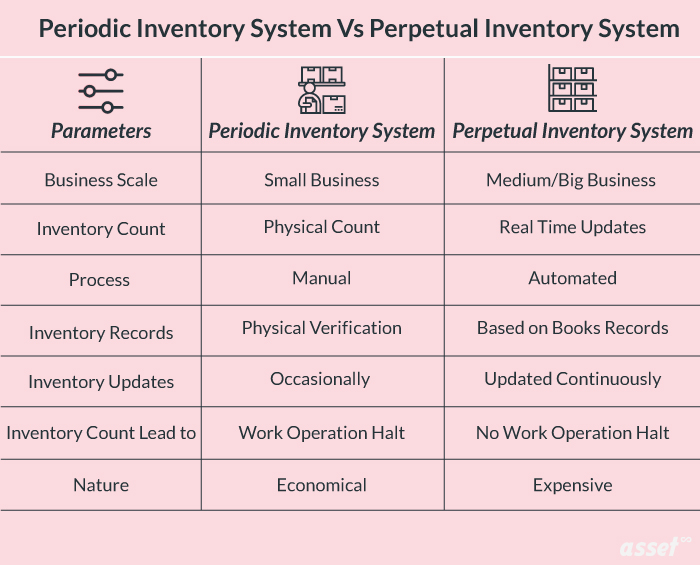
This table provides a high-level comparison of the two approaches across several practical dimensions.
2. The Accounting Mechanics: Journal Entries Compared
The fundamental difference between the two systems becomes clear when we look at the journal entries for purchasing and selling inventory. Let's consider a Moroccan SME, "ElectroMaroc," that buys and sells electronic components.
A. Recording a Purchase of Inventory
ElectroMaroc purchases 100 components at a cost of 50 MAD each, for a total of 5,000 MAD on credit.
-
Perpetual System: The purchase directly increases the inventory asset account.
- Debit:
Marchandises (Stock)(Account 311) - 5,000 MAD - Credit:
Fournisseurs(Account 4411) - 5,000 MAD - Logic: The asset 'Inventory' has increased.
- Debit:
-
Periodic System: The purchase is recorded in a temporary expense account called
Purchases. The main inventory account is not touched at this time.- Debit:
Achats de marchandises(Account 6111) - 5,000 MAD - Credit:
Fournisseurs(Account 4411) - 5,000 MAD - Logic: We are recording the expense of purchasing goods within this period.
- Debit:
B. Recording a Sale of Inventory
ElectroMaroc sells 30 components to a client for 90 MAD each, for a total of 2,700 MAD on credit. The cost of these 30 components was 1,500 MAD (30 x 50 MAD).
-
Perpetual System: This system requires two journal entries for every sale.
- To record the revenue:
- Debit:
Clients(Account 3421) - 2,700 MAD - Credit:
Ventes de marchandises(Account 7111) - 2,700 MAD
- Debit:
- To record the cost of the sale and reduce inventory:
- Debit:
Coût des marchandises vendues(CMV) - 1,500 MAD - Credit:
Marchandises (Stock)(Account 311) - 1,500 MAD
- Debit:
- Logic: We record the revenue earned AND the expense incurred (cost of the goods) at the same time. The inventory asset is reduced because the goods have left the warehouse.
- To record the revenue:
-
Periodic System: Only one journal entry is made at the time of sale.
- To record the revenue:
- Debit:
Clients(Account 3421) - 2,700 MAD - Credit:
Ventes de marchandises(Account 7111) - 2,700 MAD
- Debit:
- Logic: We only record the revenue side of the transaction. The cost of the goods sold is unknown at this point and will be calculated later.
- To record the revenue:
The following reading provides excellent side-by-side examples of these journal entries, which will help solidify your understanding.
2.2 Perpetual v. Periodic Inventory Systems
The resource 'Perpetual v. Periodic Inventory Systems' from Penn State University offers a clear, visual comparison of the journal entries for various transactions.
Focus on the section 'Inventory Systems Comparison'. Review the illustrated journal entries for 'Purchase of Inventory' and 'Sale of Merchandise'. Notice the use of the 'Purchases' account in the periodic system and the two-part entry for a sale in the perpetual system.
Test your understanding!
Imagine ElectroMaroc sells another 10 components for 95 MAD each for cash. The cost of these components is 500 MAD (10 x 50 MAD). What are the complete journal entries to record this sale under both the perpetual and periodic systems?
Show answer
Perpetual System:
- To record the revenue:
- Debit:
Banque(5141) - 950 MAD - Credit:
Ventes de marchandises(7111) - 950 MAD
- Debit:
- To record the cost:
- Debit:
Coût des marchandises vendues(CMV) - 500 MAD - Credit:
Marchandises (Stock)(311) - 500 MAD
- Debit:
Periodic System:
- To record the revenue:
- Debit:
Banque(5141) - 950 MAD - Credit:
Ventes de marchandises(7111) - 950 MAD
- Debit:
(No second entry is made at the time of sale in the periodic system).
3. End-of-Period Procedures & Calculating Cost of Goods Sold (COGS)
The different approaches during the period lead to different procedures at the end of the period.
Perpetual System
Because the Marchandises (Stock) account is continuously updated, its balance should represent the value of inventory on hand. The primary end-of-period task is to perform a physical inventory count to compare with the accounting records. Any difference is due to errors, waste, or theft (démarque inconnue) and requires an adjusting entry. For example, if the records show 10,000 MAD of inventory but a physical count reveals only 9,800 MAD, an adjustment is needed to account for the 200 MAD loss.
Periodic System
This is where the system does its main work. Since COGS and ending inventory were not tracked during the period, they must now be determined.
-
Conduct a Physical Count: The company must count every item in its inventory to determine the value of the Ending Inventory.
-
Calculate the Cost of Goods Sold (COGS): The COGS is calculated using a simple formula. It is a key calculation in accounting for merchandising businesses.
COGS = Beginning Inventory + Net Purchases – Ending InventoryIn Moroccan accounting terms, this is often expressed as the calculation of Achats revendus de marchandises:
Achats revendus = Achats de marchandises de l'exercice -/+ Variation de stocks
whereVariation de stocks = Stock initial - Stock final -
Record Adjusting Entries: Journal entries are made to remove the beginning inventory balance from the books, record the ending inventory balance (determined by the physical count), and recognize the calculated COGS.
The video from Accounting Stuff demonstrates these end-of-period calculations clearly.
Inventory Systems: Perpetual vs Periodic
Watch this segment to see how the cost of goods sold and closing inventory are determined under both systems, highlighting the end-of-period calculation required for the periodic method.
Watch from 09:16 to 12:20. Pay close attention to how the periodic system requires a physical count to determine the ending inventory, which then allows for the calculation of the Cost of Goods Sold as a 'plug' figure. Notice the video's conclusion about the key difference being the timing of when you know your results.
4. Advantages, Disadvantages, and the Moroccan Context
The choice between these systems involves a trade-off between cost, control, and timeliness of information.
| Perpetual System (Inventaire Permanent) | Periodic System (Inventaire Intermittent) | |
|---|---|---|
| Advantages | - Real-time inventory levels - Better control over inventory (theft, etc.) - Timely data for decision-making (e.g., reordering) |
- Simpler to implement - Less costly (no need for expensive software/scanners) |
| Disadvantages | - Expensive to implement and maintain - Requires employee training - Discrepancies can still occur |
- No up-to-date inventory data - COGS is unknown until period-end - Poor control over losses between counts |
In the modern Moroccan SME context, the perpetual inventory system is the standard for most businesses, even small ones. The widespread availability of accounting software (like Sage, SAP Business One, or local solutions) automates the perpetual tracking process.
However, it is a legal requirement in Morocco for all companies to perform a full physical inventory count (inventaire physique extra-comptable) at least once a year, typically at the financial year-end. This is necessary to verify the accuracy of the accounting records, regardless of which inventory system is used.
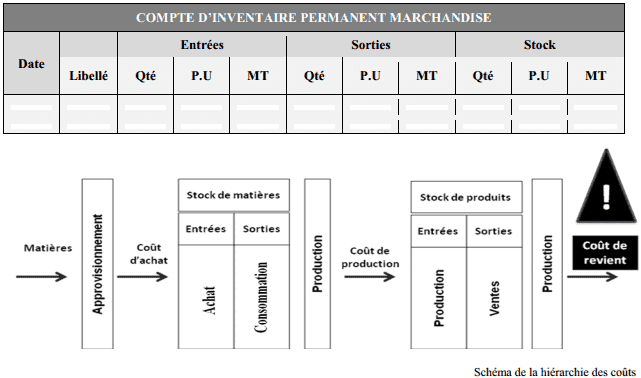
The image below shows a typical inventory card used in a perpetual system, known in French/Moroccan context as a fiche de stock.
Conclusion
You have now learned to differentiate between the two fundamental systems of inventory accounting. This is a critical distinction that impacts the daily workflow of an accountant and the quality of information available to management.
Key Takeaways:
- Perpetual System: Updates the
InventoryandCost of Goods Soldaccounts continuously with every transaction. It provides real-time data but is more complex to implement. - Periodic System: Updates the
Inventoryaccount only at the end of the period after a physical count. Purchases are collected in a temporaryPurchasesaccount, and COGS is calculated with the formula:Beginning Inventory + Purchases – Ending Inventory. - The primary difference lies in the timing of the recognition of COGS and the update to the inventory asset account.
- In practice, technology has made the perpetual system the standard for most businesses, including Moroccan SMEs.
Preview of the Next Lesson:
We have just discussed the accounting methods for inventory. All of these entries—purchases, sales, returns—are triggered by source documents like invoices, delivery slips, and credit notes. In our next lesson, we will focus on the practical task of organizing this essential paperwork. We will learn how to develop a checklist for classifying and filing accounting source documents per Moroccan legal requirements. This is a foundational skill for maintaining an orderly and auditable accounting department.