Recommended resources
The freely available resources this lesson will direct you to.
Welcome back to our course.
In the previous lessons, we've recorded transactions that create debts and receivables. When we recorded sales or the disposal of an asset on credit, we created a créance (receivable) from a client. When we recorded purchases, we created a dette (payable) to a supplier. Today, we will address the next logical step in the business cycle.
This lesson focuses on the learning outcome: Record cash receipts from customers and payments to suppliers. We will explore how to account for the settlement of these receivables and payables, which is the process of managing the company's cash flow. Mastering these entries is fundamental, as they are among the most frequent transactions an accountant handles.
1. The Foundation: Treasury Accounts and Settlement Methods
Before recording the entries, it's essential to understand the accounts involved and the common methods of payment. In accounting, all transactions involving cash, cheques, or bank transfers are managed through Treasury accounts (Comptes de Trésorerie), which belong to Class 5 of the Moroccan chart of accounts.
The two primary accounts we will use are:
- 5141 - Banques: This account tracks all transactions flowing through the company's bank accounts (cheques, bank transfers).
- 5161 - Caisse: This account tracks all transactions involving physical cash (espèces).
To grasp the mechanics of these accounts and the different settlement methods, please review the following material.
The document 'Les opérations courantes' provides an excellent theoretical introduction to financial settlements. It explains the accounting for cash, cheques, and bank transfers, which are the core of today's lesson.
Please read the introduction (Chapitre 3), section '1) Les règlements en espèces', and section '2) Les règlements par chèque ou virement bancaire'. Focus on understanding: The difference between a settlement 'au comptant' (in cash) and 'à crédit' (on credit). How the Caisses (5161) and Banques (5141) accounts function. The use of the temporary Chèques à encaisser (5111) accounts, which is a key practical step.
As you've read, the core principle is simple:
- Cash Inflow (Encaissement): Increases a treasury account. Since
BanquesandCaisseare asset accounts, an increase is recorded with a Debit. - Cash Outflow (Décaissement): Decreases a treasury account. A decrease in an asset account is recorded with a Credit.
2. Recording Receipts from Customers (Encaissements Clients)
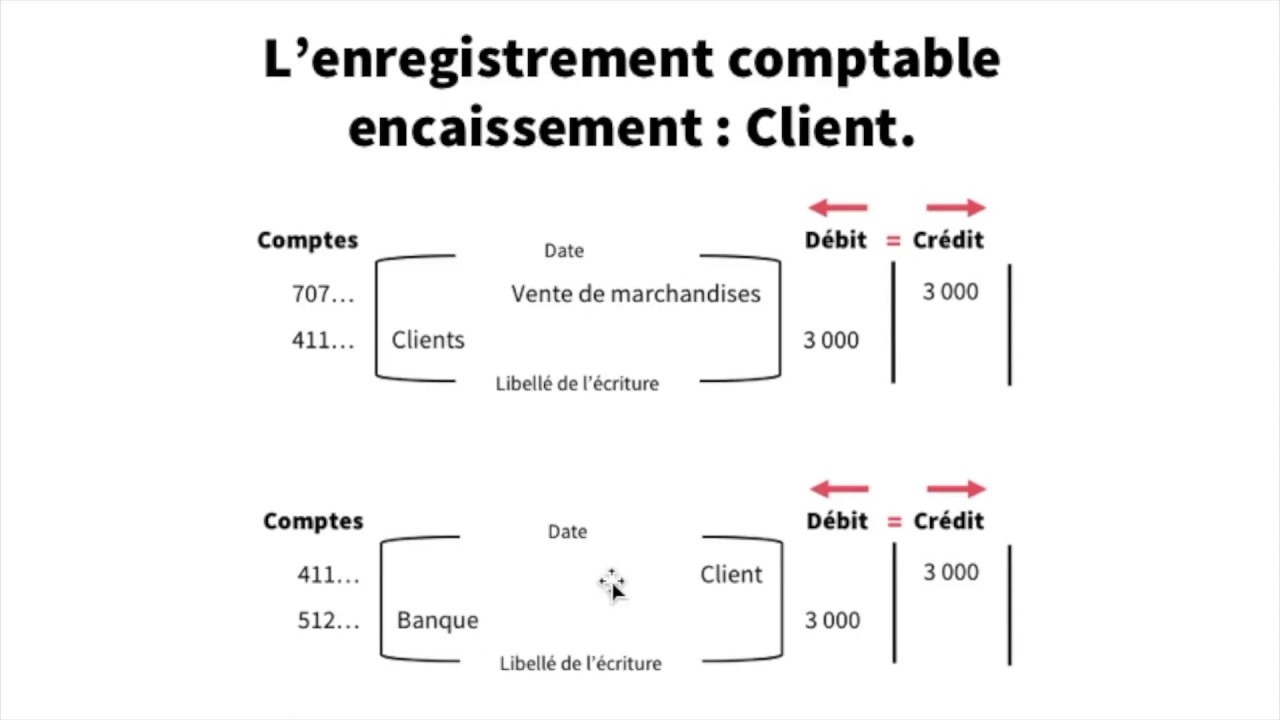
When a customer pays a previously recorded invoice, you are "settling" a receivable. This means you are converting a receivable (an asset) into cash or bank funds (another asset).
The general journal entry for a customer payment is:
| N° Compte | Intitulé du Compte | Débit | Crédit |
|---|---|---|---|
| 51xx | Banques / Caisse | Amount Received | |
| 3421 | Clients | Amount Received | |
| Règlement facture n°... |
The debit increases your cash/bank balance, and the credit decreases the amount your customer owes you. The Clients account is "cleared" or "settled" by the amount paid.
The image below perfectly illustrates this two-step process: first the sale that creates the receivable, then the payment that settles it.
A Practical Detail: Handling Cheques
As you learned from the reading, when you receive a cheque, there's a delay before the funds are actually available in your bank account. For precise tracking, especially at month-end, professional practice often uses temporary accounts:
- Upon receiving the cheque:
- Debit
51111 - Chèques en portefeuille(Cheques in hand) - Credit
3421 - Clients
- Debit
- When depositing the cheque at the bank:
- Debit
51112 - Chèques à l’encaissement(Cheques for collection) - Credit
51111 - Chèques en portefeuille
- Debit
- When the bank confirms the payment (on the bank statement):
- Debit
5141 - Banques - Credit
51112 - Chèques à l’encaissement
- Debit
While some small businesses might take a shortcut and directly debit 5141 - Banques upon receiving the cheque, this multi-step process provides much more accurate and rigorous financial control.
3. Recording Payments to Suppliers (Décaissements Fournisseurs)
Paying a supplier is the reverse of receiving money from a customer. You are settling a payable (dette), which means you are using your cash/bank funds to extinguish a liability.
The general journal entry for a payment to a supplier is:
| N° Compte | Intitulé du Compte | Débit | Crédit |
|---|---|---|---|
| 4411 | Fournisseurs | Amount Paid | |
| 51xx | Banques / Caisse | Amount Paid | |
| Règlement facture n°... |
Here, the debit to Fournisseurs decreases the liability (the amount you owe). The credit to Banques or Caisse reflects the decrease in your cash balance.
In a real company, these payments are tracked systematically. The image below shows a payment log from accounting software, which is the source for generating these journal entries.

Test your understanding!
Let's apply these concepts. "Maroc Bois SARL" performs the following operations in March:
- March 10: Receives a bank transfer of 12,000 MAD from client "Espace Deco" in full settlement of invoice V-105.
- March 15: Pays supplier "Forêt Verte" 8,500 MAD by cheque n°BC-451 for invoice A-210.
Prepare the journal entries for these two transactions.
Show answer
Journal Entries for Maroc Bois SARL:
March 10: Receipt from client
| N° Compte | Intitulé du Compte | Débit | Crédit |
|---|---|---|---|
| 5141 | Banques | 12,000 | |
| 3421 | Client "Espace Deco" | 12,000 | |
| Règlement facture V-105 par virement |
March 15: Payment to supplier
| N° Compte | Intitulé du Compte | Débit | Crédit |
|---|---|---|---|
| 4411 | Fournisseur "Forêt Verte" | 8,500 | |
| 5141 | Banques | 8,500 | |
| Règlement facture A-210 par chèque BC-451 |
4. Professional Practice & Terminology
Professional Terminology
| Terme Professionnel (French) | Accounting English | Meaning |
|---|---|---|
| Encaissement | Cash Receipt / Collection | The act of receiving money. |
| Décaissement | Cash Payment / Disbursement | The act of paying out money. |
| Règlement | Settlement | The act of paying a debt or invoice. |
| Virement bancaire | Bank Transfer | An electronic transfer of funds from one bank account to another. |
| Chèque en portefeuille | Cheque on hand | A cheque that has been received from a customer but not yet deposited at the bank. |
| Pièce justificative | Supporting Document | The proof of a transaction (e.g., bank slip, receipt, copy of a cheque). |
Frequent Mistakes to Avoid:
- Reversing Debit and Credit: Remember,
BanquesandCaisseare asset accounts. Debit them when cash comes in, credit them when cash goes out. - Crediting Sales/Purchases Instead of Receivables/Payables: A payment settles the
Client(3421) orFournisseur(4411) account. TheVentes(7111) orAchats(6111) account was already recorded at the time of the original transaction. - Forgetting Supporting Documents: Every payment or receipt must be backed by a pièce justificative. In Morocco, this is a strict legal and audit requirement.
Conclusion
Today you have learned how to record the fundamental cash flow transactions of a business. These entries connect the income-generating activities (sales) and operational activities (purchases) to the company's treasury.
Key Takeaways:
- Customer Receipts (Encaissements): Debit an asset account (
BanqueorCaisse) and Credit the receivable account (Clients). - Supplier Payments (Décaissements): Debit the payable account (
Fournisseurs) and Credit an asset account (BanqueorCaisse). - The use of temporary accounts for handling cheques (
51111and51112) allows for more precise tracking of cash flow.
Preview of the Next Lesson:
Often, when a client pays an invoice early, they might be granted a discount. Similarly, you might receive a discount for paying a supplier promptly. These events complicate the settlement entry. In our next lesson, we will apply accounting rules for sales and purchase discounts, learning how to adjust the payment and record the financial gain or loss from these discounts.